
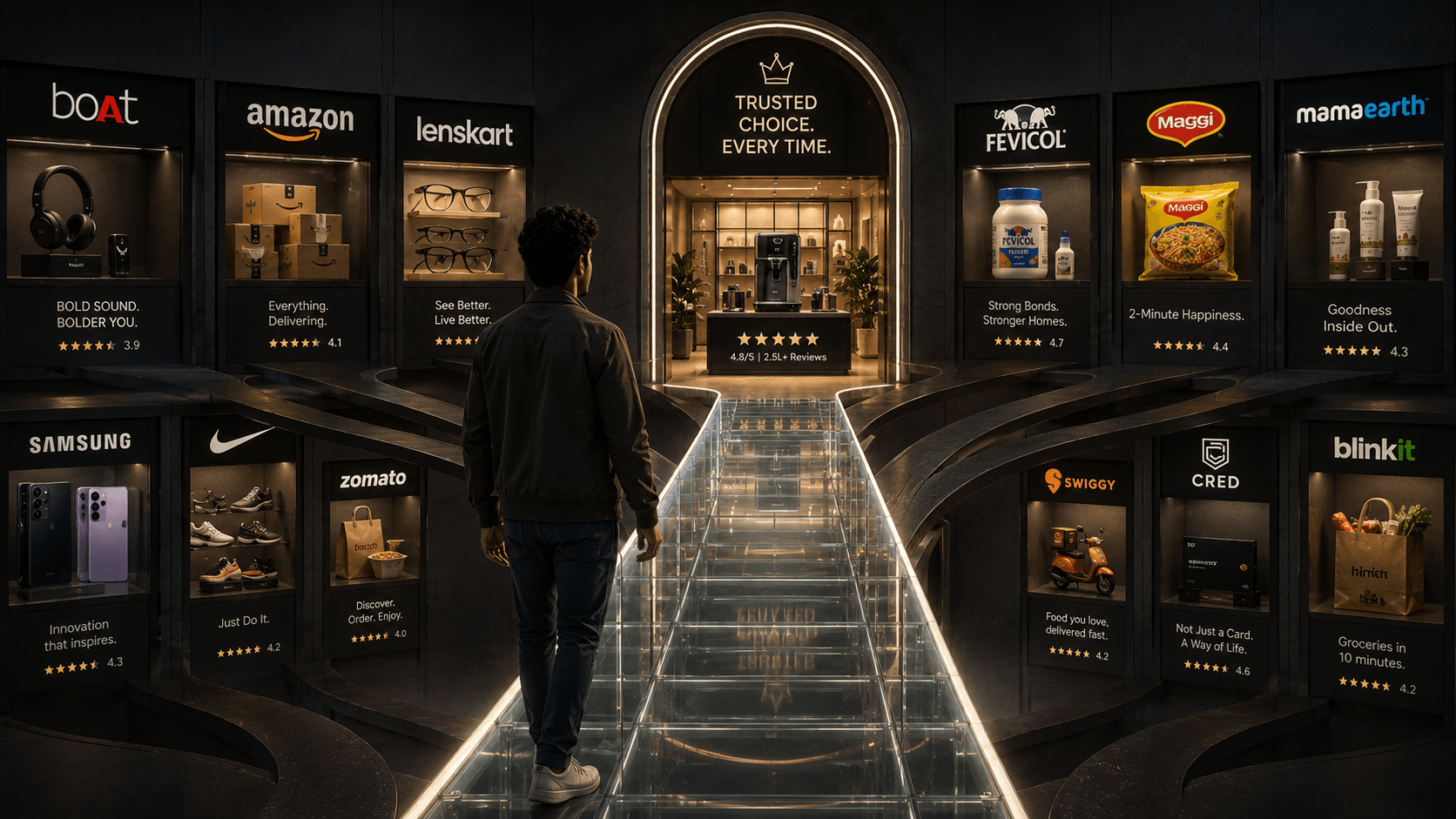




A customer sees your advertisement.
They like it.
They remember your brand.
Maybe they even click.
But when it is finally time to spend their money, something else enters the decision.
Trust.
Because knowing a brand exists is not the same as believing in it.
A customer may know your name and still hesitate to buy from you.
They may like your Instagram posts and still choose your competitor.
They may be satisfied with one purchase and still not come back.
Trust is what closes that gap.
It is the quiet belief that says:
“I think this brand will do what it says it will do.”
And that belief can become one of the most valuable assets a business builds.
Marketing can get attention.
Trust can turn that attention into a relationship.
What Is Brand Trust?
Brand trust is the customer’s confidence that a brand will consistently deliver what it promises.
It’s not simply:
“I like this brand.”
And it’s not simply:
“I’ve heard of this brand.”
It is closer to:
“I know what to expect from this brand, and I believe it will deliver.”
That expectation is built over time.
A customer buys from you.
The experience matches the promise.
They buy again.
The experience is still consistent.
They recommend you.
Another good experience follows.
Slowly, something valuable develops.
Trust.
And once trust exists, the customer doesn’t need to reconsider the entire decision every time they buy.
They already have a reason to believe.
Awareness, Satisfaction and Trust Are Not the Same Thing
These three ideas are often confused.
But they represent very different stages of the customer relationship.
Awareness
“I know this brand.”
Awareness means the customer recognises you.
That’s useful, but awareness alone doesn’t create sales.
Satisfaction
“I bought from them and had a good experience.”
Satisfaction is based on a past experience.
It tells the customer:
“That purchase went well.”
Trust
“I believe they will deliver again.”
Trust goes one step further.
It is about the future.
A satisfied customer had a good experience.
A trusting customer expects another good experience.
That’s why trust is so powerful.
Awareness gets you considered. Satisfaction gets you remembered. Trust gets you chosen again.
Why Brand Trust Matters
Imagine two brands selling exactly the same type of product.
One is unfamiliar.
The other has been consistently reliable for years.
Which one feels safer?
Usually, the trusted one.
This is because buying anything involves some degree of risk.
The customer may worry:
- Will the product actually work?
- Will the quality match the promise?
- Will the company help if something goes wrong?
- Is my money safe?
- Will the brand treat me fairly?
- Will I regret this purchase?
Trust reduces those doubts.
And reducing doubt can make the difference between:
“I’ll think about it.”
and
“I’ll buy it.”
Trust Reduces Perceived Risk
This becomes especially important when the purchase is expensive, complicated or personal.
Think about:
- A car
- Insurance
- A financial service
- A laptop
- A hotel
- A course
- A healthcare service
- A premium product
The customer isn’t just buying the product.
They’re taking a risk.
A trusted brand makes that risk feel smaller.
That’s one reason people sometimes choose a familiar brand even when a competitor offers a lower price.
The trusted brand isn’t necessarily cheaper.
It simply feels safer.
Trust Can Make Price Less Important
Price matters.
But price isn’t always the deciding factor.
Suppose Brand A costs ₹1,000.
Brand B costs ₹1,200.
If Brand B has consistently delivered better experiences, has stronger reviews, responds to customers and has a reputation for reliability, some customers will happily pay the extra ₹200.
Why?
Because they aren’t only paying for the product.
They’re paying for certainty.
The customer is effectively saying:
“I know what I’m getting.”
That’s one reason trusted brands can command a premium.
When trust is high, customers often need less convincing.
Trust Is Built Through Consistency
Trust doesn’t usually appear because of one brilliant advertisement.
It is built through repeated experiences.
A brand makes a promise.
The customer experiences the product.
The promise is delivered.
Then it happens again.
And again.
And again.
Eventually, the customer stops asking:
“Will they deliver?”
They simply expect them to.
That’s trust.
Think about a restaurant you visit regularly.
You already know what the food will taste like.
You know roughly what the service will be like.
You know what to expect when you walk through the door.
That predictability is valuable.
You don’t have to gamble on the experience every time.
The same principle applies to brands.
Consistency turns expectations into confidence.
The 7 Pillars of Brand Trust
Trust is not built through one activity.
It is created by several parts of the business working together.
Your original framework identifies seven major pillars.
1. Consistency
Your brand should behave consistently across:
- Product quality
- Communication
- Customer service
- Pricing
- Visual identity
- Overall experience
If your website promises premium service but your support team behaves poorly, the promise breaks.
If your advertisement says “simple” but the buying process is confusing, the promise breaks.
If your brand looks premium but the product feels cheap, the promise breaks.
Every interaction teaches the customer something about whether your brand can be trusted.
2. Honesty
Customers don’t expect brands to be perfect.
They do expect them to be honest.
If something goes wrong, pretending it didn’t happen can damage trust more than the original mistake.
Honesty means:
- Don’t exaggerate.
- Don’t hide important information.
- Don’t make promises you can’t keep.
- Don’t manipulate customers with misleading claims.
A transparent limitation can sometimes create more trust than an unrealistic promise.
3. Transparency
Transparency means helping customers understand what they’re getting into.
That includes things like:
- Pricing
- Terms
- Policies
- Product limitations
- Delivery expectations
- Returns and refunds
Hidden information creates suspicion.
Clear information creates confidence.
A customer should not feel like they need a detective’s licence to understand your offer.
4. Quality
Trust collapses quickly when the actual product doesn’t match the promise.
You can spend millions on advertising.
But if the product disappoints customers repeatedly, the advertising eventually works against you.
Because now you’ve simply created more people who are disappointed.
Quality is therefore not just a product issue.
It is a brand trust issue.
5. Customer Service
Something will eventually go wrong.
A delivery will be late.
A product will break.
A payment will fail.
A customer will misunderstand something.
The question is not whether problems happen.
The question is:
“What does the brand do when they happen?”
Fast, respectful and helpful support can actually strengthen trust after a problem.
A customer who sees a company take responsibility may become more confident in the company, not less.
6. Shared Values
People don’t only buy what a company sells.
Sometimes they also buy what the company stands for.
Customers may care about:
- Sustainability
- Fairness
- Privacy
- Community
- Ethical sourcing
- Inclusivity
- Social responsibility
But values only build trust when they are visible in behaviour.
Saying:
“We care about the planet.”
means very little if the company’s actions consistently contradict it.
Values become credible when customers can see them.
7. Listening
Trust becomes stronger when customers feel heard.
Reviews, complaints, feedback and social media conversations can reveal what customers actually experience.
A brand that listens can improve.
A brand that ignores feedback sends another message:
“Your experience doesn’t matter to us.”
Listening doesn’t mean agreeing with every complaint.
It means taking customer feedback seriously enough to understand it.
Your Brand Promise Is a Contract
Every brand makes promises.
Sometimes explicitly.
Sometimes implicitly.
A luxury brand promises a certain level of quality.
A budget brand promises value.
A fast-delivery company promises speed.
A financial brand promises reliability and security.
A premium hotel promises an experience.
The moment you communicate that promise, the customer forms an expectation.
The customer’s experience then determines whether the promise feels credible.
Think of it as:
Promise → Experience → Expectation
If the experience matches the promise:
Trust grows.
If the experience repeatedly falls below the promise:
Trust falls.
This is why branding isn’t simply about saying the right thing.
Your business has to behave like the brand you claim to be.
Marketing Gets Attention. Trust Gets the Second Purchase.
This distinction is important.
Marketing can create:
- Awareness
- Curiosity
- Traffic
- Leads
- First-time purchases
But what happens after the first purchase?
That’s where trust becomes critical.
A customer who doesn’t trust you has to be persuaded repeatedly.
A customer who trusts you doesn’t need the same level of persuasion every time.
They already have evidence.
They already have experience.
They already have a reason to believe.
This makes trust economically valuable.
Because a trusted brand can spend less effort convincing existing customers to choose it again.
Trust Is Especially Powerful in the Age of Social Media
Before social media, a brand could control much more of the story.
It could create an advertisement.
Publish a brochure.
Put up a billboard.
And tell customers what the brand wanted them to believe.
Today, customers can respond immediately.
They can:
- Review products
- Post screenshots
- Share complaints
- Upload unboxing videos
- Compare experiences
- Recommend brands
- Call out misleading claims
The brand no longer owns the entire conversation.
The customer is part of it.
Your Customers Can Become Your Marketing
Think about the last time you bought something because someone you trusted recommended it.
You probably didn’t need a thirty-second advertisement.
You already had a reason to believe.
That is the power of word of mouth.
When customers genuinely trust a brand, they can become one of its most effective marketing channels.
They recommend it.
Defend it.
Review it.
Share it.
Talk about it.
And unlike an advertisement, their recommendation often comes with built-in credibility.
A brand can buy attention. It cannot buy genuine advocacy at scale.
But Social Media Can Destroy Trust Quickly
The same system that can amplify positive experiences can amplify negative ones.
A single complaint can become highly visible.
A screenshot can travel across platforms.
An influencer can expose a poor experience to millions of people.
A company that ignores customers publicly may create an impression that is far worse than the original problem.
This doesn’t mean every viral complaint is automatically true.
It means brands need to understand that how they respond is now part of the brand experience.
A customer service reply is no longer necessarily private.
It can become public evidence of how the company treats people.
What Happens When a Brand Loses Trust?
Losing trust is different from losing attention.
Attention can often be regained with another campaign.
Trust is harder.
If customers believe a brand has:
- Lied
- Hidden something
- Overcharged them
- Misled them
- Delivered poor quality
- Ignored complaints
- Broken promises
another advertisement may not solve the problem.
In fact, aggressive advertising immediately after a trust failure can sometimes make things worse.
The customer may think:
“Why are you advertising instead of fixing the problem?”
That’s the key distinction.
When trust is damaged, the priority should be repairing the experience, not increasing the volume of communication.
How Do You Rebuild Brand Trust?
There is no magic apology.
But there is a process.
1. Admit the problem
Don’t pretend customers imagined it.
2. Take responsibility
Avoid hiding behind vague statements.
3. Explain what happened
Give customers enough information to understand the situation.
4. Fix the immediate problem
Solve the issue affecting existing customers.
5. Change the underlying process
If the same problem can happen again, the fix isn’t complete.
6. Communicate the improvement
Tell customers what has changed.
7. Prove it over time
This is the most important step.
One apology doesn’t rebuild trust.
Repeated better behaviour does.
Trust is rebuilt through evidence, not promises.
Brand Trust Examples
The easiest way to understand trust is to look at brands that have built it in different ways.
Apple: Trust Through Consistency
Apple has built strong associations around:
- Product design
- Simplicity
- Ecosystem integration
- User experience
- Premium positioning
Customers generally know what kind of experience they are buying into.
That predictability matters.
Apple doesn’t need to reinvent its identity every year.
Its consistency itself becomes a source of trust.
Amazon: Trust Through Convenience and Reliability
Amazon’s strength is not simply the number of products it sells.
It has trained customers to expect a certain level of convenience around:
- Search
- Ordering
- Delivery
- Tracking
- Returns
- Customer support
When customers repeatedly receive that experience, confidence develops.
The customer stops asking:
“Will this work?”
and starts assuming:
“Amazon will handle it.”
That assumption is valuable.
LEGO: Trust Through Quality and Legacy
LEGO has built a reputation around creativity, quality and consistency.
Parents aren’t simply buying plastic bricks.
They’re buying into a product category they already understand.
The brand has decades of history reinforcing the expectation.
That history itself becomes part of the trust equation.
Patagonia: Trust Through Values and Action
Patagonia demonstrates another form of trust.
The company has strongly associated itself with environmental responsibility.
But values only matter when customers can see evidence of them in the company’s behaviour.
This is the broader lesson:
A brand’s values become trustworthy when the business makes decisions that demonstrate those values.
The Biggest Mistakes That Destroy Brand Trust
Building trust takes time.
Destroying it can take much less.
Here are some of the biggest mistakes brands make.
Overpromising
If your product can’t deliver something, don’t advertise it as though it can.
A bigger promise creates a bigger expectation.
A bigger expectation creates a bigger disappointment when you fail.
Being Inconsistent
If the brand behaves differently across channels, customers become uncertain about what to expect.
Consistency matters.
Hiding Problems
Customers are often more forgiving of mistakes than deception.
A company saying:
“We made a mistake and here’s what we’re doing about it.”
can sometimes create more confidence than a company pretending nothing happened.
Ignoring Complaints
A complaint isn’t always an attack.
Sometimes it’s free research.
Repeated complaints may reveal a genuine weakness in your product or process.
Ignoring the pattern doesn’t make the problem disappear.
Treating Customers Like Transactions
Customers notice when a company cares about the sale but stops caring immediately afterward.
Trust requires the relationship to continue beyond the transaction.
Saying One Thing and Doing Another
This may be the fastest way to damage trust.
A company says:
“We put customers first.”
Then makes it nearly impossible to get a refund.
The problem isn’t just bad customer service.
The problem is the contradiction between promise and behaviour.
How Small Businesses Can Build Brand Trust
Brand trust isn’t reserved for Apple, Amazon or Patagonia.
A small business can build it too.
In fact, small businesses have an advantage that large companies sometimes don’t:
direct relationships.
If you run a local bakery, don’t promise:
“The best bakery in the city.”
Show customers:
- Fresh products
- Consistent quality
- Honest pricing
- Friendly service
- Reliable opening hours
- Quick responses
- Genuine handling of complaints
If you run a digital marketing agency, don’t promise:
“We’ll 10X your business.”
Explain what you can realistically deliver.
Show your process.
Share case studies.
Be transparent about limitations.
Respond when clients need help.
Do what you said you would do.
Every one of those actions deposits something into the customer’s trust account.
Over time, the balance grows.
A Simple Brand Trust Framework
If you’re building a brand today, ask yourself seven questions:
1. What exactly are we promising?
If you can’t answer this clearly, customers won’t know what to expect.
2. Can our product consistently deliver that promise?
If not, fix the product before increasing the advertising.
3. Are we transparent about price, limitations and policies?
Hidden information creates suspicion.
4. What happens when something goes wrong?
Your response to failure is part of your brand.
5. Do our actions match our stated values?
If not, customers will eventually notice.
6. Are we listening to customers?
Look at reviews, complaints, questions and conversations.
7. What evidence do customers have that they can trust us?
Testimonials.
Reviews.
Repeat purchases.
Case studies.
Guarantees.
Transparent policies.
Consistent experiences.
Trust needs evidence.
The Real Relationship Between Marketing and Trust
This is where everything comes together.
Marketing can introduce you.
Branding can differentiate you.
A great product can satisfy you.
But trust creates confidence in the future.
A customer who has never heard of you needs awareness.
A customer who has tried you needs satisfaction.
A customer deciding whether to choose you again needs trust.
That’s why trust should not be treated as a vague branding concept.
It has a direct impact on business.
It can influence:
- Conversion
- Repeat purchases
- Customer retention
- Referrals
- Reviews
- Premium pricing
- Customer lifetime value
Trust isn’t just something that makes a brand “feel good.”
Trust has economic value.
The Bottom Line
A brand can spend millions creating awareness.
It can create beautiful advertisements.
It can hire celebrities.
It can build a huge social media following.
But none of that guarantees that customers will believe the brand.
Because customers don’t build trust from what a company says.
They build it from what the company repeatedly does.
A promise creates an expectation.
An experience either confirms or breaks that expectation.
Repeated confirmation creates confidence.
And confidence, over time, becomes trust.
That’s why the strongest brands don’t spend all their energy trying to convince customers that they’re trustworthy.
They build businesses that give customers reasons to trust them.
And perhaps that’s the simplest way to think about brand trust:
Marketing can get a customer to notice you.
A great experience can get them to like you.
Trust is what makes them comfortable choosing you again.
Because in the end, customers don’t just buy what they understand.
They buy what they believe in.
Leave a Reply