
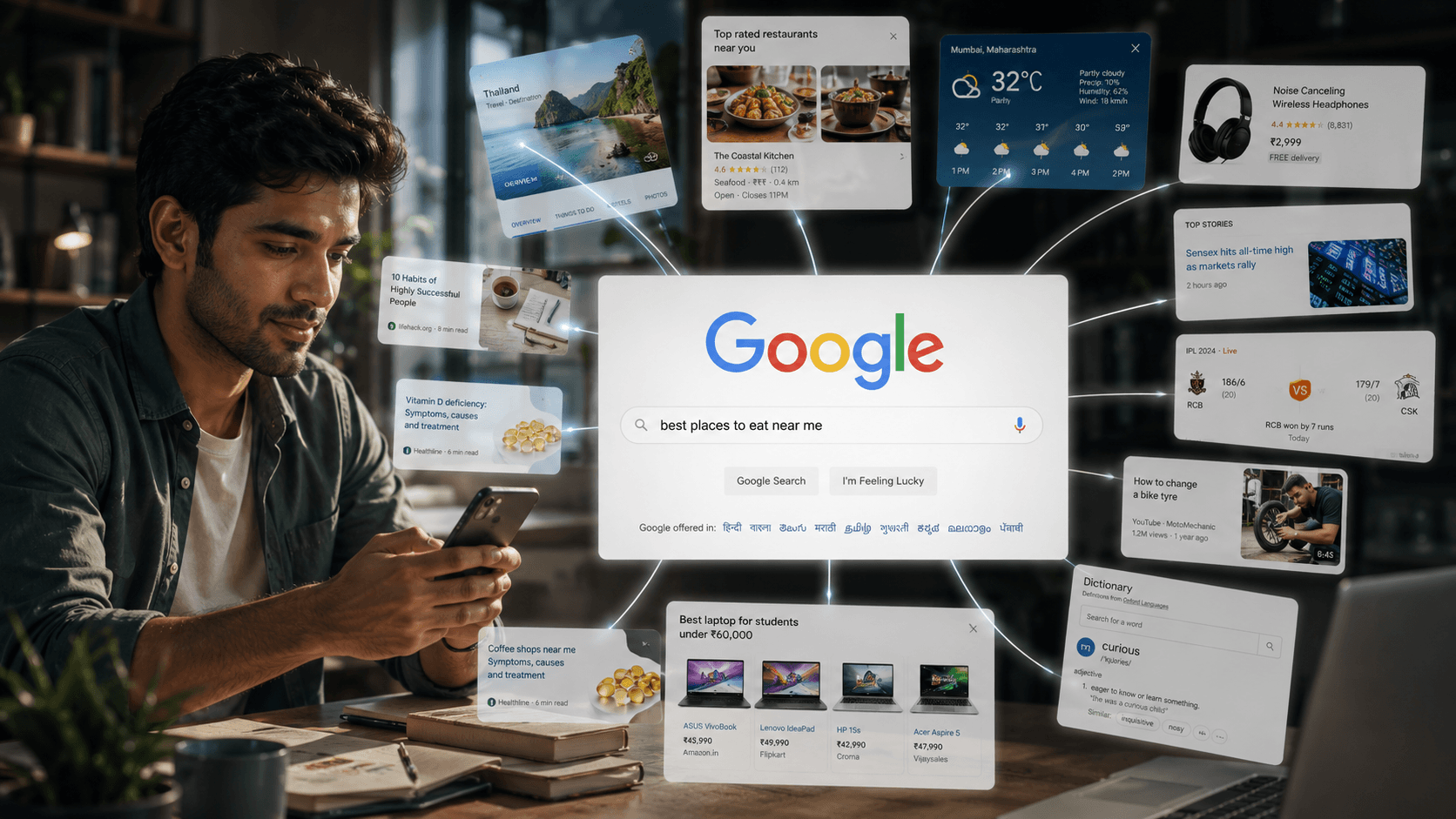




Someone asks you a question.
“What’s the capital of Japan?”
You take out your phone.
What do you say?
“Google it.”
Not:
“Search for it online.”
Just:
“Google it.”
Now imagine someone gives you a document and asks:
“Can you Xerox this?”
They aren’t necessarily asking you to use a Xerox machine.
They mean:
“Can you photocopy this?”
Someone gets a small cut.
You hear:
“Put a Band-Aid on it.”
Not:
“Use an adhesive bandage.”
And that’s interesting.
Because Google isn’t the internet.
Xerox isn’t every photocopier.
Band-Aid isn’t every adhesive bandage.
Yet their brand names have become so strongly associated with a particular need that people sometimes use the brand name to describe the category itself.
That’s more than awareness.
That’s more than recognition.
That’s positioning.
The strongest brands don’t just occupy space in the market. They occupy a specific space in the customer’s mind.
And once a brand earns that space, something remarkable happens.
The customer stops thinking about every available option.
They think of you.
Your Brand Already Has a Position
Here’s the uncomfortable truth about positioning:
You don’t get to choose whether your brand has a position.
Your customers are going to form an opinion anyway.
They will decide whether you’re:
- Premium or cheap
- Innovative or ordinary
- Specialist or generalist
- Trustworthy or risky
- Modern or outdated
- Convenient or difficult
- Different or interchangeable
The only question is whether you deliberately shape that perception.
Imagine launching a new smartphone.
You’ve spent two years developing it.
The camera is excellent.
The processor is powerful.
The battery lasts all day.
The design is beautiful.
Inside your company, everyone agrees:
“We’ve built an incredible phone.”
Then you place it next to an iPhone, Samsung Galaxy and Google Pixel.
A customer walks in.
They don’t know how many engineers worked on your product.
They don’t know how much research you conducted.
They don’t know how passionate your team is.
They see the phone and immediately start asking:
“What kind of brand is this?”
“Is it premium?”
“Can I trust it?”
“What’s it known for?”
“Why should I choose this instead of the others?”
Those questions happen inside the customer’s mind.
And that’s where positioning lives.
Not inside your strategy document.
Not inside your marketing department.
Not inside your founder’s head.
Inside the customer’s perception.
Positioning Is Not What You Say. It’s What They Remember.
A brand can say almost anything about itself.
You can call yourself:
Innovative.
Premium.
Customer-first.
Affordable.
Sustainable.
High quality.
But customers don’t automatically believe those words.
They compare your claims with their experience.
Then they form their own conclusion.
That’s why there’s often a gap between:
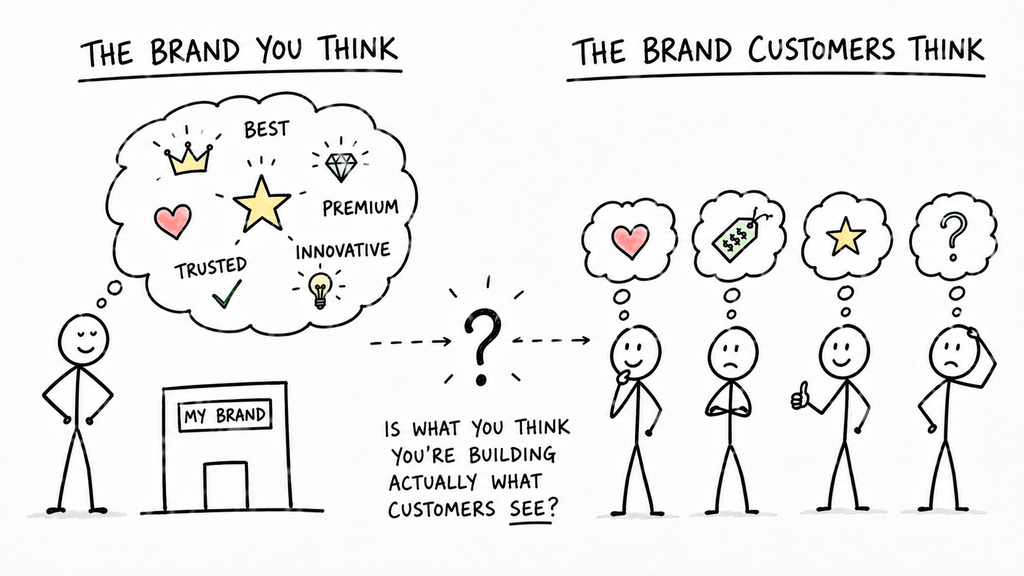
The brand you think you built
and
The brand customers think they know.
Your website might say you’re a premium consultancy.
Your customers might think you’re expensive and slow.
You might call yourself an innovative technology company.
Customers might see you as complicated.
You might describe your restaurant as authentic.
Customers might simply remember it as expensive.
The words you choose are not the position.
The association that survives in the customer’s mind is.
Why One Idea Matters So Much
Your customers are busy.
They are exposed to advertisements, social posts, emails, videos, notifications, websites, offers, products and brands every day.
There is no way they can remember everything.
So the human mind simplifies.
It creates shortcuts.
Ask someone:
“Which brand comes to mind when you think of online search?”
Google is likely to appear quickly.
Ask:
“Which car brand is strongly associated with safety?”
Many people will think of Volvo.
Ask:
“Which brand represents athletic determination?”
Nike is an obvious association.
Ask:
“Which brand is associated with luxury watches?”
Rolex is likely to enter the conversation.
These brands aren’t remembered because customers know every detail about them.
They’re remembered because they’ve built strong associations around particular ideas.
That’s the power of positioning.
You don’t need to own the whole market in someone’s mind. You need to own a meaningful corner of it.
The Customer’s Mind Is Not a Blank Canvas
This is where positioning becomes difficult.
Your brand isn’t entering an empty marketplace.
Your customer’s mind already contains competitors.
Categories already exist.
Expectations already exist.
Associations already exist.
If you launch a new coffee brand, you’re not simply introducing coffee.
You’re entering a world where customers already have ideas about:
Starbucks.
Local cafés.
Speciality coffee.
Instant coffee.
Premium coffee.
Budget coffee.
Home brewing.
And dozens of other alternatives.
So your challenge isn’t:
“How do we tell people we exist?”
It’s:
“Why should people remember us instead of all the other choices?”
That’s a much harder question.
And a much more important one.
Positioning Makes Choice Easier
Walk into a supermarket.
Look at the toothpaste shelf.
Colgate.
Sensodyne.
Pepsodent.
Closeup.
Dabur.
Dozens of variants.
Now imagine having to scientifically compare every toothpaste before making a purchase.
You’d never leave the aisle.
Instead, your brain uses shortcuts.
You might think:
“I want cavity protection.”
“My teeth are sensitive.”
“I want something familiar.”
“I’ll just buy the one I normally use.”
Positioning helps create those shortcuts.
A strong position gives the customer a simple mental answer to:
“Why this brand?”
The brand doesn’t have to win every possible argument.
It has to be meaningful in a particular situation.
That’s why positioning isn’t about being everything.
It’s about being relevant for something specific.
The Most Dangerous Position: “Just Another One”
Imagine five cafés standing next to each other.
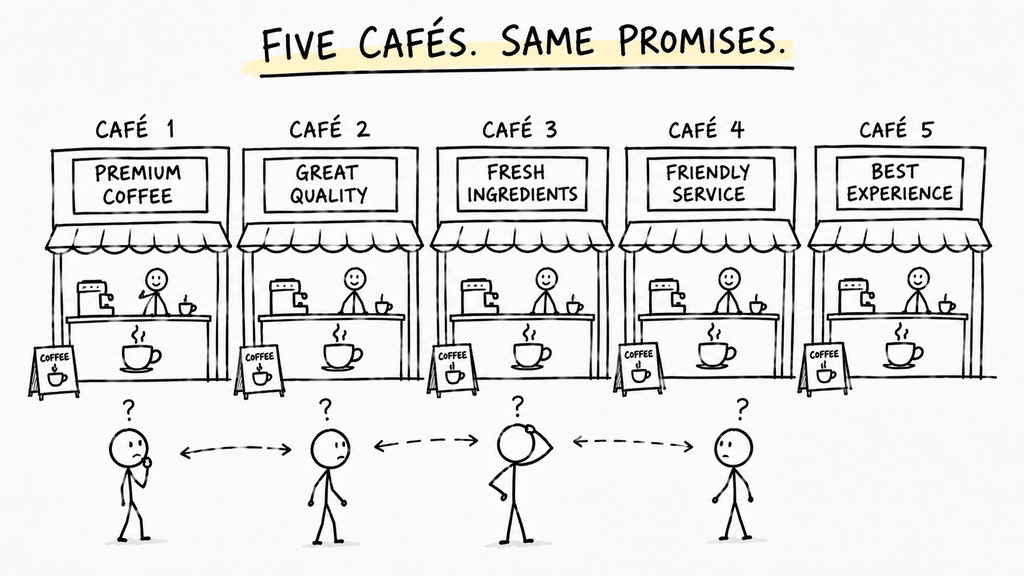
Every sign says:
Premium coffee.
Great quality.
Fresh ingredients.
Friendly service.
Best experience.
Now remove the logos.
Can you tell which café is which?
Probably not.
That’s the problem.
The businesses may actually be excellent.
But excellence without distinction is difficult to remember.
If everyone claims the same thing, the claim stops being a differentiator.
This is the me-too problem.
And it’s one of the biggest reasons good businesses remain invisible.
Being good gets you into the market. Being meaningfully different gives people a reason to remember you.
Better Isn’t Always a Position
This is one of the biggest misconceptions about branding.
Businesses constantly ask:
“How can we be better than our competitors?”
That’s a useful question for product development.
It isn’t always a useful positioning question.
Because “better” is relative.
And almost every competitor can say the same thing.
We’re better quality.
We’re better service.
We’re more innovative.
We’re more customer-focused.
We’re faster.
We’re more affordable.
Eventually, the customer hears noise.
A stronger positioning question is:
“What can we become known for that matters to our customers and is difficult for competitors to claim credibly?”
That changes the game.
The Five Questions Behind Strong Positioning
There isn’t a magic positioning formula.
But strong brands tend to answer five fundamental questions clearly.
1. Who Are You Trying to Matter To?
The fastest way to become forgettable is to say:
“Everyone.”
A restaurant that serves everyone doesn’t necessarily become the favourite of anyone.
A marketing agency that works with every industry may struggle to be remembered for anything.
A clothing brand designed for men, women, children, athletes, professionals, luxury buyers and budget shoppers is sending a very broad signal.
Specificity creates clarity.
Nike doesn’t need to be the perfect brand for everyone.
It needs to be deeply relevant to the people who connect with what Nike represents.
Your first positioning decision is therefore:
Who do we most want to matter to?
Because the more clearly you understand the customer, the easier it becomes to build a relevant position.
2. What Category Do You Want to Be Known For?
Before customers can understand why you’re different, they need to understand what you are.
Google is associated with search.
Netflix with streaming entertainment.
Airbnb with alternative accommodation.
Tesla with electric vehicles.
The category gives the brain a starting point.
If customers don’t understand what category you belong to, your differentiation becomes difficult to process.
Clarity comes before distinction.
3. What Makes You Different?
Now comes the heart of positioning.
Why should someone choose you?
Not:
“Why are we good?”
But:
“Why us?”
Maybe you’re dramatically faster.
Maybe you specialise in one audience.
Maybe you solve one problem better than anyone else.
Maybe you provide a level of craftsmanship competitors can’t easily match.
Maybe you’ve built a radically different experience.
The difference has to matter.
Being different simply for the sake of being different isn’t positioning.
It’s decoration.
4. Why Should Anyone Believe You?
This is where many positioning statements fall apart.
A company says:
“We’re India’s fastest delivery service.”
The customer asks:
“Prove it.”
A company says:
“We’re the most innovative.”
Again:
“Why should I believe you?”
A strong position needs a reason to believe.
That proof might come from:
- Product performance
- Customer results
- Reviews
- Certifications
- Technology
- Expertise
- Patents
- Awards
- Experience
- Demonstrable results
Don’t rely on adjectives.
Evidence beats adjectives.
5. What Promise Will You Keep Repeating?
Finally:
What should customers consistently expect from you?
This is your brand promise.
If you’re positioned around convenience, your experience should be convenient.
If you’re positioned around premium quality, your product and service should feel premium.
If you’re positioned around safety, safety needs to be visible in what you actually deliver.
Positioning isn’t a sentence you write once.
It’s a promise you repeatedly prove.
Different Ways a Brand Can Position Itself
There is no universal “best” position.
A brand can choose different strategic territories.
Price
“Why pay more?”
Value-focused brands make affordability the central reason to choose them.
Quality
“Pay more because it’s better.”
These brands compete through craftsmanship, reliability, performance or superior materials.
Luxury
“This represents something special.”
Luxury brands use exclusivity, heritage, craftsmanship, status and experience.
Innovation
“We do what others haven’t.”
Innovation-focused brands create expectations around new technology or new ways of solving problems.
Convenience
“We’ll make your life easier.”
Convenience can be incredibly powerful because customers value time.
Service
“We’ll treat you better.”
When products are similar, exceptional service can become the differentiator.
Lifestyle
“This is the kind of life you want to live.”
The product becomes a symbol of a broader identity.
Purpose
“What we stand for matters.”
Purpose can become powerful when the brand genuinely behaves according to it.
Emotion
“This is how we want you to feel.”
Brands can build strong associations around happiness, confidence, determination, belonging, nostalgia or aspiration.
Problem-Solution
“You have this problem. We solve it.”
Sometimes the strongest position is simply solving one frustrating problem exceptionally well.
The important thing isn’t choosing the trendiest positioning strategy.
It’s finding the intersection of:
What customers care about
What you can consistently deliver
What competitors haven’t already claimed convincingly
That’s where a defensible position begins.
Positioning Is a Choice
Here’s something businesses often avoid.
Positioning requires sacrifice.
If you want to be known for speed, you may have to optimise around speed.
If you want to be known for luxury, you probably can’t behave like a discount brand.
If you want to be known for simplicity, you can’t keep adding unnecessary complexity.
If you want to be known as a specialist, you may have to turn away customers who don’t fit your focus.
That’s uncomfortable.
But that’s the point.
If you refuse to choose what you stand for, customers will struggle to remember what you stand for.
Positioning is therefore not just about what you say yes to.
It’s also about what you say no to.
Features Don’t Create Positioning. Meaning Does.
Suppose you’re selling a laptop.
You could say:
“32GB RAM. 16-core processor. 20-hour battery.”
Those are features.
Useful, but incomplete.
Now translate them into customer outcomes:
“Edit videos faster.”
“Run demanding applications smoothly.”
“Work all day without searching for a charger.”
Now you’re talking about benefits.
And benefits are much closer to positioning because they connect the product to the customer’s life.
Whenever you’re writing marketing copy, ask:
“So what?”
Our laptop has a 20-hour battery.
So what?
You can work through the day without carrying a charger.
So what?
You can travel, work and move between meetings without worrying about finding a power socket.
Now we’re getting somewhere.
Positioning becomes stronger as the answer gets closer to why the customer should care.
Positioning Is Not Your Tagline
This confusion causes enormous problems.
A tagline is communication.
Positioning is strategy.
A tagline might express your position in a memorable phrase.
But changing the tagline doesn’t automatically change what customers believe.
You can have a brilliant slogan attached to a confused brand.
And you can have a simple slogan attached to an extremely strong position.
Think of positioning as the strategic idea.
Branding as the expression.
Marketing as the communication and activation.
The three work together.
But they are not interchangeable.
The “So What?” Test
Here’s a simple exercise every business can use.
Write down what you think makes your brand special.
Then ask:
So what?
Repeat.
Our product has advanced AI.
So what?
It automates complex analysis.
So what?
Customers can make decisions faster.
So what?
They spend less time analysing data and more time acting on it.
Now you’ve moved from:
Technology
to
customer value.
Do this repeatedly and you’ll often discover that the thing you thought was your differentiator isn’t actually the reason customers care.
That’s useful information.
The “Can Customers Repeat It?” Test
Here’s another test.
Ask five customers:
“What is this brand known for?”
Write down their answers.
Don’t help them.
Don’t give them options.
Just listen.
If all five give you roughly the same answer, you’ve probably built a strong association.
If you get:
“Good quality.”
“Affordable.”
“Modern.”
“Friendly.”
“Good social media.”
then your brand may be doing many things reasonably well without owning one clear idea.
That’s a positioning problem.
Because if your customers can’t explain why you’re different, your marketing probably isn’t clear enough.
The “Can a Competitor Steal It Tomorrow?” Test
Imagine your positioning is:
“We’re cheaper.”
Your competitor drops its price tomorrow.
Position gone.
Imagine your positioning is:
“We’re the most innovative.”
Your competitor launches something new.
Position challenged.
Now imagine your brand has spent fifteen years building an association around something supported by:
- Expertise
- Product capability
- Customer experience
- Reputation
- Community
- History
That’s much harder to copy.
Strong positioning isn’t merely different.
It’s defensible.
Positioning Doesn’t Happen in One Campaign
A common mistake is treating positioning like a branding project.
The company holds a workshop.
Chooses a statement.
Updates the website.
Changes the logo.
Runs a campaign.
Then considers the job finished.
It isn’t.
Positioning is built through repetition.
Every advertisement.
Every product.
Every customer interaction.
Every sales conversation.
Every package.
Every website page.
Every social media post.
Every employee interaction.
They all add evidence to the customer’s mental picture.
One interaction won’t define your brand.
But hundreds of consistent interactions can.
A position becomes powerful when the brand repeats the same promise long enough for customers to repeat it for you.
Your Employees Are Part of Your Position
Imagine a brand says:
“We’re premium.”
But its sales team aggressively discounts everything.
Its website feels cheap.
Its customer support is careless.
Its packaging looks generic.
What does the customer believe?
Probably not the advertising.
Because customers don’t experience departments.
They experience one brand.
That’s why positioning has to reach beyond marketing.
Product.
Pricing.
Sales.
Service.
Design.
Operations.
Hiring.
Everything should support the position.
A premium position with a discount-store experience is not premium.
It’s confusion wearing expensive clothes.
The Biggest Positioning Mistakes
Trying to Be Everything
The classic:
“We offer something for everyone.”
It sounds inclusive.
It usually produces forgettable communication.
Copying Competitors
If your entire strategy begins with:
“What are they doing?”
you risk becoming a slightly different version of them.
Study competitors to find gaps.
Don’t study them only to imitate them.
Confusing Quality With Differentiation
Everyone claims quality.
Quality is important.
But “good quality” rarely gives customers a memorable reason to choose you.
Confusing a Tagline With Strategy
A clever line cannot rescue unclear positioning.
Making a Promise You Can’t Deliver
If the experience contradicts the message, customers eventually believe the experience.
Changing the Message Constantly
If your brand stands for something different every six months, customers never get enough repetition to form a strong association.
Overcomplicating the Message
If you need three paragraphs to explain what your brand is known for, the customer probably won’t remember it.
Simple doesn’t mean shallow.
It means understandable.
What Does Successful Positioning Look Like?
You know positioning is working when the customer’s response becomes almost automatic.
Someone needs search.
They think Google.
Someone wants athletic inspiration.
Nike enters the conversation.
Someone wants a car strongly associated with safety.
Volvo appears.
Someone wants a luxury watch.
Rolex comes to mind.
This is the dream.
Not:
“We have 47 reasons you should choose us.”
But:
“When you need X, think of us.”
That’s mental availability.
That’s the shortcut.
That’s the prize.
But Don’t Confuse Being Famous With Being Positioned
A brand can be famous and still have weak positioning.
People may recognise the logo.
They may know the name.
They may have seen advertisements.
But ask:
“What is this brand really known for?”
and the answer may be vague.
Awareness answers:
“Have you heard of us?”
Positioning answers:
“What do you associate us with?”
Those are different problems.
A million people knowing your name isn’t enough.
You want them to know why your name matters.
The Real Competitive Advantage
Products get copied.
Features get copied.
Prices get copied.
Advertising styles get copied.
Even business models get copied.
But a deeply established position is much harder to reproduce.
Why?
Because it’s built from accumulated experiences.
Years of consistency.
Customer memories.
Word of mouth.
Reputation.
Associations.
Trust.
That’s why positioning can become one of the strongest forms of competitive advantage.
A competitor can copy your feature.
They can’t instantly copy what people already believe about you.
Start With One Question
If you’re building a brand today, forget the logo for a moment.
Forget the colour palette.
Forget the Instagram strategy.
Forget the tagline.
Ask:
“When my customer thinks about the category I operate in, what do I want them to think about my brand?”
Not five things.
Not ten.
One meaningful idea.
Then ask:
Who cares about this idea?
Why does it matter to them?
Why are we credible enough to own it?
What makes us different?
Can we deliver it consistently?
Can competitors easily copy it?
If you can answer those questions clearly, you have the beginnings of a real positioning strategy.
Positioning Is About Becoming the Obvious Choice
Go back to the phrase we started with:
“Google it.”
It’s a fascinating little sentence.
Google didn’t become a verb because someone decided to put “search” in a presentation.
It became deeply associated with search through years of product experience, distribution, familiarity, habit and repeated use.
The brand became a mental shortcut.
And that’s what great positioning ultimately creates.
A customer encounters a need.
Your brand appears in their mind.
Not because they carefully compared every competitor.
Because you’ve already become associated with the thing they want.
That’s the power of owning a position.
The Final Lesson
The biggest misunderstanding about brand positioning is that businesses think they’re trying to occupy more space.
More customers.
More categories.
More products.
More messages.
More claims.
But strong positioning often works in the opposite direction.
Less.
One audience you understand deeply.
One category you can explain clearly.
One meaningful difference.
One reason to believe.
One promise you can repeatedly deliver.
One idea you want customers to remember.
Because the human mind doesn’t reward brands for saying everything.
It remembers what is clear, relevant and distinctive.
Google became associated with search.
Volvo became strongly associated with safety.
Nike became associated with determination and athletic achievement.
The lesson isn’t to copy them.
The lesson is to understand what they did.
They gave people a mental shortcut.
And once that shortcut became strong enough, the brand name itself started doing part of the marketing.
So the next time someone says:
“Google it.”
don’t just think about search.
Think about what happened inside the customer’s mind.
A company name became a category cue.
A brand became a verb.
And a product became an association.
That’s positioning at its most powerful.
Don’t try to be the brand people notice. Become the brand they think of when it matters.
Leave a Reply