




The Last Slice of Pizza
Imagine you’re at a party with ten friends.
Two large pizzas arrive.
Everyone eats happily. There is plenty for everyone, so nobody thinks much about it.
Twenty minutes later, only one slice remains.
Suddenly, that last slice looks much more valuable.
You were already full a few minutes ago. But now you start thinking:
Should I take it before someone else does?
Did the pizza suddenly become tastier?
No.
The cheese did not improve. The crust did not become crispier. Nothing about the pizza changed.
Only its availability changed.
And somehow, that small change altered how valuable the pizza felt.
This happens everywhere in marketing.
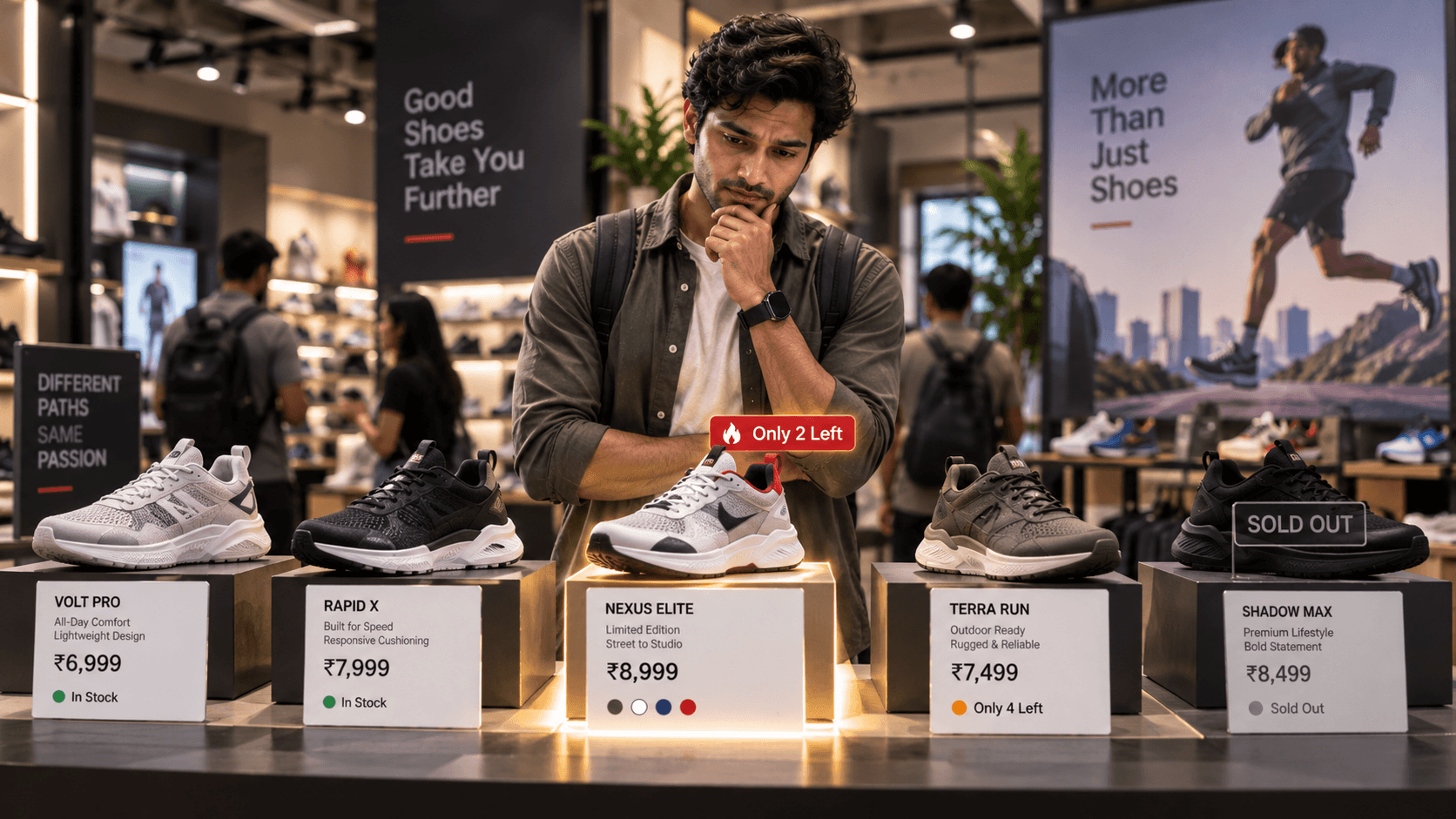
You’re shopping online for a pair of trainers and see:
Only 2 left in your size.
A moment ago, you were happy to keep browsing.
Now you start thinking:
What if someone else buys them?
What if I come back tomorrow and they’re sold out?
So you buy them.
Not because you suddenly need the trainers more.
But because you might lose the opportunity to own them.
Or imagine you’re booking a flight.
You find the perfect ticket, and then a message appears:
Only 3 seats left at this price.
Nothing about the holiday has changed.
The destination is the same.
The plane is the same.
The seat is the same.
Yet suddenly, waiting feels risky.
You stop comparing options and start thinking about booking.
Why?
Because our brains react differently when something feels limited.
Scarcity is one of the oldest ideas in economics. In simple terms, we want many things, but there isn’t always enough of them for everyone.
But scarcity is not just an economic idea.
It is a psychological one.
When something appears difficult to obtain, we often pay more attention to it. We may also see it as more valuable, more desirable or more worth having.
A limited-edition trainer.
A seasonal burger.
A luxury watch.
The last hotel room.
A course with limited places.
They all send a similar message:
If you don’t act now, you might lose the opportunity.
That message creates urgency.
It can increase curiosity.
It can make waiting feel uncomfortable.
And sometimes, it can make an ordinary product feel much more desirable.
This is why brands use limited editions, waiting lists, countdown timers, low-stock messages and seasonal launches.
They are not simply selling products.
They are making the opportunity to buy feel limited.
But why does this work so well?
Why can the same product suddenly feel more valuable simply because there is less of it?
To understand that, we need to look at one of the most famous experiments in consumer psychology.
It involved something remarkably ordinary:
two jars of cookies.
The Cookie Experiment That Changed Consumer Psychology
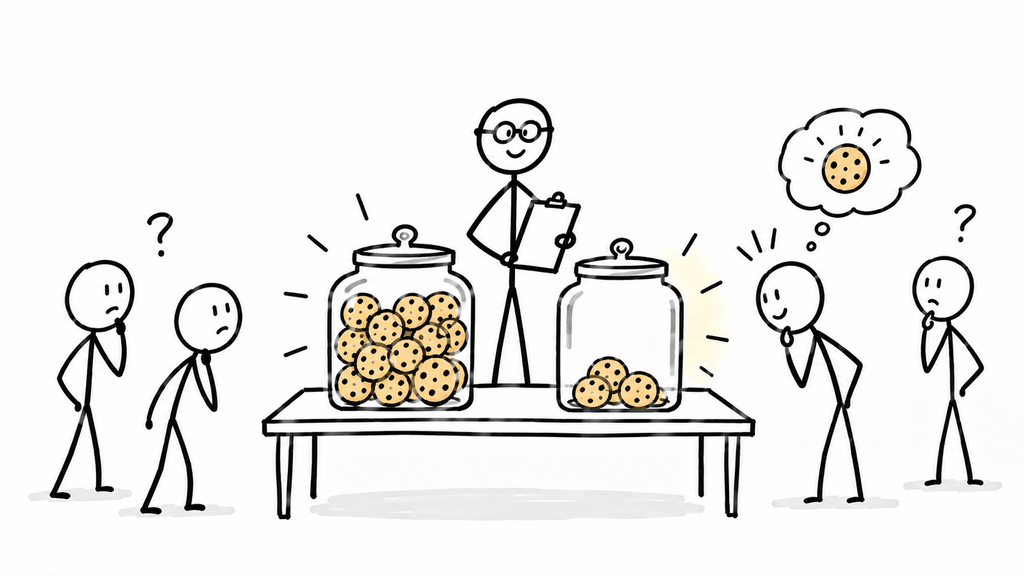
In a famous 1975 psychology experiment, researchers presented people with identical cookies in two jars.
The cookies were the same.
Same recipe.
Same ingredients.
Same product.
But there was one important difference.
One jar contained plenty of cookies.
The other contained only a few.
When people were asked to evaluate the cookies, those from the nearly empty jar were often seen as more desirable and valuable.
Some participants even rated them more positively.
Think about that.
The product had not changed.
Only the quantity had changed.
Now imagine walking into a bakery.
One tray has fifty fresh croissants.
Another has only one left.
Without tasting either one, which tray catches your attention?
Probably the second.
Your brain may immediately start creating a story:
There must be a reason these are almost gone.
Maybe they’re really good.
Other people must have bought them.
If I don’t take one now, someone else will.
Notice what has happened.
You’re no longer evaluating only the croissant.
You’re evaluating what its scarcity might mean.
That is one of the most important ideas behind scarcity marketing.
Scarcity Changes Perception, Not the Product
A limited-edition T-shirt is still a T-shirt.
A seasonal drink is still a drink.
A watch that is difficult to buy still tells the time.
Scarcity does not magically improve the physical product.
It changes the way people perceive the opportunity to own it.
A plain product can suddenly feel more interesting when it is labelled:
Limited Edition
A normal café can feel more desirable when there is a queue outside.
A seasonal drink can become something people look forward to every year because it disappears after a few weeks.
The product may remain exactly the same.
Its availability changes.
And availability can change perception.
This matters because customers rarely make decisions by carefully comparing every fact.
Our brains use shortcuts.
Our Brain Uses Shortcuts
Imagine walking through a busy market with hundreds of stalls.
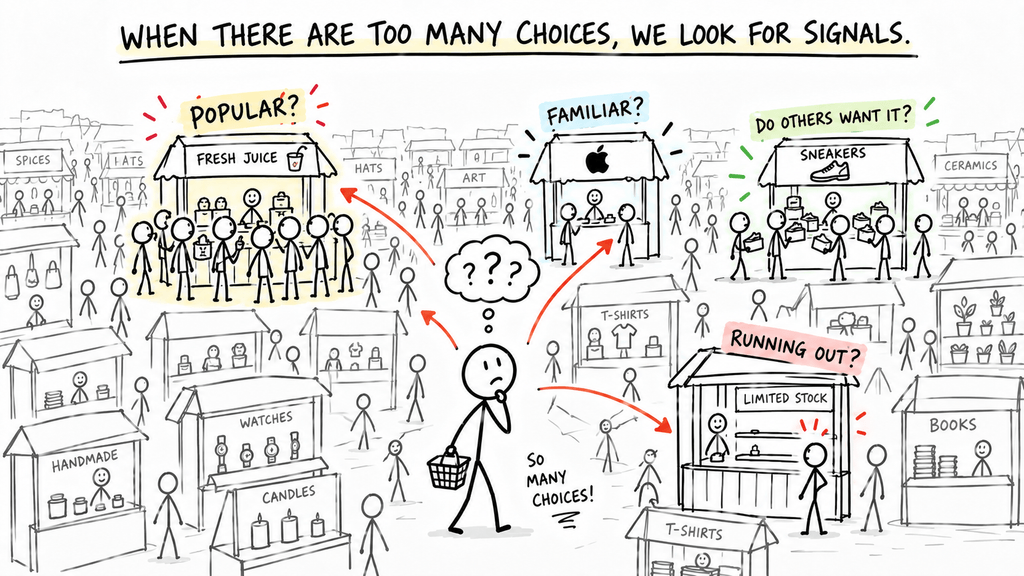
You cannot inspect every product.
You cannot compare every price.
You cannot research every seller.
So your brain looks for signals.
Is this popular?
Is it familiar?
Do other people want it?
Is it becoming difficult to get?
These shortcuts help us make decisions quickly.
Scarcity is one of them.
When something appears to be disappearing, our brain may assume that it matters.
Perhaps it is popular.
Perhaps it is valuable.
Perhaps other people know something we don’t.
The assumption may be correct.
It may also be completely wrong.
But the important point is that availability itself becomes information.
This is why scarcity can influence our decisions even when the underlying product has not changed.
You can see the same principle in online shopping.
A retailer displays:
Only 4 left in stock.
An airline shows:
Only 2 seats left at this price.
A fashion brand announces:
Limited edition.
A restaurant launches a dish for only two weeks.
Different tactics.
Same basic psychological idea.
People don’t just evaluate what something is. They also evaluate how difficult it may be to get.
And three powerful psychological forces make scarcity even stronger.
1. FOMO: The Fear of Missing Out
Imagine your friends are talking about a new café that has opened in your city.
You weren’t planning to visit.
You barely cared.
Then someone tells you:
It’s only open as a pop-up this weekend.
Suddenly, your priorities change.
You check your calendar.
Maybe you should go.
Why?
Because now there is a possibility that you will miss the experience.
You start imagining your friends talking about it next week.
You imagine seeing their photos.
You imagine everyone saying how good it was.
And you weren’t there.
This feeling is called FOMO, or the Fear of Missing Out.
Scarcity creates the possibility of regret.
You are no longer thinking only:
Do I want this?
You are also thinking:
What if I don’t get this and everyone else does?
That changes the decision.
A limited opportunity can make other people’s access feel more important to us.
This is particularly powerful when the product or experience is social.
Concert tickets.
Events.
Restaurants.
Limited fashion drops.
Exclusive communities.
New product launches.
The fear is not always about losing the product itself.
Sometimes it is about losing the experience of being part of something.
2. Loss Aversion: Losing Feels Worse Than Gaining
Imagine someone offers you ₹1,000.
You would probably feel happy.
Now imagine you already have ₹1,000 and someone takes it away.
That feels much worse.
This tendency is known as loss aversion.
People often react more strongly to losing something than to gaining something of equal value.
Scarcity taps into this idea.
Consider two messages:
Buy this product today.
and:
Offer ends tonight.
The first asks you to consider a purchase.
The second makes you think about losing the opportunity.
Or:
Only one left.
Now the decision is no longer simply:
Do I want this?
It becomes:
Am I about to lose my chance to get it?
That is a very different psychological frame.
The product has not become more valuable.
But the possibility of losing the opportunity has become more noticeable.
Scarcity turns waiting into a risk.
And that is why it can speed up decisions.
3. Social Proof: If Others Want It, It Must Be Good
Imagine you’re walking down a street with ten restaurants.
One is completely empty.
Another has a queue outside.
You’ve never eaten at either one.
Which one are you more likely to choose?
Probably the busy one.
Your brain makes a quick assumption:
If so many people are waiting, the food must be worth trying.
That is social proof.
We often look at what other people are doing when we are uncertain about what to do ourselves.
Scarcity can strengthen this effect.
If a product is almost sold out, you may assume other people bought it for a reason.
Maybe it is good.
Maybe it is popular.
Maybe you are late to discover it.
The assumption may not always be true.
But it can still influence behaviour.
Now combine the three forces.
You are looking at a limited-edition pair of trainers.
The website says:
Only 5 pairs left.
Your brain may produce three thoughts almost immediately:
If I wait, someone else might buy them.
FOMO.
If I don’t buy them now, I may lose the opportunity.
Loss aversion.
So many must have already been sold.
Social proof.
That’s a powerful combination.
But there is an important detail that marketers often miss.
Scarcity is only one example of how psychology influences marketing. The real skill is understanding when a tactic will work, why it works and how it fits into a brand’s wider strategy. Learn this way of thinking in the Positioning.co.in Marketing OS Program.
Scarcity Does Not Create Desire From Nothing
Scarcity is powerful.
But it is not magic.
If someone has absolutely no interest in your product, telling them that only two are left will not automatically make them want it.
Scarcity usually works best when some level of desire already exists.
Imagine someone has been considering buying a new laptop for weeks.
They like the product.
They have the money.
They just keep delaying.
Then they see:
Only 2 left.
Suddenly, the decision becomes urgent.
The desire was already there.
Scarcity simply changes the timing.
The thought moves from:
I’ll buy it next month.
to:
I’d better buy it today.
This is one of the most useful ways to understand scarcity.
Scarcity often accelerates decisions more than it creates them.
It reduces hesitation.
It shortens the time available for procrastination.
It turns later into now.
And for marketers, procrastination can be a bigger competitor than another brand.
The Biggest Competitor Might Be Procrastination
Customers often say:
I’ll think about it.
I’ll compare a few more options.
I’ll come back later.
Maybe I’ll buy it next month.
Nothing is wrong with these thoughts.
But from a business perspective, every delay creates another opportunity for the customer to change their mind.
They may forget.
They may lose interest.
They may find another option.
Or they may simply never return.
Scarcity changes the decision window.
Instead of an open-ended opportunity, the customer sees a closing one.
That is why countdowns, low-stock messages and limited-time offers can be so effective.
But each works in a slightly different way.
Countdown Timers: Turning Time Into a Trigger
Imagine you’re shopping online.
A banner says:
Offer ends in 02:14:37
Every second that passes makes the deadline feel closer.
Without the timer, you might leave the website and return next week.
With the timer, the decision suddenly feels time-sensitive.
The product has not changed.
The price may not even have changed yet.
But the time available to make the decision has changed.
A genuine countdown gives the customer a clear deadline.
It replaces:
I’ll decide later.
with:
I need to decide before this ends.
That can be useful when there really is a deadline.
For example, a course may genuinely start on Monday.
A seasonal product may genuinely disappear after a particular date.
A launch offer may genuinely end at midnight.
The important word is genuinely.
A countdown timer that resets every day is not creating scarcity.
It is creating suspicion.
Low-Stock Alerts: Scarcity You Can See
Now replace the timer with:
Only 2 left in stock.
The psychology changes slightly.
Instead of a limited amount of time, you are seeing a limited amount of product.
Immediately, you may start imagining someone else buying it.
What if I come back tomorrow and it’s gone?
That message can be useful when the stock information is real.
It helps customers understand that availability is genuinely changing.
But if a business displays “Only 2 left” when it has hundreds in a warehouse, the message becomes misleading.
And that leads to a much bigger problem.
Scarcity only has lasting power when customers believe it.
Airlines Don’t Just Sell Seats. They Sell Deadlines.
Flight booking is one of the clearest examples.
You may see:
Only 2 seats left at this price.
Notice the wording.
It does not necessarily mean only two seats remain on the aeroplane.
It can mean only two seats remain in that particular fare category.
If you wait, you may still get a seat.
You just might have to pay more.
So the psychological message is not simply:
The flight is nearly full.
It can also be:
If I wait, I may lose this price.
That changes the decision.
Waiting suddenly has a possible financial cost.
And once again, scarcity is making the opportunity feel temporary.
Limited Editions Create Exclusivity
Now consider a limited-edition product.
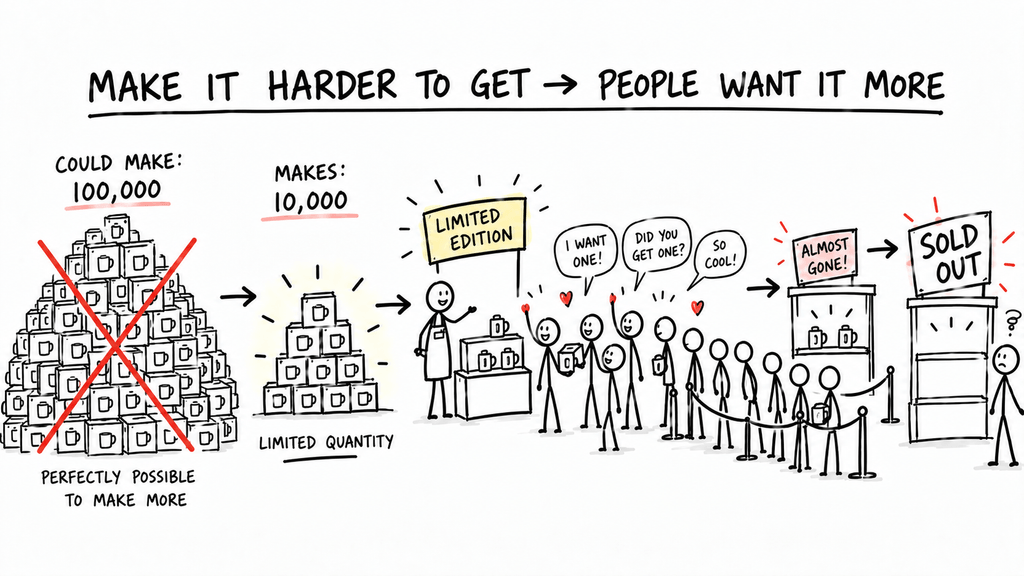
A brand could make 100,000 units.
Instead, it makes 10,000.
The product becomes harder to get.
People talk about it.
Some may queue for it.
It may sell out quickly.
Why?
Because limited availability creates more than urgency.
It can create exclusivity.
Owning something that relatively few people can own can make customers feel different from the crowd.
That is particularly powerful in fashion, footwear, watches, beauty and collectibles.
Customers may not simply be buying the product.
They may be buying the feeling of being part of a smaller group.
This is why limited editions can become part of a person’s identity.
Seasonal Products Create Anticipation
Think about a seasonal drink, festive sweet or special menu item.
If it were available every day of the year, it might become ordinary.
But when it appears for only a few weeks, something changes.
People begin looking forward to it.
They talk about it.
They notice when it returns.
They may even plan around it.
The waiting becomes part of the experience.
This is an important difference between availability and anticipation.
Scarcity does not only make people act faster.
Sometimes, it makes them look forward to something before they can even buy it.
One of the best-known examples is the McRib.
The McRib Strategy: Make It Disappear
Imagine your favourite ice cream flavour is available every day.
Monday.
Tuesday.
Wednesday.
You can have it whenever you want.
At first, you’re excited.
After a while, you stop thinking about it.
Why?
Because your brain knows:
I can always have it tomorrow.
Now imagine the shop announces:
Available for only two weeks.
Suddenly, the product feels different.
People start talking about it.
Some make a special trip.
Some post pictures.
Some worry about missing it.
The product itself has not changed.
Its availability has.
This is the basic idea behind the McRib strategy.
Why the McRib Feels Special
The McRib is a McDonald’s sandwich that has repeatedly appeared as a limited-time product.
McDonald’s could treat it like any other permanent menu item.
Instead, it has often brought the McRib back for limited periods and then removed it again.
That creates a cycle:
Return → excitement → purchase → disappearance → anticipation → return.
The product becomes an event.
This is a form of artificial scarcity.
The product is not naturally rare.
The company deliberately limits when customers can buy it.
And that creates something very useful:
anticipation.
Customers know the product will not always be there.
So when it returns, they pay attention.
Scarcity Defeats “I’ll Buy It Later”
Think about how often people postpone purchases.
I’ll buy it next week.
I’ll get it next month.
I’ll think about it.
Permanent availability makes that easy.
If the product will always be there, there is no cost to waiting.
Limited availability changes the equation.
If the product disappears tomorrow, waiting is no longer neutral.
You may lose the opportunity.
That’s why scarcity can be so effective at defeating procrastination.
It creates a reason to act now rather than later.
Scarcity Can Make Ordinary Products Feel Extraordinary
The McRib is not a luxury product.
It is a fast-food sandwich.
Yet its return can become something people talk about.
That is the fascinating part.
Scarcity can give an ordinary product cultural attention.
The product becomes a topic.
People review it.
People post about it.
People remember when it returned.
The scarcity itself becomes part of the story.
This is why seasonal and limited products can generate more attention than permanently available products.
The brand is not only selling the item.
It is selling the moment.
Scarcity Creates Memories
Think about experiences that happen only once a year.
Festivals.
Annual celebrations.
Special trips.
Seasonal traditions.
They often feel more memorable than ordinary routines.
One reason is that rarity makes an experience feel different from everyday life.
Brands can use the same principle.
A product that appears briefly can become something customers:
- Remember
- Talk about
- Wait for
- Share
- Recommend
Scarcity can therefore do more than increase short-term sales.
It can create a story around the product.
And stories are easier to remember than routine transactions.
When Scarcity Is Genuine, It Builds Trust
This is where scarcity marketing becomes more interesting.
Scarcity is not automatically good.
It depends on why the product is scarce and whether the customer believes the explanation.
Real scarcity can come from:
- Limited production
- Seasonal availability
- Genuine low stock
- Limited raw materials
- Production time
- High demand
- A deliberately limited edition
A small bakery that makes only fifty sourdough loaves a day may genuinely sell out by noon.
A handmade jewellery brand may only be able to produce twenty pieces a month.
A concert may genuinely have a fixed number of seats.
A seasonal product may genuinely disappear after a certain period.
These limitations make sense.
Customers can understand them.
And because the scarcity is real, it can create urgency without destroying trust.
Artificial Scarcity Is Not Automatically Bad
This distinction is important.
There is a difference between artificial scarcity and fake scarcity.
Artificial scarcity means a business deliberately chooses to limit availability.
For example, a fashion brand might produce only 500 jackets even though it could produce 50,000.
That is a business decision.
The scarcity is intentional.
But if the brand genuinely produces only 500 jackets and clearly communicates that fact, customers are not being deceived.
That can be perfectly legitimate.
Luxury brands use intentional scarcity.
Limited-edition collaborations use it.
Seasonal products use it.
Collector’s editions use it.
The problem is not creating a limitation.
The problem is lying about the limitation.
Artificial scarcity can be ethical.
Dishonest scarcity is not.
Fake Scarcity Destroys Trust
Imagine an online store says:
Only 2 left in stock.
You decide not to buy.
A week later, you return.
Still:
Only 2 left.
A month later:
Only 2 left.
At some point, you start asking:
Was there ever really only two?
And now something important has changed.
You’re no longer questioning the product.
You’re questioning the business.
The same thing happens with fake countdowns.
You see:
Sale ends in 10 minutes.
You rush through checkout.
The next morning, you visit the site again.
The timer has restarted.
The same sale is still running.
You don’t just feel that the promotion was misleading.
You may feel manipulated.
That emotion becomes part of your memory of the brand.
A few extra sales today may not be worth the loss of trust tomorrow.
When Everything Is Urgent, Nothing Is Urgent
Imagine every product on a website says:
Last Chance!
Every email says:
Final Hours!
Every product page says:
Only 1 Left!
Every week there is a:
Never-to-be-repeated sale!
At first, these messages might work.
But after seeing them again and again, customers stop paying attention.
The urgency becomes background noise.
This is a form of desensitisation.
The first warning gets your attention.
The hundredth barely registers.
This is why overusing scarcity can actually make scarcity less effective.
If everything is limited, nothing feels limited.
If every sale is the final sale, customers learn that the “final” sale is probably not final.
If every product is almost sold out, customers stop believing the stock message.
The problem is not that scarcity stopped working.
Credibility stopped working.
The Boy Who Cried Wolf, But With Marketing
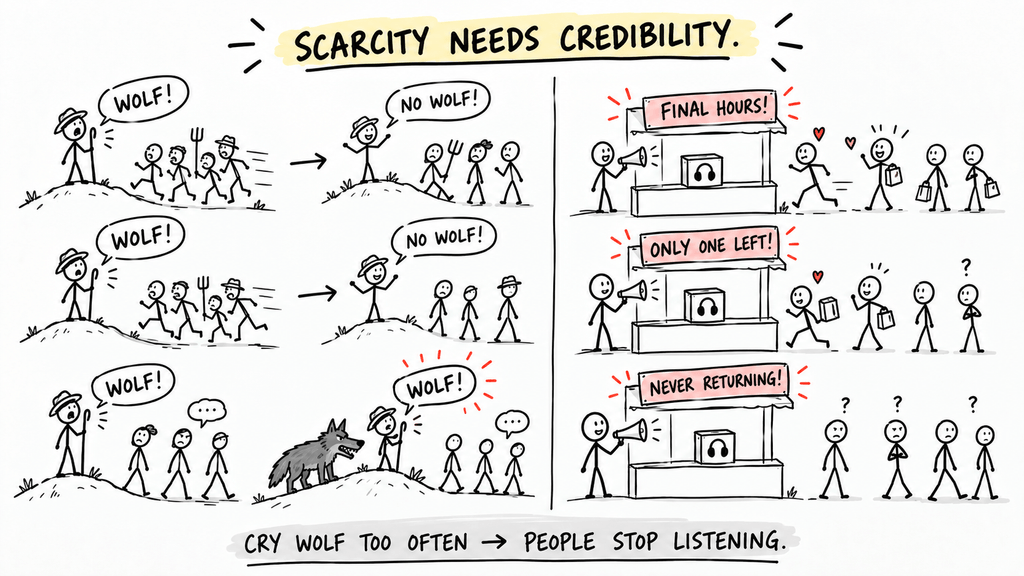
There is an old story about a shepherd boy who repeatedly shouted:
Wolf!
People rushed to help.
But there was no wolf.
After several false alarms, they stopped believing him.
Then one day, a real wolf appeared.
He shouted again.
Nobody came.
Scarcity works in much the same way.
If every campaign says:
FINAL HOURS
and every product says:
ONLY ONE LEFT
and every promotion says:
NEVER RETURNING
customers eventually stop believing the messages.
Then when you actually have a genuine limited opportunity, it becomes harder to make people care.
Overusing scarcity can train customers to ignore it.
More Sales Don’t Always Mean Better Sales
Imagine a premium fashion brand offering 50% off every weekend.
At first, customers may rush to buy.
But eventually, they learn something:
Why pay full price? Another sale will come soon.
The business may increase short-term sales.
But it may also train customers to wait.
The same principle applies to scarcity.
If every product is presented as special, nothing feels special.
If every launch is “limited”, limited becomes normal.
If every week contains a major deadline, deadlines stop meaning much.
Good marketing is not about maximising pressure.
It is about making the right opportunity feel meaningful.
Luxury Brands Take Scarcity to Another Level
Seasonal products use scarcity for a few weeks.
Limited editions may use it for a specific launch.
Luxury brands can build scarcity into the entire business model.
Think about a high-end watch or handbag that is difficult to buy immediately.
You may have the money.
You may genuinely want the product.
But you still have to wait.
Why would a company make something harder to buy when customers are ready to pay?
Because luxury brands are not competing on functionality alone.
They are competing on perception, identity and status.
Selling Less to Earn More
Most businesses want to sell more.
Luxury brands often have another priority:
Protect the feeling of exclusivity.
Imagine two private clubs.
The first lets everyone join immediately.
No waiting.
No restrictions.
The second accepts only a small number of new members.
Which feels more exclusive?
Probably the second.
The building could be identical.
The furniture could be identical.
The service could even be similar.
What changed?
Who gets access.
That is the power of exclusivity.
When everyone can have something, ownership carries less distinction.
When access is limited, ownership can become a status signal.
Waiting Can Increase Perceived Value
Imagine ordering a handmade dining table.
One carpenter says:
It will be ready tomorrow.
Another says:
There is a six-month waiting list because every piece is handcrafted.
The second table may immediately feel more valuable.
Why?
Because waiting can become evidence.
We may think:
If so many people are waiting, it must be worth it.
If it takes that long to get, it must be special.
If everyone cannot have it, owning it means something.
The waiting becomes part of the experience.
This is why scarcity in luxury is often much deeper than a simple “only two left” message.
The difficulty of obtaining the product becomes part of the product’s meaning.
Scarcity Protects Premium Positioning
Imagine a luxury handbag becoming available everywhere, all the time, with huge discounts.
The product might remain physically identical.
But its perception could change.
Luxury depends partly on controlled availability.
When demand is high and supply is carefully managed, brands can protect a sense of rarity.
Some highly desirable products can even become collectibles, with resale prices influenced by how difficult they are to obtain.
Again, the important point is not simply supply.
It is what limited supply communicates.
Scarcity can communicate:
- Exclusivity
- Achievement
- Status
- Craftsmanship
- Rarity
- Belonging
Luxury Brands Sell Identity
Nobody buys a luxury watch because a cheaper watch cannot tell the time.
A basic digital watch can do that perfectly well.
The purchase is often about something else.
Recognition.
Achievement.
Craftsmanship.
Success.
Personal identity.
The watch becomes a symbol.
Scarcity strengthens the symbol because not everyone can own it.
If everyone had exactly the same product, some of its signalling power would disappear.
This is why scarcity can become part of a luxury brand’s positioning.
The customer is not only buying what the product does. They are buying what owning it says.
Scarcity Is Sometimes the Product
For many luxury brands, scarcity is not a short-term campaign.
It is not a countdown timer.
It is not a weekend promotion.
It is built into the experience.
The limited availability itself contributes to the value.
The customer is buying:
- The product
- The craftsmanship
- The brand
- The status
- The exclusivity
- The fact that not everyone can have it
This is scarcity at its most powerful.
But it also shows why scarcity must be handled carefully.
Once scarcity becomes manipulation, the same mechanism that creates desire can destroy trust.
Scarcity Should Increase Value, Not Anxiety
Compare these two messages:
Only 5 handmade pieces are available because each one is individually crafted.
and:
BUY NOW! ONLY TWO LEFT! HURRY!
Both create urgency.
But they feel very different.
The first explains the limitation.
The second creates pressure without giving you much information.
Customers may not always be able to explain why one feels better.
But they can often sense the difference between authenticity and manipulation.
The best scarcity campaigns make people feel:
I’m lucky to have access.
The worst make people feel:
I’m being pushed into buying.
That distinction matters.
Great marketing should help customers make confident decisions.
It should not make them panic.
Explain Why Something Is Limited
Transparency changes everything.
Compare:
Limited to 1,000 copies because each book is personally signed by the author.
with:
BUY NOW BEFORE IT’S TOO LATE!
The first tells you why.
The second simply applies pressure.
Customers do not necessarily dislike scarcity.
They dislike unexplained pressure.
If something is genuinely limited, explain why.
Perhaps production takes time.
Perhaps there are only a certain number of seats.
Perhaps the collection will not be reproduced.
Perhaps the product is seasonal.
Perhaps early customers receive exclusive access.
The reason makes the scarcity believable.
Waitlists Create Anticipation Without Pressure
A waitlist is another interesting form of scarcity.
Imagine a new restaurant opens in your city.
Reservations are fully booked for three months.
The restaurant does not need to pretend that tables are disappearing every minute.
It simply says:
Join the waiting list.
Customers understand the situation.
Some will wait.
Some will choose another restaurant.
Nobody needs to be tricked.
Waitlists can create something valuable:
anticipation.
The same idea can work for products, events, communities, courses and new technology.
You are not necessarily telling people:
Buy now or regret it.
You are telling them:
Access is limited, and you can be part of the next group.
That creates excitement without unnecessary pressure.
Scarcity Should Reward Customers, Not Trap Them
Consider these two messages.
As one of our earliest customers, you’ll get first access to our new collection before everyone else.
and:
BUY NOW OR YOU’LL REGRET IT FOREVER!
The first makes the customer feel rewarded.
The second makes them feel anxious.
That difference is crucial.
The best scarcity strategies make customers feel that they have been given something valuable.
Early access.
Priority access.
A limited collaboration.
A special edition.
An invitation.
A genuine opportunity.
Scarcity should make customers feel fortunate, not frightened.
A Simple Test Every Marketer Should Ask
Before using scarcity in a campaign, ask:
If a customer discovered exactly how this campaign worked, would they still trust our brand?
If the answer is yes, you are probably on the right track.
If the answer is no, rethink the campaign.
This is a surprisingly useful test because it separates persuasion from deception.
You do not need to avoid urgency.
You need to make sure the urgency is honest.
A sale might last a few hours.
A reputation can last for years.
The Best Brands Combine Urgency With Trust
Some marketers think they have to choose.
Either create urgency.
Or build trust.
You don’t.
The strongest brands can do both.
They create genuine limited editions.
They explain why availability is restricted.
They give loyal customers early access.
They use real deadlines.
They communicate honestly when something sells out.
And when customers miss the opportunity, they do not feel cheated.
They simply look forward to the next one.
That is the difference between manipulation and good marketing.
Scarcity may help create the first purchase. Trust helps create the second, third and tenth.
The Future of Scarcity in the Age of AI
For centuries, scarcity was easy to understand.
A shop had ten products.
A concert had 500 seats.
A restaurant had twenty tables.
The limitation was physical.
You could see it.
But many modern products are different.
Software.
Online courses.
Streaming services.
AI tools.
Digital downloads.
Digital products can often be reproduced at very low cost.
So how do you create scarcity when the supply is almost unlimited?
The answer is increasingly moving away from the product itself.
And towards access.
Scarcity Is Moving From Products to Access
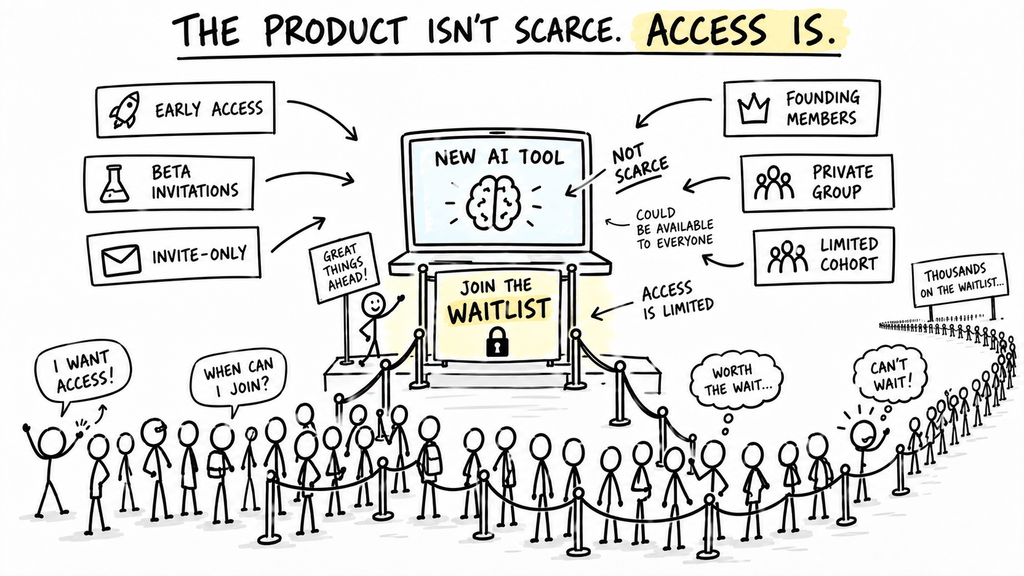
Imagine a new AI tool launches tomorrow.
The company could allow everyone to sign up immediately.
Instead, it says:
Join the waitlist.
Thousands of people register.
The software itself is not physically scarce.
The access is.
You’ve probably seen similar strategies:
- Early-access programmes
- Beta invitations
- Invite-only communities
- Founding memberships
- Private groups
- Limited launch cohorts
The product may eventually be available to millions.
But getting access first is scarce.
That creates urgency and status without needing a physical shortage.
Personalised Scarcity
Digital technology also allows brands to create more personalised access.
Instead of showing every customer the same offer, businesses can create different experiences.
A loyal customer might receive early access.
A first-time visitor might receive a welcome offer.
Someone on a waiting list might receive an invitation before everyone else.
A long-term member might receive access to a limited launch.
This is different from simply putting a giant countdown timer on every page.
The scarcity becomes more relevant.
The message is not:
Everyone must act now.
It becomes:
This particular opportunity is available to you because of your relationship with the brand.
That can make scarcity feel more meaningful.
Communities Are Becoming a Form of Scarcity
Think about private investment groups.
Invite-only events.
Exclusive professional networks.
Membership organisations.
Private online communities.
The product is not always the main attraction.
Sometimes, the real value is belonging.
Anyone can download an app.
Not everyone can become part of a respected community.
Anyone can watch content.
Not everyone gets access to a private group of people with shared interests.
As products become easier to create and distribute, access to meaningful communities can become more valuable.
In that sense, modern scarcity may increasingly be about:
Who gets access?
rather than:
How many products exist?
AI Will Make Scarcity Easier to Create
AI can personalise messages.
Websites can change offers dynamically.
Automated systems can send reminders at precise moments.
Brands can create highly targeted experiences.
This gives marketers more ways to create urgency.
But it also creates a problem.
The easier it becomes to manufacture urgency, the easier it becomes to manufacture fake urgency.
And customers are becoming better at detecting it.
Reviews spread quickly.
Social media exposes misleading campaigns.
People share screenshots.
Customers compare experiences in real time.
So the future winner may not be the brand that creates the most urgency.
It may be the brand that creates the most believable urgency.
The Psychology Will Not Change Much
The tools will change.
Today’s marketer uses countdown timers.
Tomorrow’s marketer may use an AI assistant.
Today’s business creates a waiting list.
Tomorrow’s business may create a personalised launch experience for every customer.
The technology will keep changing.
Human psychology changes much more slowly.
People will still value things that feel rare.
They will still dislike missing opportunities.
They will still appreciate exclusive experiences.
And they will still reward brands they trust.
The tools evolve.
The underlying psychology remains surprisingly familiar.
Scarcity Is Only One Piece of Great Marketing
This is perhaps the most important point in the entire article.
Scarcity can attract attention.
It can speed up decisions.
It can increase perceived value.
It can create anticipation.
It can strengthen exclusivity.
But it cannot fix a bad product.
It cannot replace trust.
It cannot create loyalty on its own.
And it cannot turn something irrelevant into something people genuinely want.
The strongest brands use scarcity to amplify existing value.
They do not use it as a shortcut around weak marketing.
Because customers may remember that a product was “only available for 24 hours”.
But what they ultimately remember is whether the product was worth buying.
That is the real lesson.
Scarcity can get attention. Value earns the purchase. Trust earns the relationship.
Key Takeaways
If you remember only one idea from this article, remember this:
Scarcity doesn’t change the product. It changes how people perceive the opportunity to own it.
Here are the main lessons.
1. Scarcity changes perceived value
The cookie experiment showed how identical products can be judged differently when one appears more limited.
The product stays the same.
Perception changes.
2. Scarcity speeds up decisions
People often delay purchases because they believe there will always be another opportunity.
A genuine deadline or limited supply makes waiting feel risky.
3. FOMO makes missing out feel painful
People do not want to feel that everyone else got an experience they missed.
Limited opportunities can make that fear stronger.
4. Loss aversion makes opportunities feel more valuable
When something might disappear, we focus on what we could lose rather than simply what we could gain.
That can push decisions forward.
5. Social proof can strengthen scarcity
When something is almost sold out, people may assume that others have already chosen it.
That can make the product appear more desirable.
6. Scarcity usually works best when desire already exists
Scarcity is not magic.
It is often more effective at turning:
I’ll buy it later.
into:
I’d better buy it now.
7. Genuine scarcity builds credibility
Real limitations can come from production capacity, seasonal availability, inventory, demand or intentional limited editions.
When the reason is believable, urgency feels natural.
8. Artificial scarcity is not automatically unethical
A brand can deliberately produce a limited number of products.
The important thing is honesty.
Intentional limitation is fine. Deception is not.
9. Fake scarcity damages trust
Fake stock messages.
Fake countdowns.
Endless “last chance” offers.
These may create short-term action, but repeated use can make customers stop believing the brand.
10. Luxury shows how powerful scarcity can become
For luxury brands, scarcity can become part of the positioning itself.
The customer is not only buying a product.
They are buying rarity, exclusivity, status and identity.
11. Scarcity can create anticipation
Seasonal products and limited launches can turn waiting into part of the experience.
Customers begin looking forward to the next opportunity.
12. Scarcity is moving towards access
In digital businesses, the product itself may be unlimited.
What becomes scarce is early access, membership, invitations, community or priority.
13. Trust matters more than urgency in the long run
Scarcity may help win the first purchase.
But customers return because the product delivered value and the brand kept its promises.
Final Thoughts
Every day, we encounter scarcity.
A flash sale.
A limited-edition product.
A waiting list.
A seasonal menu.
A nearly sold-out concert.
A message saying:
Only 2 left.
The next time you see one, pause for a moment and ask:
Is this scarcity genuine, or is it simply trying to influence my decision?
That question can make you a smarter consumer.
And if you’re a marketer, it can make you a better one.
Because great marketing is not about manufacturing panic.
It is about communicating genuine value at the right moment, to the right people.
Scarcity can help that value get noticed.
But it should never have to hide the truth.
Real scarcity creates urgency.
Fake scarcity creates suspicion.
And in the long run, trust is worth far more than a countdown timer.
Frequently Asked Questions
1. What is scarcity marketing?
Scarcity marketing is a strategy that makes a product, service or opportunity feel limited by time, quantity or access.
The goal is usually to encourage people to make a decision sooner rather than later.
2. Why does scarcity make people buy faster?
Scarcity creates a feeling that the opportunity may disappear.
This can reduce procrastination and increase urgency.
FOMO, loss aversion and social proof can make that effect even stronger.
3. What is the scarcity principle in psychology?
The scarcity principle describes our tendency to place greater value on things that appear rare or difficult to obtain.
Importantly, the product itself does not necessarily become better.
Our perception of it changes.
4. What was the famous cookie experiment?
A well-known 1975 psychology experiment presented people with identical cookies in containers with different levels of availability.
The cookies in the container with fewer cookies were often perceived as more desirable.
The study helped demonstrate how scarcity can influence perceived value.
5. What is FOMO in marketing?
FOMO means Fear of Missing Out.
It is the feeling that you may miss an experience, product or opportunity while other people get to enjoy it.
Limited events, exclusive launches and disappearing offers can trigger FOMO.
6. What is loss aversion?
Loss aversion is the tendency to react more strongly to losing something than to gaining something of similar value.
Scarcity can make customers focus on what they might lose if they wait.
7. What is social proof?
Social proof is our tendency to look at other people’s behaviour when deciding what to do.
If a product appears to be popular or nearly sold out, customers may assume that others have already chosen it for a good reason.
8. What are some examples of scarcity marketing?
Common examples include:
- Limited-time offers
- Flash sales
- Countdown timers
- Low-stock notifications
- Limited-edition products
- Seasonal products
- Waiting lists
- Early-access launches
- Invite-only communities
9. Is scarcity marketing ethical?
Yes, when it is honest.
Genuine scarcity can come from limited production, real stock levels, seasonal availability or intentionally limited editions.
The problem begins when businesses create false scarcity or deliberately mislead customers.
10. What is fake scarcity?
Fake scarcity is when a business falsely claims that something is almost sold out, that an offer is ending soon or that access is limited when it is not.
For example, a countdown timer that resets every time you visit the website is misleading.
Repeated use can damage trust.
11. What is the difference between real and artificial scarcity?
Real scarcity happens because supply is genuinely limited.
Artificial scarcity is deliberately created by a business.
For example, a brand may choose to produce only 500 jackets even though it could produce more.
Artificial scarcity can be perfectly legitimate if the limitation is real and honestly communicated.
12. Why do luxury brands use scarcity?
Luxury brands often use controlled availability to protect exclusivity and reinforce perceptions of rarity, status and prestige.
In luxury, scarcity can become part of what customers are actually buying.
13. Why do companies release limited editions?
Limited editions can create excitement, anticipation and exclusivity.
They can also encourage faster decisions and generate conversation around a product.
14. Do countdown timers actually work?
They can encourage faster decisions when they represent a genuine deadline.
For example, an offer that genuinely ends at midnight can create a clear reason to act.
But repeatedly resetting or extending fake timers can make customers stop trusting the message.
15. Can scarcity increase customer trust?
Scarcity itself does not automatically create trust.
But honest communication about genuine scarcity can support trust.
Explaining why something is limited can make the limitation feel credible rather than manipulative.
16. Does scarcity work for digital products?
Digital products are different because the product itself may be available to almost unlimited numbers of people.
Instead, scarcity can be created around access.
Examples include:
- Waitlists
- Beta access
- Early access
- Founding memberships
- Invite-only communities
The scarce resource is often not the product.
It is who gets access and when.
17. Why do seasonal products become so popular?
Seasonal products are available for a limited period.
That creates anticipation and gives customers a reason to act before the product disappears.
The waiting itself can become part of the experience.
18. What’s the biggest mistake businesses make with scarcity marketing?
The biggest mistake is overusing or faking it.
If every product is “almost sold out” and every promotion is “ending soon”, customers eventually stop believing the messages.
When credibility disappears, scarcity loses much of its power.
The best marketers know that scarcity should be used selectively.
When everything is urgent, nothing feels urgent.
Leave a Reply