
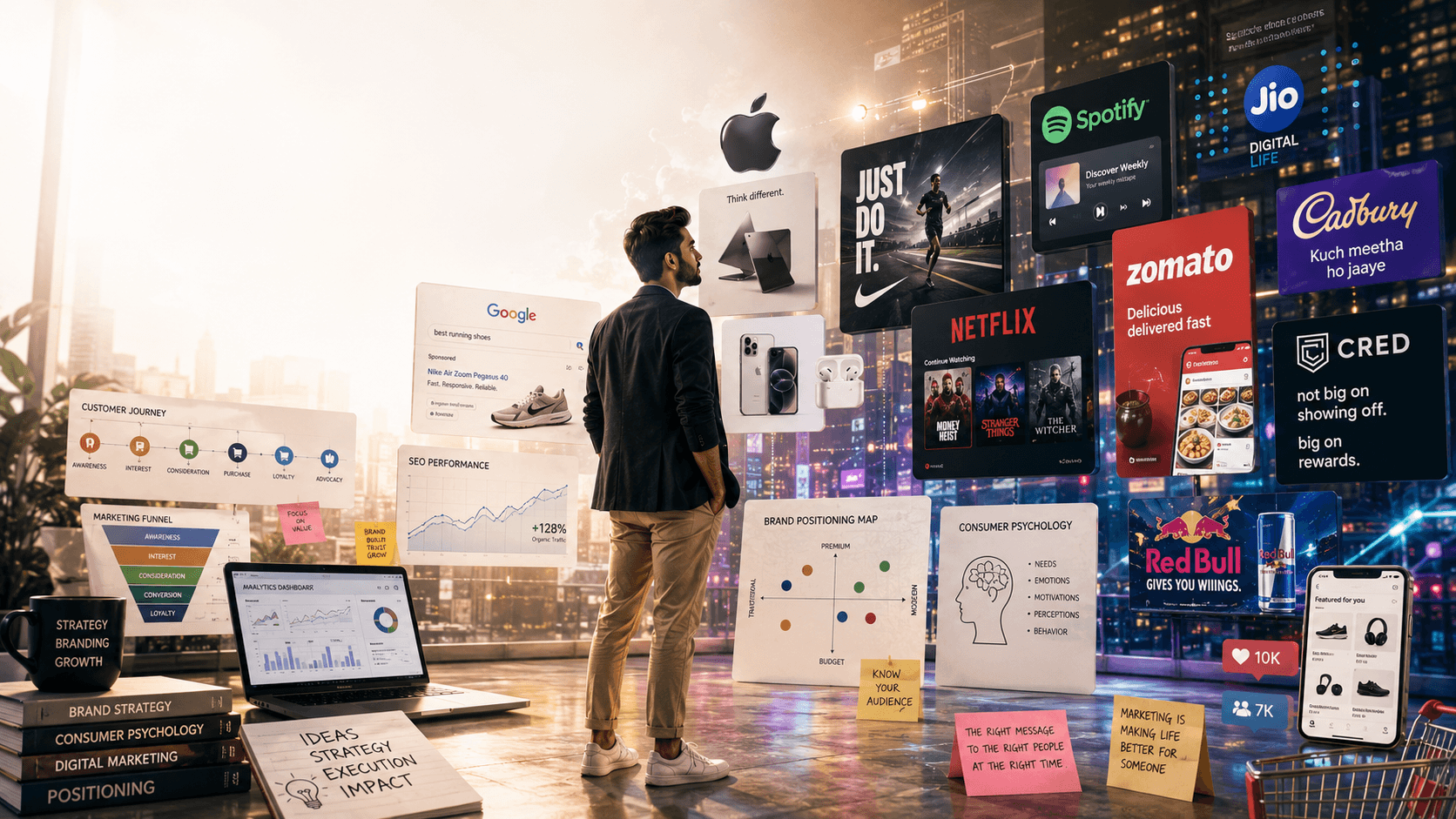




Marketing is everywhere.
You see it when a brand launches a new product, when an advertisement appears on your phone, when a company sends you an email, or when a friend recommends a product to you.
Yet marketing is one of those words that almost everyone uses and surprisingly few people can explain properly.
Ask someone what marketing is and you may hear:
“Advertising.”
“Selling.”
“Social media.”
“Running Google Ads.”
They’re not completely wrong.
But they’re only talking about parts of marketing.
So, what actually is marketing?
Let’s understand it without the textbook jargon.
Imagine You Have a Great Product
Imagine you open a café near a busy college.
You spend weeks finding good coffee beans, creating the menu and designing the interiors. The coffee is genuinely good. The prices are reasonable. The experience is great.
You finally open.
And then…
Hardly anyone comes in.
A few streets away, another café is packed every evening.
Does that automatically mean their coffee is better?
Not necessarily.
Maybe more people know about them.
Maybe their location is better.
Maybe their brand is more memorable.
Maybe people have seen their content on Instagram.
Maybe their friends have recommended them.
Maybe customers simply have more trust in that brand.
This is where marketing begins.
Having a good product is only the beginning.
People first need to discover it.
Then they need to understand why it matters.
Then they need a reason to trust it.
And finally, they need a reason to choose it over the alternatives.
That’s marketing.

What Is Marketing?
There are hundreds of definitions of marketing.
Some focus on creating value. Some focus on customers. Some focus on communication, exchange or relationships.
For a beginner, memorising one of those definitions isn’t particularly useful.
It’s more important to understand what marketing actually does.
A simple way to think about it is:
Marketing is about understanding people, identifying their problems, creating value for them, communicating that value and giving them a reason to choose your business.
And if you want one line to remember:
Marketing is the art of being remembered before you’re needed.
Think about what happens when you suddenly need food at night.
You don’t start researching every food-delivery company that has ever existed.
You already have a few names in your head.
You might open Zomato.
You might think of Swiggy.
You already know what these brands do, what kind of experience to expect and how to use them.
That familiarity didn’t appear overnight.
It was built through products, advertising, communication, customer experiences, recommendations and thousands of interactions over time.
That’s marketing at work.
Marketing Starts With People
Here’s where marketing becomes interesting.
Most businesses naturally start by thinking about their product.
“What should we sell?”
A marketer starts somewhere else.
“Who are we selling to?”
Imagine a company wants to launch a new pair of wireless earbuds.
The easiest thing would be to start listing features:
- Active noise cancellation
- 40-hour battery
- Fast charging
- Good microphone
- Low-latency mode
Then create an advertisement and start selling.
But let’s stop for a second.
Who are these earbuds actually for?
A college student might care about affordability, battery life and good sound.
A frequent traveller might care much more about noise cancellation.
Someone who spends the entire day on calls might care about microphone quality and comfort.
Someone buying premium earbuds might care about design, brand reputation and ecosystem.
Same product category.
Different people.
Different needs.
And therefore, potentially, different marketing strategies.
So before deciding what advertisement to run, a marketer needs to understand:
- Who is the customer?
- What problem are they trying to solve?
- What do they currently use?
- What frustrates them about existing options?
- What features actually matter to them?
- How much are they willing to pay?
- Where do they look for information?
- Why would they trust a new brand?
- Why would they switch from their current product?
That thinking is marketing.
The advertisement comes later.
Marketing Starts Before the Product
This is one of the biggest differences between marketing thinking and simply promoting a product.
Let’s continue with our earbuds example.
Suppose your research shows that your target customers are young professionals who spend hours on calls every day.
You discover that they don’t necessarily want the cheapest earbuds.
Their bigger frustration is poor microphone quality and uncomfortable earbuds during long calls.
Now your product decision changes.
You might prioritise:
Better microphones.
Comfortable design.
Reliable connectivity.
Long battery life.
You may even decide that some features competitors are promoting aren’t worth spending money on because your customers don’t care about them.
Notice what happened.
Customer research influenced the product itself.
This is why marketing isn’t something that starts when the product is finished.
Marketing can influence:
What you build.
Who you build it for.
How you price it.
Where you sell it.
How you communicate it.
And ultimately, why someone should choose it.
Marketing becomes much easier to understand when you see how the different pieces fit together. If you want to learn how marketers connect positioning, branding, consumer psychology and strategy to make better marketing decisions, explore the Positioning.co.in Marketing OS Program.
The Simple Marketing Process
If we simplify the entire process, it looks something like this:
Understand People
↓
Identify Their Problem
↓
Create a Valuable Solution
↓
Communicate the Value
↓
Build Trust
↓
Deliver on Your Promise
↓
Create Loyal Customers
Let’s break that down.
Understand People
Who are you trying to serve?
You need to understand their needs, behaviour, motivations and circumstances.
Identify Their Problem
What are they actually struggling with?
Sometimes the problem is obvious.
Sometimes customers themselves haven’t clearly articulated it yet.
Create a Valuable Solution
Now the business creates something that solves that problem or improves the customer’s situation.
Communicate the Value
A great solution doesn’t help if nobody understands why they should care.
This is where messaging, content, advertising, sales and other communication channels become important.
Build Trust
Customers don’t automatically believe every business.
Reviews, testimonials, reputation, demonstrations, guarantees and consistent experiences can reduce that uncertainty.
Deliver on Your Promise
If your marketing promises a great experience and the actual experience is terrible, the marketing eventually works against you.
Create Loyal Customers
A successful business doesn’t only want one transaction.
It wants customers to return, recommend the brand and build a long-term relationship with it.
This is why marketing is much bigger than simply getting someone to click Buy Now.
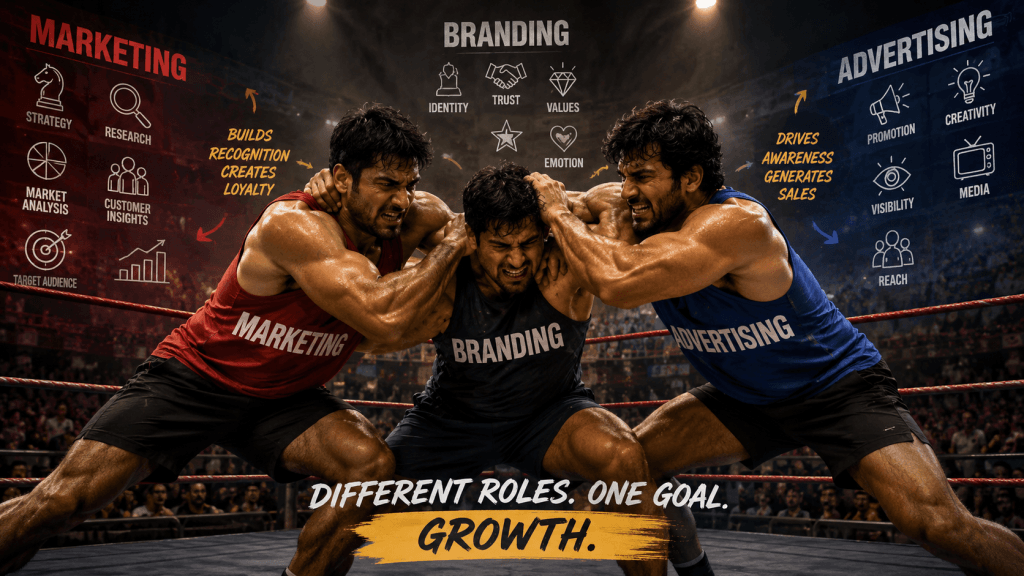
Marketing vs Advertising
This is probably one of the biggest misconceptions beginners have.
They see a company running Google Ads and say:
“That’s marketing.”
They see an Instagram campaign and say:
“That’s marketing.”
They see a billboard and say:
“That’s marketing.”
Technically, yes.
But they’re seeing one part of the system.
Let’s go back to the earbuds company.
Before running an advertisement, someone needs to decide:
Who should we target?
Then:
What problem are we solving?
Then:
What should the product offer?
Then:
What should we charge?
Then:
Where should customers buy it?
Then:
What should we communicate?
Only then do we start deciding which channels can reach those customers.
Google Ads might be useful.
Instagram might be useful.
YouTube might be useful.
Influencers might be useful.
SEO might be useful.
But those are tools and channels.
The strategy comes first.
Advertising tells people about your offer. Marketing decides what the offer should be, who it is for, why it matters and how you should take it to the market.
This distinction becomes extremely important when learning digital marketing.
Knowing how to run Google Ads doesn’t automatically tell you:
- Who should see the ads
- What message you should use
- What offer you should promote
- Which keywords matter
- Where the customer is in their buying journey
- Why they should choose you
Tools tell you how to do something. Strategy tells you what to do, when to do it and why.
Marketing vs Sales
Marketing and sales work closely together, but they aren’t the same thing.
Imagine a SaaS company launches a new software product.
Marketing might:
- Research the target audience
- Build the website
- Create educational content
- Run advertising
- Generate leads
- Communicate the product’s value
Sales then takes those opportunities and works towards converting them into customers.
The salesperson might speak to a potential customer, understand their requirements, answer questions, handle objections and close the deal.
A simple way to think about the difference is:
Marketing creates awareness, interest and opportunity. Sales converts that opportunity into revenue.
But there is an important overlap.
Good marketing can make sales easier.
If someone has already discovered your brand, read your content, seen reviews and understood your product before speaking to sales, the salesperson doesn’t have to start from zero.
Marketing vs Branding
Branding is another concept people often confuse with marketing.
Many people think branding means:
Logo.
Colours.
Fonts.
Packaging.
These are brand elements.
But your brand is much bigger than those things.
Think about Amul.
You probably recognise the Amul Girl immediately.
You may also recognise the humour, the topical advertisements and the distinctive way the brand communicates.
Over decades, these repeated experiences have created certain associations in people’s minds.
That’s what makes branding powerful.
A useful way to think about the relationship is:
Marketing helps communicate and deliver value. Branding influences what people remember and associate with your business.
They aren’t separate worlds.
They’re connected.
Marketing is much more than advertising or promotion. It is a system of decisions about customers, positioning, value, communication and growth. If you want to learn how these pieces work together in practice, explore the Positioning.co.in Marketing OS Program.
How Has Marketing Evolved Over Time?
Marketing didn’t start with Instagram.
It didn’t start with Google.
And it definitely didn’t start with AI.
Businesses have always had the same basic challenge:
How do we get people to choose our product?
What changed over time was how businesses reached people, how much they understood about customers and how customers made buying decisions.
From Making Products to Selling Products
During the rise of mass production, businesses focused heavily on producing products efficiently and making them available to customers.
If you could manufacture more and distribute more effectively, you had a major advantage.
The thinking was largely:
“We can make this product. Now let’s get it into the market.”
As competition increased, simply having a product wasn’t enough.
Businesses had to persuade people to buy.
The focus started moving towards sales, promotions and persuasive advertising.
The question became:
“How do we sell more?”
But another question eventually became important:
“Why would someone choose us again?”
That pushed businesses towards understanding customers more deeply.
From Selling Products to Understanding Customers
Businesses increasingly realised that creating a product first and then trying to convince people to buy it wasn’t always the best approach.
Instead, they could start by understanding what people actually wanted.
The question changed from:
“What can we sell?”
to:
“What do people actually need?”
Our earbuds example shows why this matters.
A student might care about price.
A traveller might care about noise cancellation.
A professional might care about call quality.
The product category is the same, but the customer’s needs are different.
Understanding those differences changed how businesses approached products, pricing, communication and customer relationships.
This was a major shift towards customer-oriented marketing.
Mass Media Changed the Scale
Then came television, radio, newspapers, magazines and outdoor advertising.
Brands could suddenly communicate with millions of people at once.
But reaching millions of people created a new problem:
How do you become memorable?
Brands started building stronger associations around their products.
Nike wasn’t simply selling sportswear.
Coca-Cola wasn’t simply selling a soft drink.
Luxury brands weren’t simply selling physical products.
Marketing increasingly became about creating meaning and perception around a product.
The goal wasn’t only:
“Buy this.”
It was also:
“Remember us.”
“Associate us with something.”
“Choose us when you need it.”
The Internet Changed How People Discover Brands
Then the internet changed the relationship between brands and customers.
Customers could now search for information themselves.
They could compare prices.
Read reviews.
Watch demonstrations.
Check competitors.
Ask questions.
Share their experiences.
The relationship moved from mostly:
Brand → Customer
towards:
Brand ↔ Customer
A customer who sees an advertisement for earbuds doesn’t have to simply believe it.
They can immediately search for reviews.
Watch YouTube comparisons.
Check Amazon ratings.
Look at Reddit discussions.
Compare prices.
And make their own decision.
The customer became an active participant in the marketing process.
Data Made Marketing More Measurable
Digital marketing created another major change.
Businesses could now understand customer behaviour in much more detail.
They could see where visitors came from, what they searched for, which pages they visited, what they clicked, where they dropped off and whether they eventually purchased.
This changed marketing from:
“I think this campaign is working.”
to:
“Let’s look at the data.”
Marketers could test different audiences, messages, landing pages and offers.
They could measure what worked.
They could learn what didn’t.
And they could improve their campaigns based on evidence.
Marketing became increasingly data-driven.
Personalisation Changed the Experience
Once businesses had more customer data, another possibility emerged:
Personalisation.
Why should every customer receive exactly the same message if every customer behaves differently?
Think about Zomato.
One customer may regularly respond to discounts.
Another may care more about free delivery.
Another may frequently order from premium restaurants.
Another may order late at night.
Understanding these behaviours allows platforms to make their communication more relevant.
Marketing started moving from:
“One message for everyone.”
towards:
“A more relevant message for different people.”
And this is where customer data, consumer psychology and technology start working together.
AI Is Changing How Marketers Work
And now we’re entering another major shift.
AI can help marketers research customers, analyse information, generate ideas, create content, personalise communication and automate repetitive tasks.
But here’s the important part:
AI hasn’t changed the fundamental job of marketing.
People still have problems.
People still have needs.
People still compare alternatives.
People still need reasons to trust brands.
People still care about value, convenience and experience.
The technology is changing how marketers work.
It isn’t changing the fact that marketing starts with people.
The 4 Ps of Marketing
One of the most famous frameworks in marketing is the 4 Ps: Product, Price, Place and Promotion.
You may have heard these terms before.
But memorising four words isn’t enough.
The important thing is understanding how they work together.
Let’s imagine we’re launching those earbuds.
Product
What are we offering?
This includes features, quality, design, packaging, warranty and the overall experience.
But the important question is:
What does our target customer actually value?
If our customers spend hours on calls, microphone quality might matter more than gaming features.
If they’re frequent travellers, noise cancellation might be more important.
Product decisions should therefore come from customer needs.
Price
How much should customers pay?
Price affects revenue, but it also affects perception.
A ₹999 product and a ₹9,999 product create very different expectations.
A low price might communicate affordability.
A high price might communicate premium positioning.
But a high price alone doesn’t make something premium.
Customers still need to believe the product is worth it.
Place
Where will customers find and buy the product?
For our earbuds, that could be Amazon, Flipkart, the brand’s website, electronics stores or other retailers.
Place is about making the product available where the customer expects to find it.
A great product becomes difficult to sell if buying it is inconvenient.
Promotion
How will people discover the product and understand why it matters?
This includes advertising, SEO, content, social media, email, influencers, public relations and many other channels.
But remember:
Promotion is only one of the 4 Ps.
And the four Ps have to work together.
Imagine a product positioned as premium.
The product looks premium.
But the company constantly communicates:
“Cheapest earbuds in the market!”
The price is heavily discounted every week.
The product is mainly sold through channels associated with bargain shopping.
The individual decisions may not be terrible.
But together, they create a confusing message.
That’s why the 4 Ps are connected.
Marketing isn’t about making four separate decisions.
It’s about making decisions that support the same strategy.

Why Is Marketing Important?
A great product is useless if nobody discovers it.
A brilliant service can struggle if nobody trusts the company behind it.
And even a successful brand can lose customers if competitors give them a better reason to switch.
Marketing helps businesses solve these problems.
Discovery
People can’t buy something they don’t know exists.
Marketing helps businesses reach potential customers through search, advertising, content, social media, referrals and other channels.
Differentiation
If ten companies sell similar products, why should someone choose yours?
Marketing helps communicate that difference.
Trust
Customers don’t automatically believe every promise a business makes.
Reviews, testimonials, demonstrations, reputation and consistent experiences help reduce uncertainty.
Conversion
Getting attention isn’t enough.
Customers eventually need a reason to act.
That might be a strong offer, clear value, social proof, convenience or simply enough trust to make the decision.
Retention
The first purchase shouldn’t be the end of the relationship.
Good marketing continues after the sale by creating experiences that encourage customers to return and recommend the business.
Marketing and the Customer Journey
Customers rarely go:
See advertisement → Buy product.
The real journey is usually more complicated.
They might first become aware of a problem.
Then search for information.
Compare alternatives.
Read reviews.
Ask friends.
Visit websites.
Compare prices.
Think about the decision.
Finally buy.
Then they experience the product.
And that experience influences whether they return or recommend it.
You can think of it as:
Discover → Research → Compare → Decide → Buy → Experience → Return
This is why marketers need to think beyond a single advertisement.
Different stages require different messages and strategies.
Someone who has never heard of your brand needs a very different message from someone who has already visited your website three times.
Understanding this journey is a major part of modern marketing.
Where Do SEO, Google Ads and Social Media Fit?
This is where many beginners get confused.
They learn SEO.
Then Google Ads.
Then Meta Ads.
Then social media.
Then email.
And suddenly marketing looks like a collection of completely unrelated skills.
It isn’t.
These are different channels and tools that can perform different jobs.
For example:
SEO can help people discover you when they search for something.
Content marketing can educate them and build authority.
Social media can create awareness and familiarity.
Google Ads can help you capture existing search demand.
Email marketing can nurture leads and bring existing customers back.
Influencer marketing can help you reach an audience that already trusts a creator.
The important question isn’t:
“Which tool should I learn?”
It’s:
“What am I trying to achieve, who am I trying to reach, and which channel makes the most sense?”
That’s the difference between using marketing tools and thinking like a marketer.
Real Marketing Lessons From Famous Brands
The easiest way to understand marketing is often to look at brands we already know.
Jio: Solve a Real Problem
Jio recognised an opportunity around affordable high-speed internet and built a powerful proposition around it.
The lesson:
Start with the customer’s problem, not your advertisement.
Apple: Build Perception
Apple doesn’t compete only through technical specifications.
Its marketing has built strong associations around design, simplicity, innovation, premium experience and status.
The lesson:
Customers don’t evaluate products only on what they technically do. They also evaluate what the brand represents.
Amul: Stay Relevant
Amul has spent decades using the Amul Girl to comment on cricket, films, current events and popular culture.
The product isn’t always the centre of the communication.
Sometimes the goal is simply to remain relevant and memorable.
The lesson:
Marketing isn’t always about asking people to buy. Sometimes it’s about giving them a reason to remember you.
Zomato: Understand Behaviour
Zomato can use customer behaviour to make recommendations, offers and communication more relevant.
Different customers can respond to different messages.
The lesson:
The better you understand customer behaviour, the more relevant your marketing can become.
Nike: Sell More Than the Product
Nike’s marketing often focuses on ambition, performance, confidence and achievement rather than simply listing product specifications.
The lesson:
People can buy the meaning associated with a product, not just the product itself.
Common Marketing Mistakes Beginners Make
Thinking marketing means advertising
Advertising is one part of marketing.
It cannot replace customer research, positioning, product strategy or customer experience.
Learning tools before understanding strategy
Knowing how to operate Google Ads doesn’t tell you what you should advertise or who should see it.
Trying to target everyone
Different people have different needs.
Trying to communicate with everyone often produces a message that doesn’t strongly connect with anyone.
Copying competitors
A competitor’s campaign worked in their context.
Your audience, product, positioning and objectives may be completely different.
Talking only about features
Customers care about what those features do for them.
Always connect:
Feature → Benefit → Customer Value
Measuring only likes and followers
Attention can be useful, but businesses ultimately need outcomes.
Depending on the objective, those outcomes could be leads, sales, revenue, retention or brand growth.
So, What Is Marketing Really?
Let’s bring everything together.
Marketing isn’t just advertising.
It isn’t just sales.
It isn’t just branding.
It isn’t SEO.
It isn’t Google Ads.
It isn’t social media.
Those are pieces of a much larger system.
Marketing starts with understanding people.
You identify a problem or need.
You create something valuable.
You decide how to price and distribute it.
You communicate why it matters.
You build trust.
You deliver on your promise.
And if you do all of that well, customers don’t just buy from you.
They remember you.
They come back.
And they recommend you.
That’s why a marketer shouldn’t start with:
“How do I sell this?”
Start with:
“Who am I trying to help, what do they need, and why should they choose me?”
The tools will change.
The platforms will change.
The algorithms will change.
AI will change how marketers work.
But people will remain at the centre of marketing.
And understanding people will always be one of the most important skills a marketer can have.
Leave a Reply