
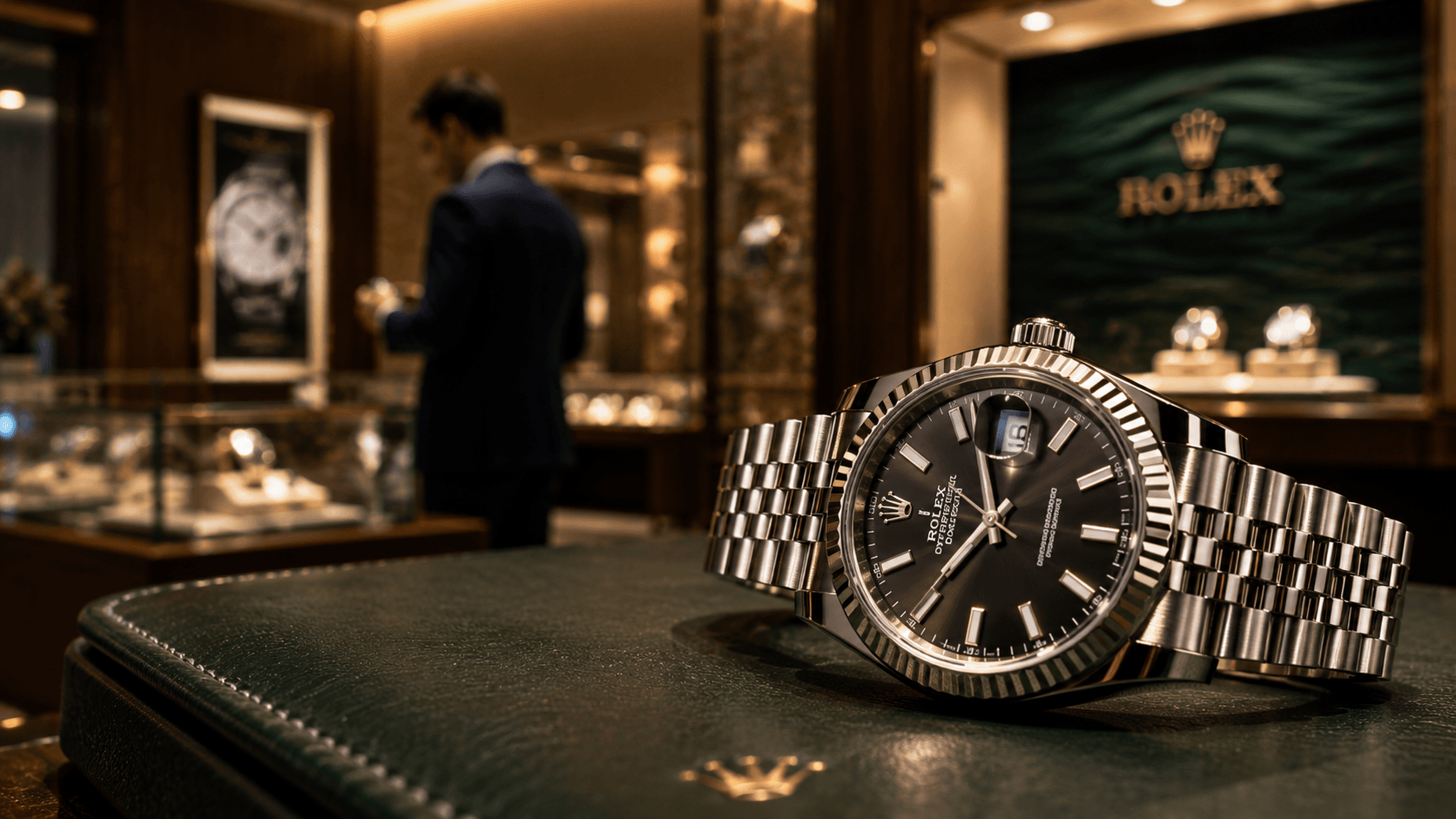




You’ve probably heard this conversation before.
“₹10 lakh for a watch? Why?”
And then someone says:
“But bro, it’s a Rolex.”
That’s actually a very interesting marketing question.
Because if we’re only talking about telling time, a ₹5,000 watch can do the job.
Your phone can do it.
Your smartwatch can do it.
So why would someone pay thousands or even lakhs for a mechanical watch?
The answer isn’t simply “because Rolex makes better watches.”
The more interesting answer is:
Rolex has built a perception of value that goes far beyond the basic function of the product.
And that’s exactly why Rolex is worth studying.
We’re not here to promote Rolex.
We’re here to deconstruct its marketing.
What does Rolex do?
Why does it work?
And more importantly:
What can a marketer learn from it?
1. A Product Can Be Worth More Than Its Function
Let’s start with the most basic question.
What does a watch do?
It tells time.
That’s its functional job.
Now compare that with what a Rolex can represent to a customer.
Craftsmanship.
Heritage.
Achievement.
Status.
Exclusivity.
Precision.
Legacy.
Suddenly, we’re talking about something much bigger than telling time.
And this is where Consumer Psychology becomes important.
Customers don’t always evaluate products purely on their functional utility.
They also think about:
What does this product mean to me?
How does owning it make me feel?
What does it say about me?
What does the brand represent?
For some Rolex customers, the watch may be connected to an achievement, a milestone, a personal interest in mechanical watches, or simply a desire for a luxury product.
The same physical product can therefore carry very different meanings for different people.
That’s perceived value.
The Marketing Lesson
Whenever you’re marketing a product, don’t stop at:
“What does my product do?”
Ask:
“What value does the customer actually perceive?”
A fitness programme doesn’t only provide workouts.
It can represent confidence and transformation.
A premium restaurant doesn’t only provide food.
It can provide experience and status.
A professional course doesn’t only provide information.
It can represent career growth and achievement.
The product is functional.
The value in the customer’s mind can be much bigger.
2. Rolex Turns a Product Into a Symbol
Think about when people usually buy something expensive for themselves.
It might be after:
A major promotion.
Building a successful business.
Retirement.
Winning something important.
Reaching a personal goal.
Or simply achieving something they’ve worked towards for years.
In these situations, the product can become associated with the achievement itself.
The watch isn’t just:
“Something I bought.”
It can become:
“Something I bought when I achieved something important.”
Think about a graduation certificate.
The paper itself isn’t particularly valuable.
You could print another copy.
But the certificate represents years of study, effort and achievement.
That’s why people frame it.
The physical object carries the meaning of the experience.
A luxury watch can work in a similar way.
It can become a physical reminder of:
“I achieved this.”
“I earned this.”
“This was an important moment in my life.”
That’s a powerful psychological association.
The Marketing Lesson
Ask yourself:
“Can my product become associated with an important moment, identity or achievement in my customer’s life?”
Because when a product becomes part of someone’s story, its value can go far beyond its functional use.
3. Price Is Not the Same as Value
Now let’s make this even more practical.
Imagine two watches.
Watch A costs ₹5,000.
Watch B costs ₹5,00,000.
Both tell time accurately.
If we evaluate them only on their basic function, the second watch can look irrationally expensive.
But that’s not how every customer evaluates a luxury product.
They may also consider:
Craftsmanship.
Materials.
Design.
Brand reputation.
Heritage.
Exclusivity.
Durability.
Status.
Personal meaning.
The customer isn’t necessarily asking:
“Which watch tells time most efficiently?”
They may be asking:
“Which product gives me the value I’m looking for?”
This is why price and perceived value are closely connected.
A product can be expensive and still feel worth it to the right customer.
And another product can be cheap and still feel overpriced if the customer doesn’t see enough value in it.
The Marketing Lesson
If customers say:
“Your product is too expensive.”
Don’t immediately assume the solution is to reduce the price.
First ask:
“Have I communicated and delivered enough value to justify the price?”
Sometimes the problem isn’t price.
The problem is perceived value.
4. Scarcity Can Increase Desirability
Now let’s look at something interesting about luxury.
Imagine you can buy a product immediately from thousands of stores.
It’s everywhere.
You don’t have to think about it.
You don’t have to wait.
You don’t have to search.
Now imagine you want a particular luxury model and it’s difficult to obtain through authorised channels.
The buying experience changes.
The product can start feeling:
More exclusive.
More desirable.
More special.
This is where scarcity becomes a marketing tool.
Rolex controls production and distribution, and some popular models can be difficult to obtain through authorised channels. That limited availability can reinforce the perception of exclusivity around the brand.
But there’s an important point here.
Scarcity doesn’t automatically create value.
If I tell you that only ten useless products are available, you probably don’t suddenly want one.
Scarcity works much better when demand already exists.
Rolex already has a strong brand and customer demand.
Limited availability can then reinforce that positioning.
The Marketing Lesson
Don’t think:
“If I make my product scarce, people will automatically want it.”
Think:
“If customers already want my product, can controlled availability strengthen its exclusivity?”
This can work with:
Limited editions.
Small-batch products.
Exclusive memberships.
Early-access launches.
Limited seats.
But remember:
Scarcity amplifies desirability. It doesn’t magically create it.
5. Consistency Can Be More Valuable Than Constant Reinvention
Now look at the way Rolex approaches design.
Compare that with smartphones.
Every year you get:
New camera.
New screen.
New processor.
New design.
New features.
The customer is constantly being shown what’s different.
Rolex operates differently.
Its major collections have evolved over time, but the fundamental design language remains highly recognisable. Instead of completely reinventing the product every year, Rolex has generally refined its materials, movements and performance while protecting its established identity.
That’s strategically interesting.
Because innovation doesn’t always mean changing everything.
Sometimes innovation means:
“Improve what you have without destroying what people already recognise and value.”
Think about a restaurant you’ve been visiting for years.
You probably want the food to improve.
You might welcome a few new dishes.
But if the restaurant completely changes its menu, design, positioning and experience every few months, you may stop recognising the place you originally liked.
Brands can have the same problem.
The Marketing Lesson
Ask:
“What should remain recognisable about my brand even five or ten years from now?”
Because your brand identity is an asset.
You can evolve your product without constantly reinventing what your brand means.
Change the execution. Protect the identity.
6. Rolex Uses Real-World Proof Instead of Just Making Claims
This is one of the most interesting parts of Rolex’s marketing history.
Imagine a watch company says:
“Our watch is extremely durable.”
That’s a claim.
Now imagine the company puts the watch into a genuinely demanding environment and demonstrates that it works.
That’s proof.
Rolex has a long history of associating its watches with exploration and extreme environments.
In 1927, swimmer Mercedes Gleitze wore a Rolex Oyster during her attempt to swim across the English Channel. The watch continued functioning after the swim, helping Rolex demonstrate the waterproof capability of its Oyster case.
Then in 1953, Rolex watches accompanied Sir Edmund Hillary and Tenzing Norgay during the first successful ascent of Mount Everest. The achievement became part of Rolex’s story around reliability and exploration.
Rolex later developed a specially designed watch for the Mariana Trench, where it successfully withstood the extreme underwater pressure.
Now compare the two approaches.
“Our watch is reliable.”
versus:
“Here is where our watch has actually been used.”
The second one gives the customer something much more powerful:
Evidence.
The Marketing Lesson
Whenever you’re making a marketing claim, ask:
“Can I demonstrate this instead of simply saying it?”
Instead of:
“Our course is practical.”
Show the projects.
Instead of:
“Our software saves time.”
Show the workflow before and after.
Instead of:
“Our product is durable.”
Show what it survives.
Because:
A claim tells customers what you want them to believe. Proof gives them a reason to believe it.
7. Rolex Doesn’t Just Show Products. It Shows What the Product Has Been Part Of
This is another subtle part of Rolex’s marketing.
When you see a Rolex associated with an explorer, athlete or accomplished individual, the person isn’t valuable simply because they’re famous.
The interesting question is:
“What does this person represent?”
An explorer can represent:
Discovery.
Courage.
Endurance.
An elite athlete can represent:
Performance.
Precision.
Excellence.
When those people are repeatedly associated with Rolex, those ideas can become connected to the brand.
Rolex’s partnerships have historically included explorers, athletes and other accomplished individuals, reinforcing associations around excellence, achievement and reliability.
The strategy isn’t simply:
“Successful people wear Rolex.”
It’s more subtle.
The brand repeatedly places itself around achievement.
The watch becomes part of the story.
The Marketing Lesson
When choosing an influencer, celebrity or brand ambassador, don’t start with:
How many followers do they have?
Start with:
What do they represent?
What does their audience associate with them?
Does that association strengthen my positioning?
Because:
Reach can create awareness. Relevance creates meaning.
8. Rolex Doesn’t Need to Chase Every New Trend
Now let’s go back to the watch industry for a moment.
During the 1970s and 1980s, quartz watches became extremely popular.
They were:
More accurate.
Cheaper.
Easier to manufacture.
Easier to maintain.
This created enormous pressure on traditional mechanical watchmakers.
The period became known as the Quartz Crisis.
Now imagine you’re a traditional watch brand watching customers move towards a cheaper and more technologically convenient alternative.
The obvious reaction is:
“We need to become more like them.”
But Rolex took a more nuanced approach.
It did experiment with quartz technology through the Oysterquartz collection, so it wasn’t simply ignoring the technology.
But it didn’t allow quartz technology to completely redefine what Rolex stood for.
It continued building around qualities such as:
Craftsmanship.
Heritage.
Mechanical engineering.
Prestige.
Timeless design.
And that’s the important strategic lesson.
The Marketing Lesson
When a new competitor or technology enters your market, don’t immediately ask:
“How do we become like them?”
First ask:
“What do our customers actually value about us?”
Sometimes you absolutely need to adapt.
But blindly copying competitors can destroy the very identity that made your brand valuable.
Adaptation is necessary. Identity is also an asset.
The strategic challenge is knowing what should change and what should not.
9. Luxury Marketing Doesn’t Follow the Same Rules as Mass Marketing
Now let’s connect everything.
A mass-market business might optimise heavily for:
Price.
Availability.
Convenience.
Volume.
Promotions.
Luxury brands often operate with a different set of priorities.
They can place much greater emphasis on:
Exclusivity.
Craftsmanship.
Heritage.
Scarcity.
Status.
Experience.
Long-term desirability.
That’s why copying a luxury brand’s tactics blindly can be a terrible idea.
Imagine a supermarket selling a basic household product and suddenly saying:
“Only 20 units available. Join our waiting list.”
That’s not automatically luxury.
It might just be annoying.
The tactic has to make sense within the positioning and category.
The Marketing Lesson
Never copy a tactic without understanding the strategy behind it.
Scarcity works differently for luxury than for groceries.
Premium pricing works differently for a luxury watch than for a commodity.
Influencer marketing works differently for fashion than for B2B software.
The tactic is not the strategy.
Context matters.
10. Rolex’s Marketing Is a System, Not a Collection of Tactics
Now let’s put everything together.
Rolex’s strength doesn’t come from one clever advertisement.
It’s the result of multiple decisions reinforcing one another.
Functional Product
Creates real product value.
↓
Positioning
Connects the product with luxury, craftsmanship, achievement and heritage.
↓
Perceived Value
Makes the customer evaluate the product on more than functionality.
↓
Scarcity
Reinforces exclusivity when demand already exists.
↓
Consistent Design
Makes the brand recognisable across generations.
↓
Real-World Proof
Demonstrates reliability instead of relying only on claims.
↓
Associations
Connects the brand with accomplished people and extraordinary achievements.
↓
Consistency
Reinforces the same core identity over decades.
↓
Brand Equity
The Rolex name itself becomes part of the product’s perceived value.
That’s the important part.
None of these elements is particularly magical on its own.
Scarcity is more powerful because the brand already has demand.
The design is more valuable because the brand has heritage.
The athlete and explorer associations are more powerful because the brand already has a clear identity.
The premium price makes more sense because the customer perceives value beyond functionality.
The pieces reinforce one another.
And that’s what makes the strategy interesting.
What Can a Normal Business Learn From Rolex?
Now you might be thinking:
“This is Rolex. I don’t sell luxury watches.”
Exactly.
You shouldn’t copy Rolex.
You should understand the principles behind what Rolex does.
Imagine you run a premium coffee brand.
You could compete by saying:
“Our coffee is ₹20 cheaper.”
Or you could build value around:
Better quality.
Distinctive packaging.
A memorable experience.
Consistent taste.
A recognisable identity.
A reason to choose you over another coffee brand.
The product is still coffee.
But the perceived value around the product can be much larger than the ingredients inside the cup.
Or imagine you run a digital marketing course.
You could say:
“We have 50 hours of videos.”
“We have 12 modules.”
“We cover SEO, Google Ads and Meta Ads.”
Those are features.
Instead, you could position the course around:
Practical marketing skills.
Real projects.
Learning how marketers actually think.
Building confidence to execute campaigns independently.
Again, the product hasn’t magically changed.
The meaning and perceived value around it have changed.
That’s the lesson we should take from Rolex.
The Real Lesson
When you look at Rolex as a customer, you might simply see:
An expensive watch.
But when you look at Rolex as a marketer, you should see:
Positioning.
Perceived value.
Scarcity.
Consistency.
Proof.
Association.
Heritage.
Brand equity.
And that’s exactly how I want you to look at brands.
Don’t just ask:
“Why is this product expensive?”
Ask:
“What has the brand done to make customers perceive more value in it?”
Don’t ask:
“Why is this product popular?”
Ask:
“What associations has the brand built over time?”
Don’t ask:
“Why is everyone talking about this brand?”
Ask:
“What does this brand represent in the customer’s mind?”
That’s the difference between looking at a brand as a customer and analysing it as a marketer.
Final Thoughts
Rolex’s marketing strategy isn’t really about convincing people that they need a watch.
Most people don’t need a Rolex.
That’s precisely why the marketing is interesting.
The brand has built a proposition where the product can represent something much larger than its basic function.
Craftsmanship.
Achievement.
Status.
Heritage.
Exclusivity.
Legacy.
And those associations weren’t created through one viral advertisement.
They were built through decades of consistent positioning, product design, storytelling, proof, scarcity and brand experience. The source material similarly frames Rolex’s strength as the combination of craftsmanship, consistency, scarcity, timeless design, storytelling and real-world proof.
That’s the real lesson.
Great brands don’t simply make products valuable.
They build meaning and perceived value around those products.
So the next time you see a Rolex advertisement, don’t just look at the watch.
Ask yourself:
What are they actually selling?
What does the product represent?
Why does the customer perceive this much value?
Which psychological principles are being used?
What proof is the brand giving me?
Which parts of this strategy could work in another industry?
Because once you start asking those questions, you’re no longer just consuming marketing.
You’re analysing it.
And that’s exactly what a marketer should do.
Leave a Reply