




Imagine you own a mango farm.
Your mangoes are excellent. They’re fresh, they’re delicious, and people who try them love them.
But there’s one problem.
Not enough people know you exist.
You could put up a large billboard near the highway.
You could advertise in the local newspaper.
You could distribute flyers in nearby housing societies.
Or you could create an Instagram page, appear on Google, run online advertisements and take orders through WhatsApp.
All of these can help you find customers.
But they work differently.
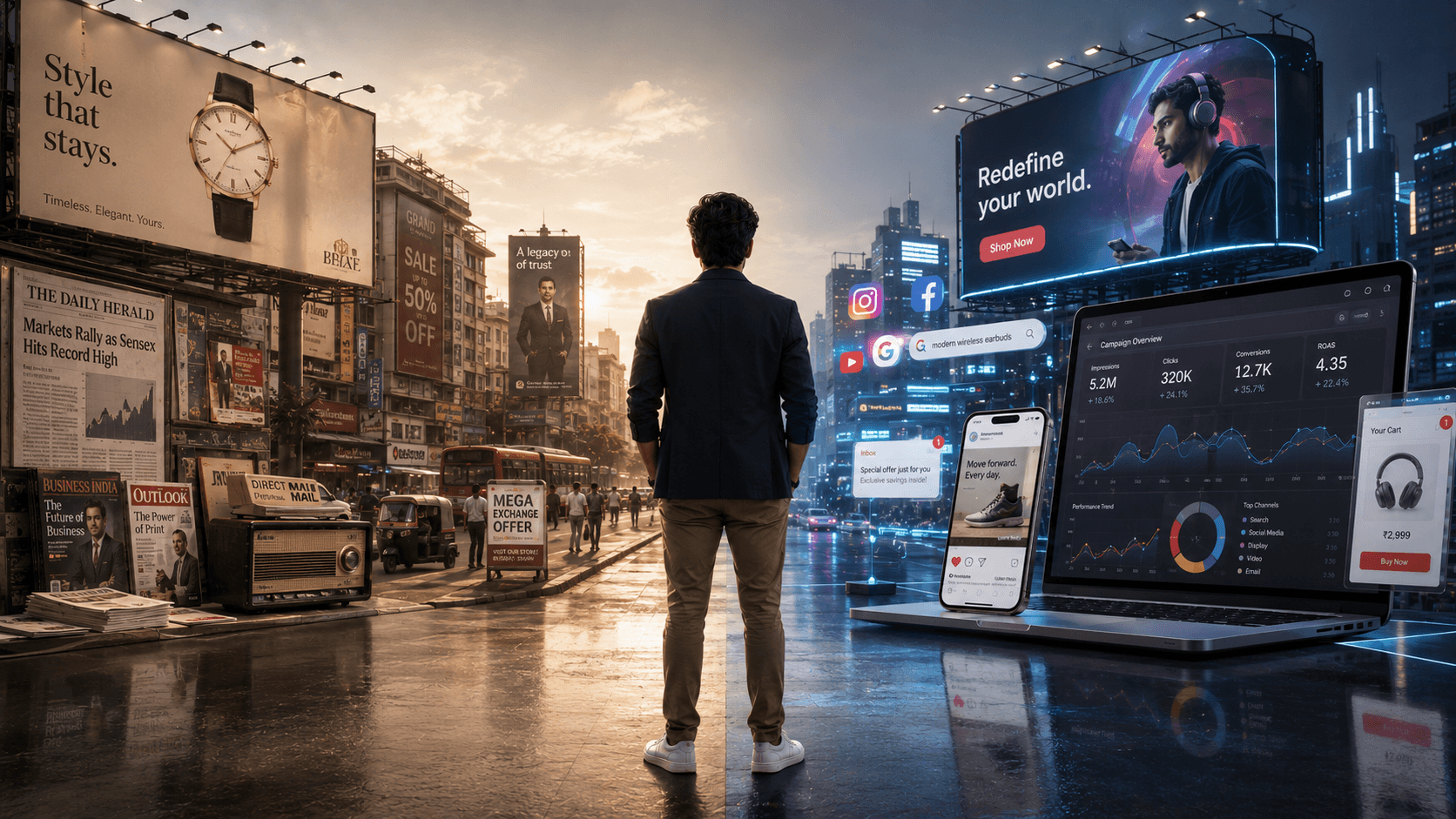
The first group is traditional marketing.
The second is digital marketing.
And that brings us to the question almost every beginner eventually asks:
Traditional marketing vs digital marketing: which one is better?
The answer isn’t as simple as “digital is new, so digital wins.”
Traditional marketing still works.
Digital marketing has transformed how businesses reach people.
And in many cases, the smartest strategy is to use both.
The real question is:
Where are your customers, what are you trying to achieve, and which marketing channels are best suited to that job?
Let’s break it down.
Traditional Marketing vs Digital Marketing in Simple Terms
At the simplest level:
Traditional marketing uses established offline channels to communicate with customers.
Examples include:
- Television
- Radio
- Newspapers
- Magazines
- Billboards
- Posters
- Flyers
- Brochures
- Direct mail
- Events
- Outdoor advertising
Digital marketing uses digital and internet-connected channels to reach, engage and convert customers.
Examples include:
- Search engines
- Websites
- Social media
- Online advertising
- SEO
- Content marketing
- Influencer marketing
- Mobile apps
- Online marketplaces
But the difference goes deeper than offline vs online.
The more important differences are how each approach reaches people, how precisely audiences can be selected, how quickly campaigns can be changed, how performance can be measured, and where each channel fits into the customer journey.
What Is Traditional Marketing?
Traditional marketing refers to marketing activities that primarily use offline media and physical channels to reach customers.
These methods existed long before smartphones, social media and search engines.
A business can advertise on television.
A local restaurant can distribute flyers.
A real-estate company can put up billboards.
A newspaper can carry an advertisement for a new store.
A company can sponsor a cricket match or participate in a trade exhibition.
The technology may be older, but the objective is the same:
Get the right people to notice, understand and consider a business or its offering.
Common Types of Traditional Marketing
Let’s return to our mango farmer, Rahul.
Suppose Rahul wants to sell more mangoes during the summer.
He has several traditional marketing options.
Newspaper Advertising
Rahul could place an advertisement in a local newspaper announcing that fresh Alphonso mangoes are available at his farm.
People reading the newspaper may notice the advertisement and decide to visit.
Television Advertising
If Rahul’s business becomes large enough, he could advertise on television.
A commercial shown during a popular programme or sporting event could put his brand in front of a very large audience.
Radio Advertising
Rahul could run a short radio advertisement targeting people in the surrounding area.
Someone driving home might hear about the farm and decide to stop on the way.
Billboards and Outdoor Advertising
Rahul could place a billboard near a busy highway.
Thousands of people passing through the area might see the message.
Some may remember the farm when they are ready to buy mangoes.
Flyers and Pamphlets
Rahul could distribute flyers in nearby housing societies.
This would be particularly useful if his target customers are concentrated in a specific local area.
Events and Sponsorships
Rahul could participate in a local food festival or sponsor a community event.
Instead of simply showing an advertisement, he gets an opportunity to put the business into a real-world experience.
That’s another important strength of traditional marketing.
It can put a brand directly into the physical environment where people live, travel and interact.
Why Traditional Marketing Still Works
It’s easy to assume that traditional marketing must be outdated because digital marketing has grown so quickly.
But that’s not how marketing works.
A channel doesn’t become ineffective simply because a newer channel exists.
People still:
- Watch television
- Listen to radio
- Read newspapers and magazines
- Drive past billboards
- Visit physical stores
- Attend events
- Receive printed material
If a particular audience still consumes a particular medium, that medium can still be useful.
For example, a local restaurant opening in a neighbourhood may get more value from local signage, flyers, outdoor advertising and community events than from trying to reach people across the entire country with online advertising.
The right channel depends on the customer.
Advantages of Traditional Marketing
Traditional marketing has several important strengths.
1. It Can Create Broad Awareness
Television, radio and outdoor advertising can expose a message to a large number of people.
This can be particularly useful for businesses selling products to broad markets.
2. It Can Be Powerful Locally
A business that serves a specific geographic area doesn’t necessarily need global reach.
A billboard near a store, a local newspaper advertisement or flyers distributed nearby can reach exactly the community the business depends on.
3. It Creates Physical Presence
A physical advertisement can make a business feel tangible.
A billboard.
A storefront.
A printed brochure.
A branded event.
A product display.
These are experiences that exist in the physical world.
4. It Can Reinforce Brand Recognition
Think about the large advertisements you see on highways, at airports or around major sporting events.
You may not purchase the product immediately.
But repeated exposure can help make the brand familiar.
That familiarity can matter when the customer eventually enters the market.
5. It Can Reach Offline Audiences
Not every customer spends their time scrolling through Instagram or searching Google.
Some audiences continue to consume traditional media heavily.
If your customers are there, your marketing should be there too.
Limitations of Traditional Marketing
Traditional marketing has weaknesses as well.
1. Measurement Can Be More Difficult
Suppose Rahul puts an advertisement in a newspaper.
He can estimate the number of people who received or potentially saw the newspaper.
But how many people actually noticed his advertisement?
How many became interested?
How many visited the farm because of it?
How many bought mangoes?
Those questions can be difficult to answer precisely.
There are ways to improve measurement, such as unique phone numbers, promotional codes, dedicated URLs and customer surveys, but offline attribution is often less direct.
2. Campaigns Can Be Harder to Change
Imagine Rahul discovers that his newspaper advertisement contains the wrong phone number.
The newspaper has already been printed.
He can’t simply log in and edit it.
He has to wait for the next advertisement or pay to publish another one.
That makes traditional campaigns less flexible than many digital campaigns.
3. Targeting Can Be Less Granular
Traditional media can certainly target audiences.
A business can choose a particular newspaper, television programme, radio station, location or event based on the audience it attracts.
But many digital platforms offer more granular audience selection and optimisation options.
4. Some Channels Require Significant Upfront Investment
Television commercials, large billboards and major print campaigns can require substantial budgets.
That doesn’t mean traditional marketing is always expensive.
A local flyer campaign may be inexpensive.
The point is that some traditional channels have relatively high entry costs.
What Is Digital Marketing?
Now let’s return to Rahul’s mango farm.
His traditional marketing is bringing in some customers.
But Rahul notices something interesting.
Some younger customers tell him:
“I saw your Instagram Reel.”
Another says:
“I found your farm on Google.”
Someone else says:
“My friend shared your post in our WhatsApp group.”
Rahul realises that customers aren’t discovering his business only through newspapers, billboards and flyers.
They’re discovering it online.
That’s where digital marketing comes in.
Digital marketing is marketing conducted through digital channels and technologies, particularly internet-connected platforms.
Digital marketing allows businesses to reach people through the places where they increasingly spend time, search for information, compare options, communicate with others and make purchases.
Common Types of Digital Marketing
Digital marketing is much bigger than social media.
Search Engine Optimisation
SEO helps businesses make their websites and content more discoverable when people search for relevant information, products or services.
If someone searches:
“Best mangoes in Ratnagiri”
and Rahul’s website appears, he has earned an opportunity to attract that customer.
Search Advertising
Businesses can also pay for advertisements that appear when people search for relevant terms.
This can be particularly useful when customers already have a specific need or intent.
Social Media Marketing
Platforms such as Instagram, Facebook, LinkedIn and YouTube allow businesses to:
- Publish content
- Educate customers
- Entertain audiences
- Build communities
- Answer questions
- Collect feedback
- Promote products
Content Marketing
Businesses can create:
- Blog posts
- Videos
- Guides
- Podcasts
- Case studies
- Newsletters
- Tutorials
Instead of constantly saying “Buy from us,” content marketing can attract people by being useful.
Email Marketing
Email allows businesses to communicate directly with people who have chosen to hear from them.
It can be used for:
- Newsletters
- Offers
- Product updates
- Educational content
- Customer retention
Influencer Marketing
Businesses can collaborate with creators who already have the attention and trust of a relevant audience.
The key word is relevant.
A creator with one million followers isn’t necessarily more valuable than a creator with fifty thousand highly relevant followers.
Online Advertising
Businesses can advertise across search engines, social platforms, websites, apps, video platforms and other digital environments.
The major advantage is not simply that the advertisement appears online.
It’s the additional ability to define audiences, test creative, collect performance data and optimise campaigns.
Advantages of Digital Marketing
1. More Granular Targeting
Digital platforms can often allow marketers to target audiences using combinations of factors such as:
- Location
- Demographics
- Interests
- Search intent
- Previous interactions
- Website activity
- Other platform-specific signals
This can be extremely useful when a business serves a specific audience.
But digital targeting isn’t magic.
Platforms don’t know everything about everyone, and privacy regulations, platform policies and changes in tracking technology affect what can be targeted and measured.
So the better statement is:
Digital marketing generally provides more granular targeting options than many traditional channels.
2. Better Access to Performance Data
Digital campaigns can provide detailed information about what happened after a campaign was launched.
Depending on the channel and setup, marketers may be able to track:
- Impressions
- Reach
- Clicks
- Click-through rate
- Leads
- Conversions
- Conversion rate
- Cost per acquisition
- Revenue attributed to a campaign
This gives marketers much faster feedback than many traditional channels.
But there’s an important distinction:
Digital marketing is highly measurable. It isn’t perfectly measurable.
Customers can interact with several channels before buying.
Some conversions happen offline.
Tracking can be incomplete.
A customer may see an advertisement, remember the brand, search for it later and purchase without ever clicking the original advertisement.
So attribution still requires careful thinking.
3. Greater Flexibility
Suppose Rahul runs an Instagram advertisement and realises the offer isn’t working.
He can pause the campaign.
Change the creative.
Adjust the audience.
Change the budget.
Test a different message.
This level of flexibility makes digital marketing particularly useful when businesses need to experiment and learn quickly.
4. Lower Barrier to Entry
A small business doesn’t need a television commercial to begin digital marketing.
It can start with:
- A website
- Google Business Profile
- Social media
- Helpful content
- Small paid campaigns
Starting small doesn’t guarantee success.
But it makes experimentation more accessible.
5. Global Reach
A physical store is limited by geography.
A digital business can potentially reach customers anywhere in the world.
A course creator in India can sell to someone in Singapore.
An Indian software company can acquire customers in the United States.
A small online brand can build an audience far beyond its physical location.
Limitations of Digital Marketing
Digital marketing isn’t perfect either.
1. The Competition Is Enormous
Almost everyone can create a website.
Almost everyone can publish content.
Almost everyone can run an advertisement.
That means getting attention is difficult.
Being online isn’t a competitive advantage by itself anymore.
2. Platforms Control the Environment
Businesses often depend on platforms such as search engines and social networks.
Algorithms change.
Advertising policies change.
Organic reach changes.
Features disappear.
A strategy built entirely around one platform can therefore become fragile.
3. People Are Overwhelmed With Digital Content
Customers see:
- Ads
- Emails
- Videos
- Notifications
- Social posts
- Messages
all day.
So the challenge isn’t simply reaching people.
It’s earning their attention.
And attention alone isn’t enough.
The message also has to be relevant enough to make them care.
4. Privacy Changes How Marketing Works
Digital marketing increasingly operates in a privacy-conscious environment.
Tracking technologies are changing.
Consumers expect more control over their data.
Regulations continue to evolve.
This means marketers have to think carefully about consent, first-party data and responsible measurement.
5. Digital Marketing Requires Constant Learning
Digital platforms change quickly.
New tools appear.
Algorithms change.
Consumer behaviour evolves.
AI is changing how content, advertising, analytics and customer service are handled.
The solution isn’t to chase every new trend.
It’s to understand the fundamentals well enough to adapt when the tools change.
Traditional Marketing vs Digital Marketing: The 7 Biggest Differences
Now let’s compare them directly.
1. Reach
Traditional marketing can reach very large audiences.
A television advertisement during a major sporting event can potentially reach millions of viewers.
A billboard can reach thousands of people travelling through a particular location.
Digital marketing can also reach enormous audiences.
But it can additionally make it easier to define and refine specific audience segments.
So the difference isn’t:
Traditional = large
Digital = small
Both can scale.
The difference is the degree of flexibility available in how the audience is selected and reached.
2. Targeting
Traditional marketing often targets audiences through the characteristics of a medium or location.
For example:
- A business magazine reaches professionals.
- A children’s publication reaches parents and children.
- A billboard near a railway station reaches commuters.
- A local newspaper reaches a regional audience.
Digital marketing can use additional signals such as search behaviour, interests, location and previous interactions.
This generally allows more granular targeting.
3. Measurement
Traditional marketing can be measured, but measurement is often more indirect.
Digital marketing generally provides more immediate and detailed campaign data.
That’s a major advantage when marketers need to test, compare and optimise.
But neither channel should be judged only by the metrics that are easiest to measure.
A billboard might generate brand familiarity without producing an immediately trackable click.
A digital advertisement might generate thousands of clicks without generating profitable customers.
Measurement is useful only when you’re measuring the right thing.
4. Interaction
Traditional advertising is usually more one-directional.
A television commercial communicates a message.
A billboard communicates a message.
A newspaper advertisement communicates a message.
Digital channels allow customers to respond immediately.
They can:
- Click
- Comment
- Share
- Message
- Subscribe
- Review
- Compare
- Purchase
This makes digital channels particularly powerful for ongoing interaction.
5. Flexibility
A billboard, newspaper advertisement or television commercial can be expensive or difficult to change once it has been produced and distributed.
Digital campaigns can often be changed much faster.
That allows marketers to test and optimise continuously.
6. Cost Structure
Digital marketing often allows businesses to start with smaller budgets and scale gradually.
Traditional marketing can have higher production or placement costs for certain channels.
But saying “digital is cheap” would be misleading.
Competitive advertising markets can be expensive.
High-quality content can be expensive.
Influencer campaigns can be expensive.
Large digital campaigns can cost millions.
The better distinction is:
Digital marketing generally offers more flexible entry and budgeting options, not guaranteed low costs.
7. Customer Intent
This is one of the most important differences.
Imagine someone driving past a billboard for a new laptop.
They may not currently be shopping for one.
The advertisement creates awareness.
Now imagine someone searches:
“Best laptop for video editing under ₹1 lakh.”
That person has already expressed a need.
The marketer can respond to that intent.
This is one reason search-based digital marketing can be extremely powerful.
It can reach people when they are actively looking for something.
Traditional marketing can create demand and awareness.
Digital marketing can do that too, while certain digital channels can also respond to existing intent.
Traditional Marketing vs Digital Marketing Comparison
| Factor | Traditional Marketing | Digital Marketing |
|---|---|---|
| Main channels | TV, radio, print, billboards, events | Search, websites, social media, email, online ads |
| Reach | Can be extremely broad | Can be broad or highly segmented |
| Targeting | Usually based on media, geography and audience profile | Often offers more granular targeting |
| Measurement | Often more indirect | Generally more detailed and immediate |
| Interaction | Usually limited | Usually highly interactive |
| Flexibility | Changes can be slower | Campaigns can often be changed quickly |
| Entry barrier | Can be high for some channels | Often easier to start small |
| Customer intent | Often interrupts existing media consumption | Can respond to active intent in channels such as search |
| Physical presence | Strong | Limited unless connected to physical experiences |
| Global reach | Usually constrained by geography and media distribution | Can potentially reach audiences globally |
| Best use cases | Mass awareness, local visibility, physical experiences | Targeted reach, search intent, measurable campaigns, content and engagement |
Which Is Better for Local Businesses?
This is where things get interesting.
Imagine a restaurant that serves people within a five-kilometre radius.
Does it need to reach people across India?
Probably not.
Its customers may discover it through:
- Local signage
- Word of mouth
- Flyers
- Outdoor advertising
- Google Search
- Google Maps
- Online reviews
This is a perfect example of why traditional vs digital isn’t an either/or decision.
A restaurant might use traditional channels to create local visibility and digital channels to help customers discover, evaluate and contact it.
The right combination depends on how customers actually behave.
Which Is Better for an Online Business?
Now imagine an online course, software product or e-commerce brand.
Its potential customers may live across cities or countries.
They may discover the product through:
- YouTube
- Social media
- Online reviews
- Influencers
- Blogs
- Online advertisements
In this situation, digital marketing may naturally play a much larger role.
But even online businesses can benefit from offline marketing when the objective and audience make sense.
There is no rule saying an online business can’t use a billboard.
Is Traditional Marketing Dead?
No.
The idea that traditional marketing is dead comes from confusing the growth of digital media with the disappearance of offline behaviour.
Offline behaviour hasn’t disappeared.
People still watch television.
They still travel past billboards.
They still attend events.
They still visit stores.
They still read printed material.
They still encounter brands in the physical world.
What has changed is the customer journey.
Years ago, someone might discover a business entirely offline.
Today, the journey often crosses multiple channels.
And that is where traditional and digital marketing become much more interesting together.
The Real Change: Customers Move Between Channels
Imagine Rahul puts up a billboard advertising his mango farm.
You notice it while driving.
You don’t stop immediately.
Instead, you search:
“Rahul Mango Farm reviews.”
You find his website.
You watch a few Instagram videos.
You read customer reviews.
You look at the location on Google.
Then you decide to visit.
What happened?
The billboard created awareness.
Search helped you investigate.
Social media gave you more information.
Reviews reduced uncertainty.
Digital channels helped move you toward the decision.
The customer journey crossed offline and online environments.
That’s how marketing actually works in the real world.
Traditional Marketing and Digital Marketing Can Work Together
Instead of treating the two as competitors, businesses can use them to support one another.
Example 1: Billboard + Search
A person sees a billboard.
Later, they search for the brand online.
The billboard creates awareness.
Search captures the interest.
Example 2: Print + QR Code
A magazine advertisement directs customers to a website through a QR code.
The physical advertisement starts the interaction.
The digital experience continues it.
Example 3: Event + Social Media
A company participates in a physical event.
Customers experience the brand offline.
The company then shares videos, photographs and content from the event online.
One activity creates multiple touchpoints.
Example 4: Store + Digital
A customer visits a physical store.
They scan a QR code for more information.
They later receive an offer through an approved digital communication channel.
Offline and online become parts of the same customer experience.
The Best Marketing Strategy Isn’t About Choosing a Channel
This is the lesson most beginners miss.
A business owner sees a competitor running Instagram advertisements and thinks:
“We should run Instagram ads too.”
Another sees a competitor’s billboard and thinks:
“We need a billboard.”
Neither starts with the customer.
The better sequence is:
Customer → Problem → Value → Objective → Channel → Message → Measurement
Not:
Popular channel → campaign → hope
A channel is a tool.
It isn’t the strategy.
You can have a terrible digital marketing strategy.
You can have an excellent traditional marketing strategy.
And you can have a terrible traditional marketing strategy.
The quality of the marketing depends on the thinking behind the channel.
How to Decide Between Traditional and Digital Marketing
Before spending money, ask these questions.
1. Where Do Your Customers Spend Their Time?
If your audience spends significant time with:
- Television
- Radio
- Newspapers
- Physical events
traditional channels may deserve consideration.
If they spend significant time:
- Searching Google
- Watching YouTube
- Using Instagram
- Reading online content
- Shopping online
digital channels may be more relevant.
Don’t follow the newest platform.
Follow your customer.
2. What Are You Trying to Achieve?
Are you trying to create:
- Awareness?
- Leads?
- Sales?
- Store visits?
- App downloads?
- Trial users?
- Repeat purchases?
- Long-term brand preference?
The objective matters.
A billboard may be useful for awareness.
Search advertising may be useful for capturing existing demand.
Email may be useful for retention.
A physical event may be useful for experience and relationship building.
The same business can need different channels for different objectives.
3. Where Is the Customer in the Buying Journey?
A person who has never heard of your business needs something different from someone actively comparing your product.
Think about the journey:
Awareness
The customer discovers you.
Consideration
The customer evaluates you.
Conversion
The customer decides whether to buy.
Retention
The customer decides whether to stay.
Advocacy
The customer decides whether to recommend you.
Different channels can play different roles at different stages.
4. What Is Your Budget?
A small business doesn’t need to imitate the marketing budget of a multinational company.
Start with what you can realistically test.
Learn.
Improve.
Then scale what works.
5. How Quickly Do You Need to Learn and Adapt?
If your business changes offers frequently or you need rapid experimentation, digital channels can provide significant advantages.
If you’re building broad awareness over a long period, traditional media may also have an important role.
A Simple Decision Framework
Here’s the shortcut.
Choose traditional marketing when:
- Your customers strongly consume offline media.
- You need broad awareness.
- Your business depends heavily on local physical presence.
- Physical experiences matter.
- You want to reach audiences through television, radio, print or outdoor media.
- The medium fits your audience and objective.
Choose digital marketing when:
- Customers search for your product or service online.
- You need more granular audience targeting.
- You want rapid testing and optimisation.
- You need detailed campaign data.
- Your business operates primarily online.
- You want to reach customers across geographic boundaries.
- You want ongoing digital engagement.
Consider using both when:
- Your customers move between online and offline channels.
- You need broad awareness and measurable follow-up.
- Your business has both physical and digital touchpoints.
- Different customer segments consume different types of media.
- You want one channel to create awareness and another to capture demand.
So, Which One Is Better?
There is no universal winner.
If you sell a product to a mass audience, television may be incredibly valuable.
If people actively search for your service, search marketing may be more effective.
If you run a local restaurant, a combination of local visibility, Google presence, reviews and social media may make more sense.
If you run a global software company, digital channels may naturally dominate.
The right answer depends on the situation.
That’s why asking:
“Is traditional marketing better than digital marketing?”
isn’t particularly useful.
A better question is:
“Which channel is most capable of helping me achieve my objective with the audience I want to reach?”
That’s the question a marketer should be asking.
The Bottom Line
Traditional marketing isn’t dead.
Digital marketing isn’t automatically better.
And neither one is a strategy by itself.
Traditional marketing can help businesses create broad awareness, establish physical presence and reach audiences through established media.
Digital marketing can provide more granular targeting, detailed performance data, rapid experimentation, search visibility and ongoing interaction.
And when customers move between physical and digital environments, the two can work together.
The smartest marketers don’t choose a channel because it’s fashionable.
They start with the customer.
They understand the objective.
They understand the buying journey.
Then they choose the channels that make sense.
Because marketing isn’t about being traditional or digital.
It’s about being relevant.
Frequently Asked Questions
What is the main difference between traditional marketing and digital marketing?
Traditional marketing primarily uses offline channels such as television, radio, newspapers, billboards and events.
Digital marketing uses digital channels such as search engines, websites, social media, email and online advertising.
The deeper differences involve targeting, measurement, interaction, flexibility and customer intent.
Is digital marketing better than traditional marketing?
Not necessarily.
Digital marketing often offers greater flexibility, targeting and measurement.
Traditional marketing can be highly effective for mass awareness, local visibility, physical experiences and audiences that consume offline media.
The right choice depends on the customer, objective, budget and buying journey.
Is traditional marketing still effective in 2026?
Yes.
Traditional marketing continues to be used across industries.
Television, radio, print, outdoor advertising, events and other offline channels can still be effective when they reach the right audience and support the right objective.
Is social media marketing the same as digital marketing?
No.
Social media marketing is one part of digital marketing.
Digital marketing also includes SEO, search advertising, email marketing, content marketing, websites, online advertising and other digital channels.
Is digital marketing cheaper than traditional marketing?
Digital marketing often has a lower barrier to entry and allows businesses to start with smaller budgets.
However, it isn’t automatically cheap.
Competitive advertising markets, professional content production, influencers and large campaigns can all become expensive.
Which is better for a small business?
It depends on the business.
A local restaurant may benefit from signage, flyers, local events, Google Search, reviews and social media.
An online business may rely much more heavily on digital channels.
Start with your customers and your objective rather than assuming one channel is always better.
Can traditional and digital marketing be used together?
Yes.
In many cases, they work extremely well together.
For example, a billboard can create awareness while search, social media and a website help interested customers learn more and take action.
Is traditional marketing dead?
No.
Traditional marketing remains relevant because people still consume offline media and interact with brands in physical environments.
What has changed is that customer journeys increasingly cross between offline and digital channels.
Which marketing is better for building brand awareness?
Both can contribute to brand awareness.
Traditional channels such as television, radio and outdoor advertising can provide broad exposure.
Digital channels can also build awareness through video, social media, content, search and online advertising.
The best choice depends on the audience, reach required and overall strategy.
Which marketing is easier to measure?
Digital marketing generally provides more detailed and immediate performance data.
However, digital attribution is not perfect, and traditional marketing can also be measured using methods such as surveys, promotional codes, dedicated URLs and response tracking.
What should a beginner learn first: traditional or digital marketing?
Learn marketing fundamentals first.
Understand customers, value, positioning, objectives, customer journeys and measurement.
Then learn traditional and digital channels as tools for applying those principles.
Tools change.
The underlying marketing logic lasts much longer.
Final Takeaway
Traditional marketing and digital marketing are not two teams waiting to defeat each other.
They are two sets of tools.
Sometimes one is more appropriate.
Sometimes the other is.
And sometimes the strongest strategy uses both.
The key is not asking:
“Traditional or digital?”
Ask:
“Who am I trying to reach, what do I want them to do, and where can I most effectively reach them?”
Once you start thinking that way, choosing marketing channels becomes much easier.
Don’t choose the channel first. Choose the strategy first.
Leave a Reply