




Imagine Rahul has finally opened the burger restaurant he’s been dreaming about.
The burgers are good.
Really good.
He uses fresh ingredients, the prices are reasonable, the restaurant looks great, and his friends keep telling him:
“You’re going to do really well.”
So Rahul opens the doors and waits.
One hour passes.
Two customers walk in.
Another hour passes.
Still nothing.
Rahul starts wondering:
“If my burgers are good, why isn’t anyone coming?”
The next morning, he calls a friend who works in marketing.
His friend asks him three questions.
“What do you want your restaurant to be known for?”
Rahul isn’t sure.
“Who exactly are you trying to serve?”
Rahul thinks for a moment.
“Anyone who likes burgers?”
His friend smiles.
Then comes the third question:
“How are those people supposed to know you exist?”
Rahul suddenly realises that he has been thinking about only one part of the business.
He has a product.
But he hasn’t figured out how to make that product meaningful to a particular group of people, how he wants the business to be perceived, or how to reach those people.
This is where three commonly confused concepts come in:
Branding. Marketing. Advertising.
People often use these words as if they’re interchangeable.
They’re not.
They are connected, but they solve different problems.
And once you understand the difference, a lot of marketing suddenly becomes easier to understand.
Branding, Marketing and Advertising in Simple Words
Let’s start with the simplest explanation.
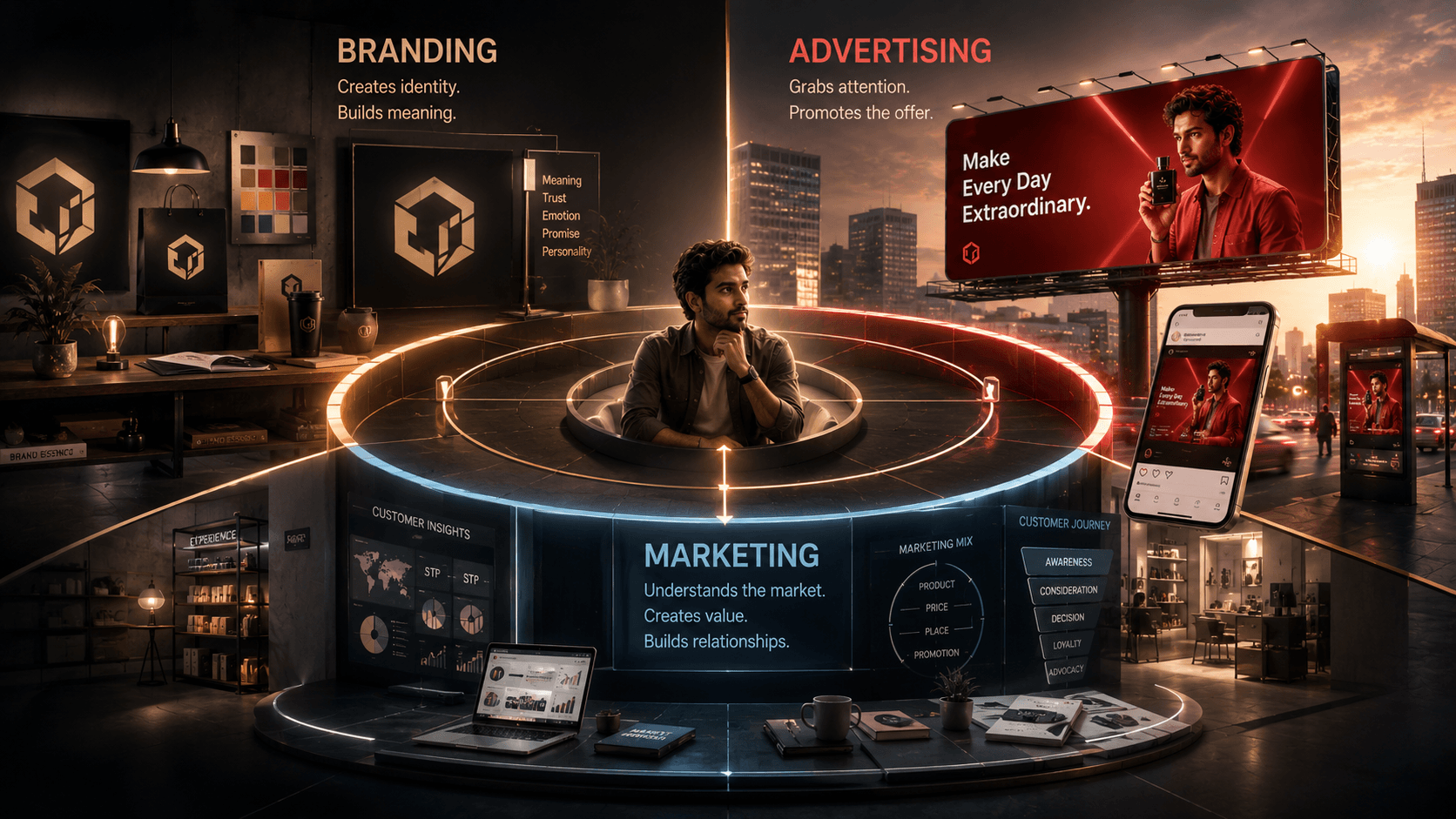
Branding is about shaping the identity and associations you want people to build around your business.
Marketing is about understanding customers, creating and delivering value, and making strategic decisions about how your business will compete and grow.
Advertising is about paying to place a promotional message in front of an audience.
So, if we reduce everything to three questions:
Branding: What should people know and associate with us?
Marketing: Who are we serving, what value are we creating, and how will we compete?
Advertising: How will we pay to get a particular message in front of an audience?
That’s the basic distinction.
But there’s a little more to it.
What Is Branding?
A brand is not simply a logo.
It’s not just your colours.
And it’s not the font you use on your website.
Those things are part of brand identity, but branding goes beyond visual design.
Branding is the deliberate work of shaping how your business presents itself and the associations you want people to build around it.
Let’s go back to Rahul.
Rahul doesn’t want his restaurant to be remembered as just another burger shop.
He wants people to think:
“That’s the burger place for students who want good food without waiting forever.”
Now he has something to build around.
His name, visual identity, tone of voice, menu, packaging, restaurant atmosphere and customer experience can all reinforce that idea.
That’s branding.
The logo is part of it.
The colours are part of it.
The restaurant design is part of it.
But the meaning people attach to the business is what makes branding much bigger than graphic design.
Your Logo Is Not Your Brand
This is probably the most common branding misunderstanding.
A business creates a logo and says:
“We’ve built our brand.”
Not quite.
A logo helps people recognise you.
It doesn’t automatically determine what they think about you.
Imagine two restaurants using equally attractive logos.
One consistently serves excellent food, treats customers well and delivers exactly what it promises.
The other has slow service, inconsistent food and unhappy customers.
The logos might look equally impressive.
The brands won’t feel equally impressive.
Why?
Because people don’t experience a logo in isolation.
They experience the business.
Every interaction adds another piece to their perception.
That’s why branding is not simply about making a business look good.
It’s about creating recognisable and consistent meaning around the business.
What Is Marketing?
Marketing is much broader.
At its core, marketing is about understanding customers and the market, creating value for them, communicating that value, delivering the offering, and facilitating exchange.
For Rahul, marketing means asking questions such as:
- Who are my most important customers?
- What do they need?
- What problem are they trying to solve?
- What kind of burger would they actually want?
- How much are they willing to pay?
- Where do they prefer to buy food?
- What alternatives do they have?
- Why would they choose my restaurant?
- How can I reach them?
- How can I encourage them to come back?
Notice something important.
Rahul hasn’t created a single advertisement yet.
He’s already doing marketing.
That’s because marketing is not simply promotion.
Marketing can influence decisions about the product, price, distribution, positioning, communication and customer relationships.
Advertising is only one piece of that much larger puzzle.
Marketing Is Not Just “Posting on Instagram”
This is another common misunderstanding.
A business posts three times a week on Instagram.
It runs a few ads.
It sends some WhatsApp messages.
And someone says:
“We’re doing marketing.”
Maybe.
But those are marketing activities, not the entire discipline of marketing.
Suppose Rahul discovers that students near his restaurant have only 20 minutes between lectures.
They want something filling.
They don’t want to spend too much.
And they don’t want to wait 30 minutes for their food.
Rahul could simply advertise his existing burgers.
Instead, he decides to create a student lunch combo that fits those needs.
Now he’s making a marketing decision.
He has used customer understanding to shape the offer.
That’s why marketing begins before communication.
Before you promote something, you need something worth promoting to someone who actually wants it.
What Is Advertising?
Advertising is narrower.
It is paid communication used to promote a product, service, brand or message to an audience.
When Rahul pays Instagram to show an offer to students near his restaurant, that’s advertising.
When a company pays for a television commercial, that’s advertising.
When a business pays for a billboard, that’s advertising.
When a company pays for a search ad, that’s advertising.
Advertising can appear across many channels:
- Search engines
- Social media
- Television
- Radio
- Newspapers
- Websites
- Billboards
- Streaming platforms
- Apps
The important characteristic is that the business is paying for placement or distribution of the message.
Advertising can be incredibly useful.
But it has a limitation:
Advertising can amplify a message. It cannot decide whether the underlying offer is valuable.
That’s where marketing comes in.
A Simple Example
Let’s say Rahul has discovered that students want quick, affordable meals.
He creates a student combo:
Burger + fries + drink
He prices it affordably.
He makes sure the kitchen can prepare it quickly.
He decides to target students within a few kilometres of the restaurant.
He creates the message:
“Between lectures? Grab a fresh burger meal in 10 minutes.”
Now look at what happened.
Rahul understood a customer need.
He created an offer around that need.
He decided on the price.
He chose the audience.
He developed the message.
That’s marketing.
Then he pays Instagram to put that message in front of students nearby.
That’s advertising.
And the consistent identity and associations Rahul is building around the restaurant are part of branding.
Same business.
Different jobs.
Branding vs Marketing vs Advertising
Here’s the distinction at a glance:
| Branding | Marketing | Advertising | |
|---|---|---|---|
| Main focus | Identity, meaning and associations | Customers, value, strategy and growth | Paid promotional communication |
| Main question | “What should people associate with us?” | “Who do we serve, what value do we create, and how do we compete?” | “How do we get this message in front of this audience?” |
| Typical activities | Brand identity, positioning, voice, experience, consistency | Research, segmentation, targeting, product, pricing, distribution, communication, retention | Search ads, social ads, TV, radio, billboards, sponsored placements |
| Example for Rahul | Build a friendly, student-focused burger brand | Create and price a student meal based on customer needs | Pay Instagram to promote the meal |
The boundaries aren’t perfectly rigid.
Branding can influence marketing.
Marketing can shape the brand.
Advertising can strengthen or weaken brand associations.
But the concepts shouldn’t be treated as synonyms.
They are connected systems with different primary jobs.
Why Marketing Is Bigger Than Advertising
This distinction is worth spending time on because it causes enormous confusion.
Imagine Rahul says:
“We need more marketing.”
What does he actually need?
Maybe more advertising.
But maybe not.
Perhaps his restaurant isn’t attracting customers because:
- His prices are too high.
- His menu doesn’t fit local demand.
- His target customer is unclear.
- His location is inconvenient.
- His value proposition is weak.
- His product isn’t differentiated.
- His delivery experience is poor.
- His customers don’t understand what makes him different.
None of those problems can automatically be solved by buying more ads.
Advertising can make more people aware of the offer.
But if the offer itself isn’t right, you’re simply introducing more people to the wrong thing.
That’s why marketing has to come before the question:
“How much should we spend on advertising?”
The better question is:
“What are we trying to achieve, for whom, and why should they care?”
Once that’s clear, advertising becomes much more useful.
What Happens When You Skip Marketing?
Let’s say Rahul jumps straight into advertising.
He spends ₹50,000 on Instagram ads.
The ads reach thousands of people.
But Rahul hasn’t really decided who his best customers are.
His message is:
“Best burgers at amazing prices!”
Students see it.
Families see it.
Office workers see it.
Tourists see it.
Almost everyone is included.
And because the message is trying to appeal to everyone, it doesn’t feel particularly relevant to anyone.
Rahul has spent money.
But he hasn’t necessarily solved the underlying problem.
This is one of the biggest mistakes businesses make:
They use advertising to compensate for a lack of marketing strategy.
More reach doesn’t fix an unclear offer.
More impressions don’t fix weak positioning.
More clicks don’t fix a product nobody wants.
Advertising can make a good strategy louder.
It cannot replace the strategy.
What Happens When You Skip Branding?
Now imagine Rahul has a decent marketing strategy but pays little attention to the identity of his business.
His Instagram page looks premium.
His restaurant looks playful.
His website sounds corporate.
His packaging uses completely different colours.
His advertisements talk about cheap student meals.
Customers encounter a different version of Rahul’s business everywhere they go.
Again, the business doesn’t automatically fail.
But something important becomes harder:
building a clear mental picture of the brand.
A customer may remember the food.
But what do they remember about the business?
What does it stand for?
Who is it for?
What makes it recognisable?
What should they expect the next time they see it?
Branding helps answer those questions consistently.
What Happens When You Skip Advertising?
Now let’s flip the situation.
Rahul has:
- A good product
- A clear customer
- A strong value proposition
- A recognisable brand
- A sensible marketing strategy
But almost nobody knows the restaurant exists.
He may get some customers through location and word of mouth.
But reaching new customers becomes difficult.
This is where advertising can help.
Advertising can buy attention and awareness at scale.
It can introduce the business to people who haven’t discovered it yet.
It can promote a new product.
It can drive traffic.
It can generate leads.
It can encourage a purchase.
It can also contribute to brand building when the communication is consistent over time.
So advertising isn’t the villain in this story.
It’s simply a tool.
And like any tool, its effectiveness depends on what you’re using it to accomplish.
The Role of Positioning
There’s another concept sitting quietly underneath all three:
Positioning.
This matters because branding, marketing and advertising become much easier when the business knows what position it wants to occupy in the customer’s mind.
Suppose Rahul says:
“We sell burgers to everyone.”
That’s not much of a position.
Now suppose he decides:
“We are the fast, affordable burger option for college students who don’t have time for a long lunch.”
Now things start becoming clearer.
His positioning gives the business a strategic direction.
His value proposition explains the value he offers to that customer.
His branding helps make that position recognisable and memorable.
His marketing determines how he creates, delivers and communicates that value across the market.
His advertising can then put specific messages in front of the people he wants to reach.
These concepts are not isolated.
They form a chain of decisions.
Where Does the Value Proposition Fit?
This connects directly to another important marketing concept.
Remember our earlier value proposition:
“Fresh burgers for busy college students, ready in 10 minutes.”
That isn’t the brand.
It isn’t the entire marketing strategy.
And it isn’t an advertisement.
It’s a clear expression of customer value.
It tells Rahul’s target customer what they can expect and why the offer may be relevant to them.
You can think about the relationship like this:
Positioning defines the place you want to occupy.
Value proposition explains the value you offer to the target customer.
Branding helps people recognise and associate that meaning with your business.
Marketing turns the strategy into decisions and actions across the customer and market.
Advertising is one paid communication tool used to reach an audience.
Once you see these connections, the three terms stop looking like competing definitions and start looking like parts of a larger system.
Is Branding the Foundation of Marketing?
You’ll often hear:
“Branding comes first. Then marketing. Then advertising.”
It’s a useful way to introduce the concepts, but don’t take it too literally.
Real businesses aren’t assembly lines.
You don’t “finish branding” on Monday, “start marketing” on Tuesday and launch your first advertisement on Wednesday.
The activities influence one another.
Marketing research can reveal that customers perceive the brand differently than expected.
Advertising results can reveal which messages resonate.
Customer experiences can strengthen or weaken the brand.
A change in positioning can affect the marketing strategy.
A new product can require a change in brand communication.
So instead of thinking:
Branding → Marketing → Advertising
think:
Branding ↔ Marketing ↔ Advertising
They interact.
But interaction doesn’t erase the differences between them.
Can a Small Business Benefit From Branding?
Absolutely.
Branding isn’t reserved for companies with enormous budgets.
A local café can have a brand.
A salon can have a brand.
A freelancer can have a brand.
A tuition centre can have a brand.
An online store can have a brand.
A neighbourhood bakery can have a brand.
The scale of the business doesn’t determine whether branding matters.
What matters is whether customers can form clear associations around the business.
A small café that consistently feels warm, local and personal is building a brand.
A freelancer who becomes known for explaining complex ideas simply is building a brand.
A bakery known for one particular style of celebration cake is building a brand.
The budget may be small.
The impression can still be strong.
Can Advertising Build a Brand?
Yes, but advertising isn’t the brand.
Think about it this way.
Advertising can tell people:
“This is what we want you to know about us.”
The customer’s experience eventually tells them:
“This is what we actually think about you.”
If those two stories match, advertising can reinforce the brand.
If they don’t, the mismatch becomes a problem.
Imagine Rahul runs beautiful advertisements promising:
“The fastest fresh burgers in town.”
But customers regularly wait 30 minutes.
The advertisement has done its job.
It got attention.
The problem is that the business didn’t deliver the promise.
The result may be disappointment rather than stronger brand equity.
So:
Advertising can communicate a promise. The business experience has to support it.
What Should a Small Business Focus On?
This is probably the most practical question in the entire article.
If you’re a small business owner, you don’t need to think:
“Should I do branding or marketing or advertising?”
You need to ask what problem you’re currently trying to solve.
If people don’t understand what your business stands for, work on your positioning and brand.
If you don’t understand your customers or what they actually want, work on your marketing strategy and customer research.
If you have a strong offer but not enough people know about it, advertising may help.
If people know you but don’t see a reason to choose you, your value proposition or positioning may need work.
If people buy once but don’t return, look beyond advertising and examine the product, experience, value and customer relationship.
This is a much better way to think about the three concepts.
Don’t ask:
“Which one is more important?”
Ask:
“What business problem am I trying to solve?”
Then choose the appropriate tool.
A Simple Framework to Remember
If all of this still feels like a lot, remember Rahul.
Positioning
Where do we want to stand in the customer’s mind?
Value Proposition
What valuable reason do we give that customer to choose us?
Branding
How do we make that meaning recognisable and consistent?
Marketing
How do we create, deliver and communicate that value in the market?
Advertising
How do we pay to put a specific message in front of an audience?
That’s the bigger picture.
And it explains why simply “running ads” is not the same thing as “doing marketing”.
The Rahul Test
Let’s return to Rahul one last time.
At the beginning, Rahul thought:
“I have a good burger. People will come.”
Now he understands the bigger picture.
He identifies the customers he wants to serve.
He understands what they value.
He creates an offer around those needs.
He decides what he wants the restaurant to be known for.
He builds a consistent identity around that idea.
He creates a marketing strategy to reach and serve those customers.
And when he wants to put a particular offer in front of more students, he uses advertising.
Now every activity has a job.
The brand isn’t just decoration.
The marketing isn’t just social media posting.
The advertising isn’t just “boosting a post”.
Everything is connected to a business objective.
And that’s the real lesson.
The Biggest Lesson
Branding, marketing and advertising aren’t three separate departments competing for attention.
They’re different activities that contribute to the same larger goal:
creating value for customers and building a business that customers choose.
Branding helps shape meaning.
Marketing connects the business with the market.
Advertising buys attention for specific messages.
None of them can magically replace the others.
A brilliant advertisement can’t rescue an irrelevant offer.
A beautiful brand can’t compensate forever for a poor customer experience.
A clever marketing strategy can’t grow indefinitely if nobody knows the business exists.
But when the pieces fit together, something powerful happens.
The right people understand what you offer.
They recognise you.
They see why you’re relevant.
They encounter a consistent message.
And when the experience matches the promise, they have a reason to come back.
Final Takeaway
So, what’s the difference between branding, marketing and advertising?
Here’s the simplest answer:
Branding shapes what your business means.
Marketing decides how you create and deliver value in the market.
Advertising pays to put a message in front of an audience.
Don’t confuse the logo with the brand.
Don’t confuse the advertisement with the marketing strategy.
And don’t confuse attention with demand.
A strong business knows who it wants to serve, what value it creates, what it wants to be known for, and how to communicate that value.
Branding gives that value meaning. Marketing turns it into a market strategy. Advertising helps put the message in front of people.
That’s the difference.
Leave a Reply