
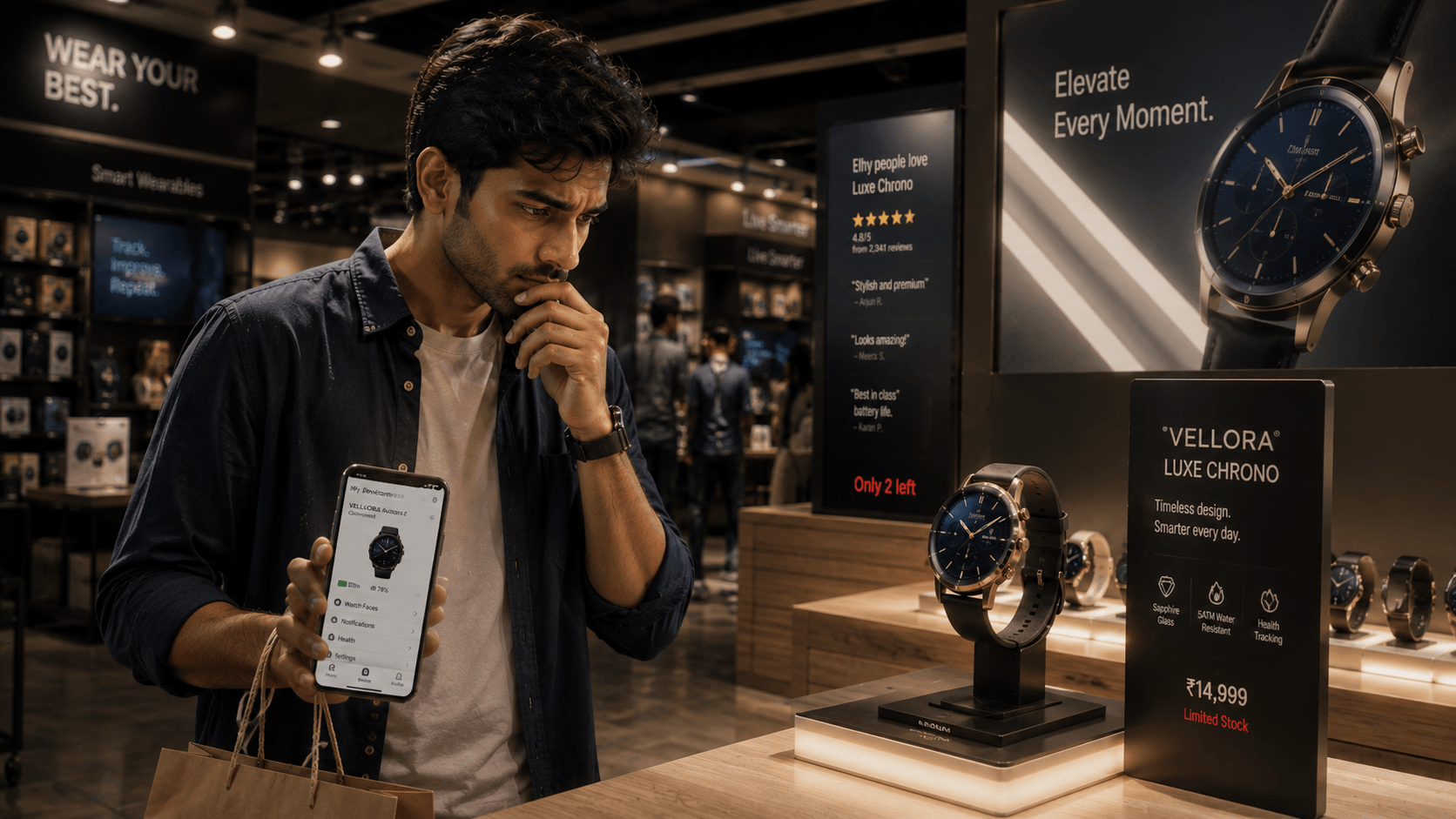




You Went to Buy One Thing…
You walk into a shopping mall on a Saturday afternoon to buy a pair of shoes.
That’s it.
Twenty minutes later, you’ve found the perfect pair. You should be heading home.
Then you see a leather belt.
“That would look good with these shoes.”
A few steps later, there’s a jacket.
“The shoes would look even better with this.”
Then you notice a watch. Then a wallet. Then sunglasses.
You came looking for one thing and leave with four shopping bags.
When you get home, everything feels exciting. The shoes look great with the belt. The jacket completes the outfit. The new watch makes the whole thing feel even better.
A few days later, the excitement fades. The shopping bags disappear into the cupboard and life returns to normal.
Sound familiar?
This happens because people don’t always buy things for their practical function.
We buy what those things represent.
A new phone can represent being up to date. A luxury watch can represent success. A pair of running shoes can represent the healthier, more disciplined person we want to become.
The product is physical.
The reason we want it often isn’t.
That’s why people queue for a new phone when their existing one still works perfectly, buy clothes despite having a wardrobe full of them, or purchase gadgets that seemed essential on Friday and are forgotten by Monday.
We’re not simply buying objects.
We’re buying feelings, identities, experiences and possibilities.
And this is where consumer psychology becomes particularly interesting.
Because if people don’t buy things simply because they need them, what exactly makes something feel like a need in the first place?
What Do We Actually Need?
Let’s make the question simpler.
Imagine you’re stranded somewhere with only the basics available.
What would you need?
Food. Water. Shelter. Basic clothing. Medicine.
The list is surprisingly short.
Now look around your home.
You’ll probably find multiple pairs of shoes, clothes you rarely wear, kitchen gadgets you bought with good intentions, books you’ve been meaning to read and a drawer full of old phone chargers that somehow survived every attempt at decluttering.
None of these things are essential for survival.
Yet they’re part of our everyday lives.
Why?
Because humans don’t live only to survive.
We also want comfort, convenience, security, belonging, achievement and recognition. We want to express who we are and, sometimes, who we wish we were.
That makes the distinction between needs and wants much more complicated than it first appears.
Needs vs Wants
On paper, the difference seems obvious.
You need food.
You want pizza from your favourite restaurant.
You need clothes.
You want the latest trainers.
You need a phone.
You want the newest iPhone.
But our perception of a need can change.
Imagine your three-year-old phone still works perfectly. The battery lasts all day, the camera is good enough and it runs all the apps you use.
Then a new model launches.
It has a better camera, a brighter display and a faster processor.
Suddenly, your phone feels old.
Nothing about the phone changed overnight.
Your reference point changed.
Yesterday, your phone was perfectly adequate. Today, you’re comparing it with something newer.
This happens with far more than phones.
Your car still works, but your neighbour buys a new one.
Your wardrobe is full, but a new collection arrives at your favourite clothing brand.
Your laptop does everything you need, but a newer model promises twice the performance.
The object hasn’t necessarily become worse. Your standard has changed.
This is one of the most important things to understand about consumer behaviour: needs are not always objective.
Our perception of what is necessary is influenced by our surroundings, our expectations and the alternatives we see.
We don’t simply ask:
“Does this product solve a problem?”
We also ask, often without realising it:
“Is there something better?”
And once we start comparing, a perfectly good product can begin to feel inadequate.
That’s how a want can slowly acquire the language of a need.
“I want a newer car” becomes:
“I need something more reliable.”
“I want expensive trainers” becomes:
“I need better shoes.”
Sometimes those reasons are completely genuine.
Other times, they’re simply the logical explanation our brain creates for a decision that was driven by something else.
And that “something else” is often emotion.
Your Brain Doesn’t Just Buy Products
Imagine you’re choosing between two coffee shops.
The first has a board outside:
Fresh Coffee. ₹120
The second says:
Handcrafted Coffee. Ethically Sourced. A Space for Creatives.
Both sell coffee.
Both contain caffeine.
Both will probably do the job.
Yet the second description creates a very different impression.
Why?
Because you’re no longer comparing coffee.
You’re comparing meaning.
The first café is selling a drink. The second is selling an experience and, perhaps, a small part of an identity.
This is an important distinction in consumer psychology.
We like to think we make purchasing decisions by comparing prices, features, reviews and specifications.
Sometimes we do.
But before we start rationally comparing features, our brain has already formed an impression of what a product means to us.
A smartwatch might mean convenience to one person, fitness to another and status to someone else.
A premium coffee might mean better taste to one customer and a sophisticated lifestyle to another.
The physical product is the same.
The psychological value isn’t.
This is why two people can look at the same product and have completely different reactions.
One sees a ₹10,000 pair of headphones.
Another sees peace and quiet during a two-hour commute.
One sees an expensive bicycle.
Another sees fitness, freedom and weekend rides.
The product hasn’t changed.
The meaning has.
And that meaning can be powerful enough to influence what we’re willing to pay.
Every Purchase Has a Functional Job and an Emotional Job
A useful way to understand consumer behaviour is to look at what a product does on two levels.
The first is its functional job.
A phone lets you communicate.
A watch tells you the time.
A car gets you from one place to another.
A coffee gives you caffeine.
Then there’s the emotional or psychological job.
The phone can make you feel connected or up to date.
The watch can make you feel successful.
The car can make you feel independent or respected.
The coffee can become part of the experience you associate with productivity, relaxation or socialising.
The functional job explains why a product is useful.
The emotional job often explains why someone chooses one product over another.
This is where marketing becomes more than simply listing features.
If every phone could only be sold by explaining its processor, battery and camera, buying decisions would be much easier.
But consumers don’t buy specifications in isolation.
They buy what those specifications mean for their lives.
A better camera can mean better family photos.
A faster laptop can mean less frustration at work.
A premium mattress can mean better sleep.
A gym membership can represent the intention to become healthier.
The marketer’s job is not to invent these meanings from nothing.
It’s to understand which existing human desire the product can genuinely serve, and communicate that connection clearly.
We Buy Better Versions of Ourselves
Now consider a different kind of purchase.
Someone buys an expensive pair of running shoes.
They haven’t run in months.
But the shoes are excellent. Lightweight. Comfortable. Designed for serious runners.
Along with the shoes come performance clothes, a fitness tracker and a water bottle.
What exactly did that person buy?
Technically, they bought fitness equipment.
Psychologically, they may have bought something else:
the image of themselves as a healthier, more disciplined person.
This happens all the time.
People buy books because they want to become well-read.
They buy guitars because they imagine themselves playing music.
They buy cooking equipment because they picture themselves preparing impressive meals.
They buy language courses because they imagine speaking confidently in another language.
Sometimes these purchases genuinely help us change.
But sometimes the purchase itself creates a temporary feeling of progress.
That’s the trap.
Buying running shoes isn’t the same as running.
Buying books isn’t the same as reading.
Buying a camera doesn’t make you a photographer.
The product can support a new identity, but it cannot build that identity for you.
Actions create identity. Buying the tools is only the beginning.
And brands understand this desire extremely well.
Sports brands don’t simply sell shoes. They sell discipline, performance and achievement.
Travel brands don’t simply sell flights and hotels. They sell adventure and freedom.
Universities don’t simply sell classrooms and courses. They sell opportunity.
Luxury brands don’t simply sell bags or watches. They sell status, taste and exclusivity.
The product is the vehicle.
The customer is buying the possibility of becoming someone different.
The Silent Story Behind a Purchase
Every purchase can contain a small story we tell ourselves.
“If I buy this, I’ll be more organised.”
“If I buy this, I’ll look more professional.”
“If I buy this, people will take me more seriously.”
“If I buy this, I’ll finally start going to the gym.”
“If I buy this, I’ll feel happier.”
Sometimes those stories are true.
A better laptop really can make work easier. A good pair of shoes really can make exercise more comfortable.
But sometimes the purchase becomes a substitute for the change itself.
That’s why understanding consumer psychology matters.
The question isn’t simply:
“Why did this person buy the product?”
It’s:
“What job was the product doing in that person’s mind?”
That question can reveal far more.
It also explains why products that look identical on paper can have dramatically different perceived value.
One person sees a ₹2,000 coffee.
Another sees a place to meet friends after work.
One person sees a ₹5,000 notebook.
Another sees the beginning of the book they’ve always wanted to write.
One person sees a premium gym membership.
Another sees the person they hope to become.
The object is only part of the purchase.
The rest exists inside the customer’s head.
And once we understand that, another psychological effect becomes easier to spot.
Because sometimes buying one thing doesn’t make us satisfied.
It makes us want another thing.
And another.
And another.
That’s the Diderot Effect.
Leave a Reply