
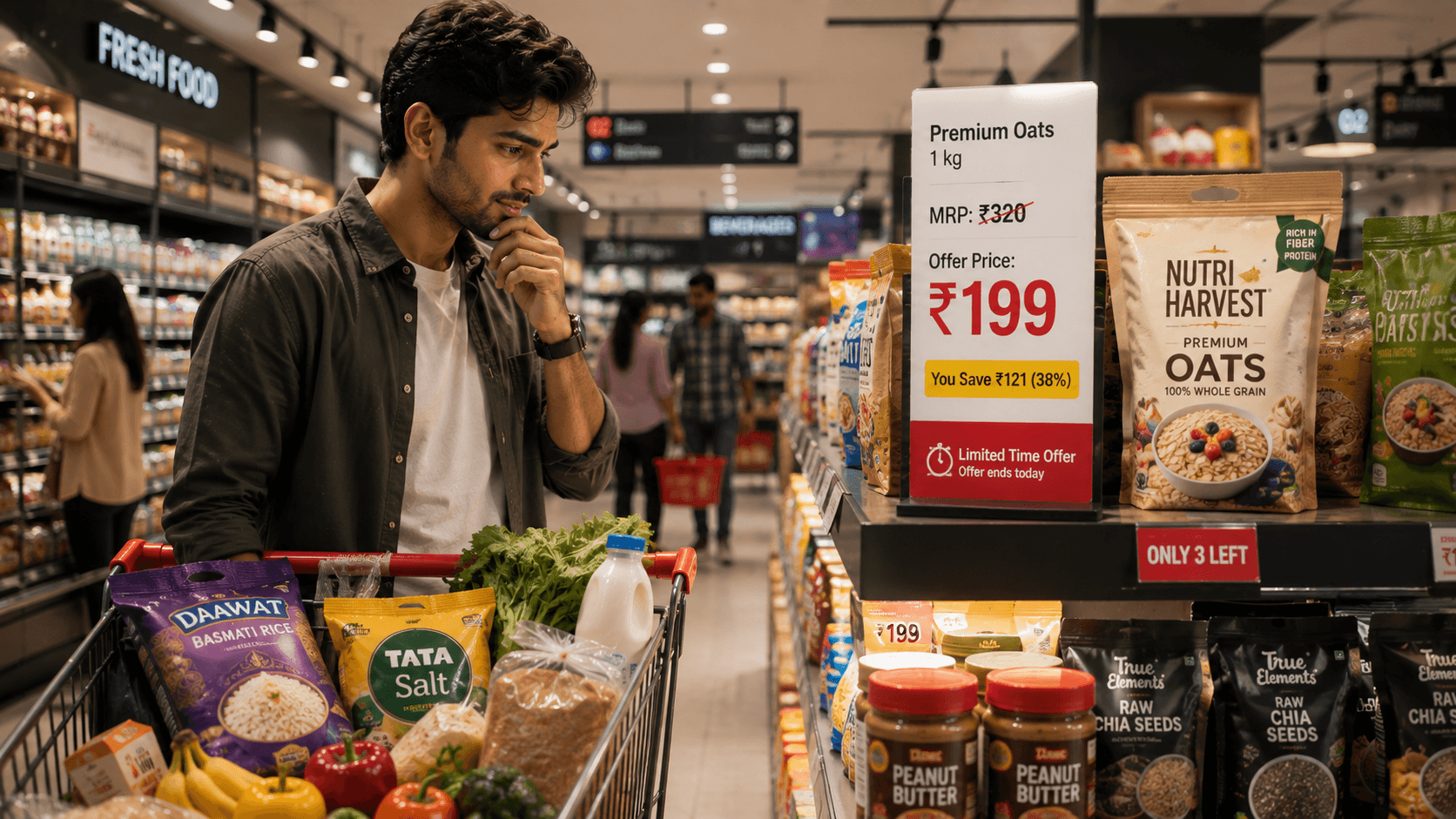




The ₹5,000 You Never Planned to Spend
Imagine walking into a supermarket on a Sunday afternoon.
You need toothpaste.
That’s it.
You pick up your usual tube and head towards the checkout. Then you notice a bright yellow sign:
BUY 2, GET 1 FREE
You weren’t planning to buy shampoo. You don’t particularly need three bottles of it either.
But suddenly, buying two feels sensible.
A few aisles later:
30% OFF
You pick up some biscuits.
Then you shop online later that evening. Your basket is sitting at ₹870.
The website says:
FREE SHIPPING ABOVE ₹999
You could pay ₹70 for delivery.
Or you could add another ₹129 worth of products and get delivery for free.
So you add a packet of coffee.
Then perhaps a phone charger.
By the time you reach checkout, something strange has happened.
You walked into the supermarket planning to spend ₹120.
You’ve now spent several thousand rupees.
And somehow, you don’t feel like you’ve spent too much.
You feel like you’ve saved money.
That’s the strange power of discounts.
The toothpaste hasn’t become better because it’s on sale. The shampoo hasn’t become more useful. The biscuits haven’t suddenly become tastier.
The products haven’t changed.
Your perception of the purchase has.
And that’s the real story behind discount psychology.
A discount can make a purchase feel less like an expense and more like an opportunity. It can create excitement, urgency and the satisfying feeling that you’ve made a clever decision.
That’s why businesses use discounts for far more than simply lowering prices.
A new café might offer 20% off to persuade people to try it for the first time.
A clothing retailer might discount winter jackets to clear old stock.
An e-commerce site might offer free shipping above ₹999 to increase the size of each order.
A restaurant might run a weekday offer to fill tables during quieter hours.
A brand might give existing customers an exclusive offer to encourage them to return.
In each case, the discount is doing something beyond reducing price.
It’s trying to change behaviour.
But why does it work?
To understand that, we need to start with a surprisingly simple question.
What Is a Discount, Really?
At first, the answer seems obvious.
A discount means paying less.
A product that normally costs ₹1,000 is now available for ₹800.
You save ₹200.
Simple.
But psychologically, a discount is much more than a lower number.
Imagine two shops selling exactly the same pair of shoes.
The first displays:
₹4,000
The second displays:
Was ₹6,000
Now ₹4,000
You are paying ₹4,000 either way.
Yet the second offer feels better.
Why?
Because the second shop has given your brain something to compare the price with.
The first shop asks:
“Are these shoes worth ₹4,000?”
The second encourages a different question:
“Am I getting ₹6,000 worth of shoes for ₹4,000?”
That is a very different mental calculation.
The shoes haven’t changed.
Their quality hasn’t changed.
Their usefulness hasn’t changed.
Only the reference point has changed.
And once the reference point changes, the price can feel different.
This is one of the most important ideas in pricing psychology:
People rarely judge a price in isolation. They judge it relative to something.
That something might be the original price, a competitor’s price, another product on the same shelf, or even the amount they expected to spend.
Consider a ₹15,000 smartphone.
On its own, you might think:
“That’s expensive.”
Now place it next to a ₹1,20,000 flagship phone.
Suddenly, ₹15,000 can feel surprisingly reasonable.
The ₹15,000 phone hasn’t become cheaper.
You’ve simply changed the comparison.
This is why the way a price is presented can matter almost as much as the price itself.
A Discount Changes the Question in Your Head
This is where things get interesting for marketers.
When a customer sees a product priced at ₹4,000, they can evaluate the product itself.
Is it good quality?
Will it last?
Do I need it?
Is there a better alternative?
Is it worth ₹4,000?
But show the same product as:
Was ₹6,000
Now ₹4,000
and the customer’s attention can shift.
The question becomes:
“How much am I saving?”
That sounds like a small change.
It isn’t.
The first question is about value.
The second is about the deal.
And when customers start evaluating the deal rather than the product, their behaviour can change.
This is why a discount doesn’t necessarily make people want a product more.
Sometimes it simply makes the decision to buy feel more attractive.
That’s an important distinction.
A customer might not have been convinced that a ₹4,000 pair of shoes was worth buying.
But if they believe those same shoes were worth ₹6,000 yesterday, ₹4,000 suddenly feels like an opportunity.
The product hasn’t become more valuable.
The purchase has become more attractive.
Discounts Sell the Feeling of Winning
Now imagine two people buying the exact same jacket.
One pays ₹5,000.
The other also pays ₹5,000, but the second customer bought it during a sale:
Was ₹8,000
Now ₹5,000
Both have spent ₹5,000.
Both own the same jacket.
Yet the second customer may feel happier about the purchase.
Why?
Because they don’t feel that they simply spent ₹5,000.
They feel that they saved ₹3,000.
And that saving creates another feeling:
“I got a good deal.”
This matters because people don’t evaluate every purchase purely as an exchange of money for a product.
They also evaluate how well they think they performed as a shopper.
“Did I overpay?”
“Did I get a bargain?”
“Could I have bought this cheaper?”
“Did I find a better deal than other people?”
A discount can answer all of these questions in the customer’s favour.
Instead of feeling that money left their wallet, they can feel that they won something.
That’s why someone might happily tell a friend:
“I saved ₹5,000 during the sale.”
They are less likely to lead with:
“I spent ₹20,000 today.”
Both statements are true.
But one focuses on the loss.
The other focuses on the gain.
And the brain tends to enjoy the second story much more.
The Smart Shopper Effect
This feeling becomes even stronger when customers believe they discovered the discount themselves.
Think about the last time you found a coupon code just before paying online.
You enter it.
It works.
Your bill drops from ₹6,000 to ₹5,100.
The product hasn’t changed.
But you probably feel good about yourself.
You found something.
You avoided paying the higher price.
You feel resourceful.
That is the Smart Shopper Effect.
The customer isn’t just happy about saving money.
They’re happy because they believe they made a smart decision.
This is why businesses use:
- Coupon codes
- Cashback
- Member-only prices
- Exclusive vouchers
- Student discounts
- Birthday offers
- Loyalty rewards
The financial benefit matters, but the emotional benefit matters too.
The customer feels as though they have unlocked extra value.
And that can make the purchase itself more rewarding.
The Reward Can Start Before You Buy
Here’s the really interesting part.
The positive feeling doesn’t always wait until the product arrives.
Imagine you’ve been considering a ₹10,000 pair of headphones.
You find them online.
You hesitate.
Then you search for a coupon code.
You find one.
It works.
The price drops to ₹8,000.
You haven’t bought the headphones yet.
They haven’t arrived.
You haven’t even put in your card details.
Yet you feel a small sense of victory.
The discount itself has become part of the reward.
This helps explain why people enjoy hunting for bargains.
Some shoppers aren’t particularly interested in shopping.
They enjoy finding the deal.
They compare prices.
Search for coupon codes.
Wait for sale days.
Refresh websites.
Check different sellers.
Follow brands for promotional announcements.
The product matters, but so does the feeling of discovering something valuable at a lower price.
In a modern shopping environment, the hunt has become part of the experience.
When Saving Makes You Spend More
And here’s where discount psychology becomes slightly ironic.
The same feeling that makes saving enjoyable can make us spend more than we planned.
Imagine you walk into a clothing store intending to spend ₹3,000 on a jacket.
Then you see another jacket.
It was supposedly ₹8,000.
Now it’s ₹5,000.
Suddenly, spending an extra ₹2,000 feels easier to justify.
“I’m getting ₹8,000 worth of value for ₹5,000.”
But there’s a problem.
If you weren’t going to buy that jacket in the first place, you haven’t saved ₹3,000.
You’ve spent ₹5,000.
This is one of the simplest traps created by discounts.
The customer’s attention moves from:
“Do I need this?”
to:
“How much am I saving?”
The bigger the saving appears, the easier it becomes to forget the original purpose of the purchase.
That’s why a ₹10,000 product at 50% off can feel more tempting than a ₹4,500 product with no discount.
The ₹4,500 product is actually cheaper.
But the ₹10,000 product gives you the feeling that you’re winning ₹5,000.
And once a purchase feels like a win, spending can become surprisingly easy.
This is the first major lesson of discount psychology:
A discount doesn’t have to make a product more useful to make it more attractive. It only has to make the purchase feel like a better decision.
And businesses have another psychological lever that makes this effect even stronger.
What happens when the customer isn’t just worried about spending money…
but worried about losing the deal?
FOMO: The Fear of Missing a Good Deal
Imagine you’re browsing an online store.
You see a pair of shoes you’ve been considering.
They’re ₹4,000.
You’re not ready to buy.
Then a message appears:
20% OFF. Offer ends tonight.
Suddenly, the decision feels different.
A few minutes ago, the question was:
“Do I want these shoes?”
Now it becomes:
“What if I want them tomorrow and the discount is gone?”
That is FOMO, or the Fear of Missing Out.
FOMO is powerful because it changes the perceived cost of waiting.
Without a deadline, waiting feels free.
You can think about the purchase tomorrow.
Compare prices.
Read reviews.
Decide whether you actually need it.
Introduce a deadline and waiting suddenly feels risky.
You may lose the offer.
The product may sell out.
The price may go back up.
Someone else may buy the last available item.
The customer is no longer thinking only about gaining the product.
They’re also thinking about losing the opportunity.
And that changes behaviour.
Loss Aversion: Why Losing Feels Worse Than Gaining Feels Good
FOMO works partly because people tend to be highly sensitive to losses.
Imagine someone gives you ₹1,000.
You feel good.
Now imagine someone takes ₹1,000 away from you.
The emotional reaction is often much stronger.
The amounts are identical.
The psychological experience isn’t.
This general tendency is known as loss aversion.
In the context of discounts, the “loss” doesn’t have to be losing money.
It can be losing an opportunity.
Suppose a website tells you:
₹500 OFF
You might think:
“Nice. I’ll consider it.”
Now change the message:
₹500 OFF UNTIL MIDNIGHT
The financial benefit is exactly the same.
But now there is something to lose.
If you wait, you might lose the ₹500 saving.
That can create urgency without changing the product at all.
This is why phrases such as:
Offer ends tonight.
Sale ends in 2 hours.
Last chance.
Price goes up tomorrow.
can be so effective.
They turn a passive opportunity into a potential loss.
Scarcity Makes Things Feel More Valuable
FOMO becomes even stronger when the product itself appears scarce.
Imagine two cafés selling the same croissants.
The first has hundreds available all day.
The second makes only fifty every morning.
By noon, they’re usually sold out.
Which one are you more curious about?
The recipe might be identical.
The ingredients might be identical.
But limited availability changes how people perceive the product.
If something is difficult to obtain, we can start assuming it is more valuable, desirable or worth acting on quickly.
This is the psychological power of scarcity.
Scarcity can take several forms:
- Limited stock
- Limited editions
- Limited-time offers
- Invitation-only access
- Waiting lists
- Early access
- Seasonal availability
A product doesn’t necessarily become better because it is scarce.
But scarcity can make the opportunity feel more important.
Think about a limited-edition sneaker.
The customer isn’t only buying the shoe.
They’re buying access to something that not everyone can get.
That makes scarcity particularly powerful for brands where identity and status matter.
Urgency Is Not the Same as Scarcity
These two ideas are often used together, but they’re not identical.
Urgency says:
“You need to decide soon.”
Scarcity says:
“There may not be much of this left.”
A countdown timer creates urgency.
A message saying “Only 3 left” creates scarcity.
Combine them:
Only 3 left. Sale ends in 2 hours.
Now the customer has two reasons to act quickly.
But there is an important lesson here for marketers.
Scarcity works best when it is credible.
If a website always says:
Only 2 left!
but somehow still has the same product available three months later, customers eventually stop believing the message.
The same applies to endless countdown timers.
If a sale supposedly ends at midnight but returns every morning with the same “last chance” message, the urgency becomes meaningless.
Once customers recognise manufactured urgency, the psychological effect weakens.
Good marketing doesn’t need to manufacture panic.
It needs to give customers a real reason to act now.
The Psychology of “FREE”
Now we arrive at one of the most powerful words in marketing:
FREE.
Consider two offers.
Offer A
50% OFF
Offer B
BUY ONE, GET ONE FREE
In many situations, the financial benefit can be very similar.
Yet the second offer often feels more exciting.
Why?
Because free feels different from cheap.
A 50% discount tells you that you’re paying less.
FREE tells you that you’re paying nothing for the additional item.
That psychological difference is important.
When the price of something reaches zero, we can stop evaluating it in the same way we evaluate other prices.
We don’t normally think:
“Is this free item worth ₹0 compared with other products?”
We simply experience:
“I’m getting something for nothing.”
That creates a disproportionately positive reaction.
This is often referred to as the Zero Price Effect.
The idea is simple:
Zero isn’t always experienced as just another price point.
The difference between ₹10 and ₹5 is ₹5.
The difference between ₹5 and ₹0 is also ₹5.
Mathematically, they’re identical.
Psychologically, they don’t always feel identical.
That’s why marketers love the word FREE.
Why Free Gifts Work
Imagine buying a ₹2,000 skincare product.
The brand offers two choices.
Option A:
₹2,000
Option B:
₹2,000 + FREE face mask
The face mask may only cost the company ₹100 to produce.
But it can make the offer feel considerably more attractive.
The customer isn’t thinking only about the ₹2,000 price anymore.
They’re thinking:
“I’m getting an extra product for free.”
This creates a feeling of gain.
And unlike a simple discount, the free gift doesn’t necessarily reduce the perceived price of the main product.
That’s important for brands.
If you repeatedly reduce a product from ₹2,000 to ₹1,500, customers can start thinking that ₹1,500 is what the product is really worth.
But if you keep the main product at ₹2,000 and add a small gift, the price can remain intact while the customer receives an additional reason to buy.
This is one reason free gifts can sometimes be a better promotional tool than straightforward price cuts.
Why Free Shipping Works
Free shipping is another clever application of the Zero Price Effect.
Imagine you’ve filled your online basket with ₹870 worth of products.
At checkout, you see:
Shipping: ₹70
That ₹70 can feel surprisingly irritating.
You already decided to spend ₹870.
Now the website wants another ₹70 simply to bring the products to your door.
So you see:
FREE SHIPPING ABOVE ₹999
You are ₹129 short.
Suddenly, adding another product feels easier than paying ₹70 for delivery.
You might add coffee.
A notebook.
A packet of snacks.
Something you didn’t originally need.
You’ve now spent ₹999 or more to avoid a ₹70 charge.
From the customer’s perspective, it feels like they avoided a cost.
From the business’s perspective, the basket value has increased.
This is why free shipping thresholds are so useful in e-commerce.
The business isn’t simply giving something away.
It’s using the idea of free to influence the size of the transaction.
Why Buy One, Get One Free Feels So Good
BOGO offers work through a similar mechanism.
Compare:
Buy two, get 50% off the second.
with:
Buy one, get one FREE.
The underlying economics can be very similar.
But the language changes the psychological experience.
The first offer emphasises a reduction in price.
The second emphasises an additional gain.
You’re not just paying less.
You’re getting something.
This distinction is particularly useful for products that people naturally buy in multiples:
- Snacks
- Cosmetics
- Personal care products
- Socks
- Books
- Restaurant meals
- Software subscriptions
- Household products
But BOGO isn’t automatically a good offer.
If the customer only wants one item, giving them a second product may simply encourage unnecessary spending.
The psychology works because the offer changes the customer’s perception of what they’re receiving.
The business still has to make sure the offer makes commercial sense.
Price Anchoring: The First Number Matters
Let’s return to our ₹4,000 shoes.
Suppose you see:
₹4,000
You have to decide whether ₹4,000 is a fair price.
Now suppose you see:
₹8,000
₹4,000
Your brain now has a reference point.
₹8,000 becomes the anchor.
₹4,000 feels lower because you have something to compare it with.
This is called price anchoring.
The basic idea is that the first relevant number we encounter can influence how we judge numbers that come afterwards.
And anchoring isn’t limited to sales.
It appears everywhere.
A restaurant menu might list an extremely expensive dish at ₹4,500.
You don’t intend to order it.
But suddenly, the ₹1,800 dishes look more reasonable.
A furniture store might display a ₹2 lakh sofa next to one priced at ₹85,000.
The ₹85,000 sofa now feels more affordable by comparison.
A technology company might offer three subscription plans:
Basic: ₹499
Pro: ₹999
Enterprise: ₹2,499
The expensive Enterprise option can make Pro feel more reasonable.
The business doesn’t necessarily expect everyone to buy the most expensive option.
Sometimes the expensive option exists partly to influence how the other options are perceived.
The important lesson is:
A price doesn’t need to look cheap on its own. It can look cheap compared with something else.
Anchoring Works Beyond the Original Price
This is why marketers shouldn’t think about anchoring only in terms of crossed-out prices.
The anchor can be:
- A previous price
- A competitor’s price
- A premium product
- An expensive menu item
- A larger package
- A higher subscription tier
- A recommended retail price
- The customer’s original expectation
Imagine you’ve decided to spend ₹3,000 on headphones.
You find one pair for ₹2,800.
That’s close to your budget.
Then you see another pair for ₹7,000.
Suddenly, the ₹2,800 pair feels like a bargain.
Your original budget was one anchor.
The ₹7,000 alternative becomes another.
Our perception of value is constantly being shaped by the comparisons around us.
This is why pricing is not simply about choosing a number.
It’s about understanding what that number will be compared with.
The Danger of a False Anchor
Anchoring is powerful, but that doesn’t mean every high original price is meaningful.
Imagine a retailer displays:
MRP ₹10,000
Sale ₹4,000
That looks like a ₹6,000 saving.
But what if the product was almost never genuinely sold for ₹10,000?
The customer is being encouraged to compare ₹4,000 with a reference point that may not reflect the product’s real market value.
This is where discount psychology becomes an ethical issue.
A reference price should provide useful information, not create a fictional bargain.
The same problem appears when products are permanently “70% off”.
If something is always discounted, customers eventually start treating the sale price as the normal price.
And once that happens, the original anchor loses credibility.
Good pricing psychology isn’t about fooling customers into believing something is cheaper.
It’s about framing real value clearly.
Why Higher Prices Can Sometimes Signal Higher Quality
Here’s another reason constant discounting can be dangerous.
We like to think:
Lower price = better deal.
But sometimes people use price as a shortcut for judging quality.
Imagine you’re choosing between two bottles of olive oil.
One costs ₹250.
The other costs ₹1,200.
You haven’t tasted either.
You don’t know which one was produced better.
Yet many people will instinctively assume the ₹1,200 bottle is more premium.
Why?
Because price can act as a quality signal.
When we don’t have enough information to evaluate quality directly, we often use other cues.
Price is one of them.
This is known as a price-quality heuristic.
It’s not always accurate.
An expensive product can be poor quality.
A cheaper product can be excellent.
But perception doesn’t require perfect accuracy.
It only requires a shortcut that feels reasonable.
That’s why a premium product can sometimes lose part of its appeal when it is repeatedly discounted.
The customer may start wondering:
“If this is always on sale, was it really worth the original price?”
The lower price has saved them money.
But it may also have reduced their confidence in the product’s value.
The Problem With Constant Discounts
Now imagine a clothing brand that runs a 50% sale once a year.
Customers wait for it.
They look forward to it.
The sale feels special.
Now imagine the same brand runs a 50% sale every three weeks.
Something changes.
The sale stops feeling like an event.
It becomes the normal buying pattern.
Customers learn:
“Don’t buy at full price. Another sale will come.”
This is one of the biggest problems with excessive discounting.
A promotion designed to create urgency can eventually create patience.
The customer no longer feels pressure to buy.
They feel pressure to wait.
This is sometimes called discount conditioning.
Customers learn the business’s behaviour and adapt their own behaviour accordingly.
If you always discount at the end of the month, customers may wait until the end of the month.
If you always have a festival sale, customers may wait for the festival.
If you permanently display “50% OFF”, customers may stop believing the original price.
The business has effectively trained customers to avoid paying full price.
Discounts Can Change What Customers Expect to Pay
Suppose a customer buys a ₹2,000 product for ₹1,200 during a sale.
Later, they see the same product at ₹2,000.
Even though ₹2,000 was the original price, it may now feel expensive.
Why?
Because the customer has a new reference point.
The ₹1,200 sale price has entered their mental calculation.
This is another reason discounting can be dangerous.
Every promotion teaches customers something about what your product is “worth”.
If customers repeatedly experience the product at ₹1,200, you may eventually struggle to convince them that it is worth ₹2,000.
The discount hasn’t just changed one transaction.
It has changed the customer’s price expectation.
The Customers You Attract Matter Too
There’s another problem businesses sometimes overlook.
Not every customer attracted by a discount is equally valuable.
A deep discount can bring in people who are highly price-sensitive.
They may buy today because you’re cheaper.
But if another brand becomes cheaper tomorrow, they may leave just as quickly.
Compare that with a customer who chooses your brand because of:
- Product quality
- Trust
- Service
- Convenience
- Design
- Reputation
- Experience
- Brand preference
That customer may be willing to pay more.
This doesn’t mean discount-driven customers are bad customers.
A first purchase can become a long-term relationship.
The problem comes when discount becomes the only reason to buy.
If customers have no reason to choose you beyond price, your competitive advantage becomes fragile.
Someone else can simply offer a bigger discount.
The Beginning of a Price War
Now imagine two competing businesses.
Business A cuts its price by 10%.
Business B responds with 15%.
Business A responds with 20%.
Business B goes to 25%.
Soon, both businesses are fighting for customers by giving away more margin.
That’s a price war.
Customers may benefit temporarily because prices fall.
But businesses can suffer because every sale becomes less profitable.
Eventually, they may have to reduce costs somewhere else.
That could mean less advertising, fewer services, lower investment in product development or pressure on suppliers.
And once competitors have trained customers to expect extremely low prices, raising prices becomes difficult.
This is why competing purely on price can become a dangerous game.
If your only advantage is:
“We’re cheaper.”
someone else can always try to become cheaper.
A stronger position is:
“We’re worth more.”
Discounts Can Hide Bigger Business Problems
There’s an uncomfortable question every business should ask before launching a sale:
Why aren’t people buying at the current price?
Sometimes the answer is simple.
The product is seasonal.
The business has excess stock.
The company is acquiring customers.
Demand is temporarily low.
A competitor has launched an aggressive promotion.
Those are legitimate reasons to discount.
But sometimes the problem is deeper.
Perhaps the product isn’t differentiated.
Perhaps customers don’t understand its value.
Perhaps the positioning is weak.
Perhaps the experience is poor.
Perhaps the business is targeting the wrong audience.
A discount can temporarily hide these problems.
Sales increase.
Revenue moves.
Everyone feels better.
But once the discount ends, the original problem returns.
That’s why discounting should never become a substitute for fixing the product, positioning or customer experience.
So What Should Businesses Offer Instead?
If constant discounts can damage a business, what can it do when customers want more value?
The answer isn’t necessarily to give less.
It’s to add value without always cutting price.
Consider a laptop company.
Option A:
10% OFF
Option B:
Free setup
Three-year warranty
Priority support
Free data transfer
The second offer may cost the business something.
But it doesn’t tell customers that the laptop itself is worth less.
Instead, it increases the overall value of the purchase.
This distinction is important:
A discount reduces what the customer pays. Value increases what the customer receives.
They’re not the same thing.
Bundles Can Feel Like Better Value
Imagine buying a camera.
You have two choices.
Camera only
or
Camera + memory card + carry case + cleaning kit
The bundle costs more than the camera alone.
Yet many customers choose it.
Why?
Because the bundle feels complete.
The customer doesn’t have to search for compatible accessories.
They don’t have to make several decisions.
They know everything they need is included.
Bundling shifts attention away from the individual prices of each component and towards the total value of the package.
This can be particularly effective when the products naturally belong together.
A laptop with a bag and mouse.
A camera with a memory card.
A skincare routine with several complementary products.
A meal with a drink and dessert.
A software package with additional features.
The key is that the bundle should make genuine sense.
If a business throws unwanted products into a package and calls it “value”, customers will notice.
The best bundles don’t simply contain more things.
They make the purchase easier and more useful.
Loyalty Can Be More Valuable Than Discounts
Businesses often use discounts to acquire customers.
But what about the customers who are already buying?
Imagine you order from the same online store every month.
Then you discover that a new customer receives ₹500 off, while you receive nothing.
You might reasonably wonder:
“What about me?”
Discounts can be powerful acquisition tools, but loyalty programmes can create a different kind of value.
Instead of giving everyone a lower price, a business can reward existing customers with:
- Loyalty points
- Early access
- Birthday rewards
- Complimentary upgrades
- Exclusive products
- Priority service
- Member-only experiences
The customer receives something special without the brand having to permanently reduce its standard price.
The deeper goal is not just another purchase.
It’s to encourage the customer to make the next purchase.
That’s why airlines have frequent-flyer programmes.
Hotels have reward points.
Supermarkets have membership cards.
Streaming platforms offer subscriber benefits.
They’re not simply encouraging one transaction.
They’re encouraging a relationship.
Exclusivity Can Be More Powerful Than a Discount
Think about luxury brands.
You rarely see them shouting:
EVERYTHING 70% OFF!
Instead, they might offer:
Private collection.
Members preview.
Early access.
Limited edition.
Invitation only.
Notice what’s happening.
The brand isn’t making the product cheaper.
It’s making access feel more valuable.
This is the psychology of exclusivity.
People can place greater value on opportunities that seem difficult to obtain.
Being among the first customers can feel rewarding.
Being part of a select group can feel rewarding.
Owning something that isn’t widely available can feel rewarding.
This is why premium brands may use:
- Limited collections
- Waiting lists
- Invitation-only launches
- VIP events
- Early product access
- Exclusive experiences
These strategies can create desire without reducing price.
And that matters because the brand is protecting something important:
perceived value.
Better Service Can Beat a Discount
Sometimes the best alternative to a discount isn’t another product.
It’s peace of mind.
Imagine buying a laptop.
Company A offers:
10% OFF
Company B offers:
Free setup
Three-year warranty
Faster support
Free repairs
Company A gives you a lower price.
Company B gives you confidence.
Which one feels more valuable depends on what the customer cares about.
Someone who has had a terrible experience with technical support may value the second offer enormously.
This is an important lesson for businesses.
Customers don’t only pay for products.
They pay to reduce uncertainty.
They pay for convenience.
They pay for reliability.
They pay for service.
They pay for peace of mind.
A business that can communicate those benefits clearly becomes less dependent on discounts.
Customers Remember How You Treat Them
A discount says:
“Here’s a lower price.”
A great customer experience can say:
“We’re glad you’re here.”
That feeling can come from many places.
A handwritten thank-you note.
Priority support.
A surprise gift.
A personalised recommendation.
A simple return process.
A staff member who actually solves the problem.
An unexpected upgrade.
These things may not appear on a price comparison website.
But they influence how customers remember the brand.
And memory matters.
Customers may forget whether they received 10% or 15% off six months ago.
They may remember that the company made a problem easy to solve.
They may remember that the staff treated them well.
They may remember that the product worked exactly as promised.
That’s the difference between creating a transaction and creating a relationship.
Why Premium Brands Rarely Depend on Discounts
Now think about two stores.
The first has giant signs everywhere:
70% OFF
MEGA SALE
BUY ONE, GET ONE FREE
LAST CHANCE
The second is quieter.
Clean displays.
Minimal signage.
Simple prices.
Products presented carefully.
Which one feels more premium?
For many people, the second store will.
That’s interesting because nothing about the actual products necessarily changed.
The pricing environment changed the perception of the brand.
Premium brands often compete on qualities such as:
- Craftsmanship
- Design
- Exclusivity
- Quality
- Heritage
- Experience
- Status
- Trust
A constant stream of discounts can interfere with that positioning.
If a luxury handbag is 80% off every weekend, customers may start asking:
“Was it ever really worth the original price?”
“Why are they always trying to sell it cheaper?”
“Is something wrong with the product?”
The discount may increase short-term demand.
But it can weaken long-term desirability.
Premium Brands Don’t Ask, “How Can We Be Cheaper?”
They ask:
“How can we become more desirable?”
That’s a very different question.
A premium watch brand may invest in craftsmanship.
A high-end restaurant may invest in ingredients and service.
A luxury hotel may invest in the experience.
A technology company may invest in design and reliability.
A specialist brand may invest in expertise.
These businesses aren’t necessarily trying to win the customer who wants the lowest possible price.
They’re trying to become the brand that a particular customer believes is worth paying more for.
That’s a much stronger position.
Because if the customer buys only because you’re cheaper, someone else can steal them by being cheaper tomorrow.
If they buy because they genuinely prefer you, price becomes only one part of the decision.
When Discounts Actually Make Sense
None of this means discounts are bad.
Discounts can be extremely useful when they have a clear job.
1. Customer acquisition
A new brand has a problem.
Nobody knows whether its product is worth trying.
A launch offer can reduce the perceived risk of the first purchase.
Imagine opening a new café in a neighbourhood.
Nobody knows your coffee.
Nobody knows your service.
Nobody knows whether the experience is worth ₹250.
A first-order discount gives people a reason to try.
Once they’ve tried you, the product and experience need to do the rest.
The discount opens the door.
It shouldn’t have to hold the door open forever.
2. Clearing inventory
Sometimes the product itself isn’t the problem.
The timing is.
A clothing retailer at the end of winter may still have hundreds of jackets in stock.
Keeping those jackets until the next winter ties up storage space and working capital.
A discount can turn old inventory into cash.
That’s why end-of-season sales exist.
The goal isn’t simply:
“Sell more.”
It’s:
“Move this inventory before it becomes less useful.”
That’s a very different business objective.
3. Seasonal demand
Some businesses naturally experience peaks and valleys.
A restaurant might be quiet on weekday afternoons.
A hotel might have lower occupancy during certain periods.
A retailer might experience slow demand between major shopping seasons.
A targeted promotion can help shift demand into those quieter periods.
The discount is being used to influence when people buy, not simply whether they buy.
4. Product trials
Discounts can also reduce the risk of trying something unfamiliar.
This is particularly useful when the product needs to be experienced before its value becomes obvious.
A new food product.
A new subscription service.
A new beauty brand.
A new fitness class.
A new software platform.
The first purchase can be difficult because the customer doesn’t know what to expect.
A trial offer reduces that psychological barrier.
5. Rewarding loyalty
A discount can also be used selectively to reward customers who already have a relationship with the brand.
The important word is selectively.
Giving every customer a permanent lower price can weaken price perception.
Giving loyal customers a special benefit can strengthen the relationship.
When Businesses Should Avoid Discounts
There are also situations where discounting may create more problems than it solves.
When the product already has strong demand
If customers are already eager to buy, lowering the price may simply reduce your margin.
You don’t need to pay customers to do something they’re already willing to do.
When the product is genuinely differentiated
If your product offers something competitors cannot easily copy, competing on price may waste one of your strongest advantages.
When you are building a premium brand
Frequent discounts can conflict with positioning built around quality, exclusivity and desirability.
When customers are already price-sensitive
Repeated discounts can make the problem worse by teaching customers to wait for the next one.
When the real problem is weak positioning
If customers don’t understand why your product is different, another discount may not solve the underlying problem.
It may simply delay the problem.
The Best Brands Build Value Before They Build Discounts
Think about a brand you genuinely admire.
Would you immediately stop buying from it if another company offered 10% off?
Maybe.
But perhaps not.
Why?
Because you’re buying more than the product.
You’re buying trust.
Quality.
Convenience.
Design.
Service.
Experience.
Identity.
Reputation.
That’s what makes a strong brand less vulnerable to price competition.
Businesses that compete mainly on price often have to keep finding new ways to become cheaper.
Businesses that compete on value can ask a different question:
“How can we make customers feel that we’re worth the price?”
That might mean improving the product.
Improving the experience.
Improving customer support.
Making the product easier to use.
Building stronger trust.
Creating better design.
Communicating the benefit more clearly.
Strengthening the brand.
Improving the positioning.
A discount is one way to create an attractive offer.
It is not the only way.
The Difference Between a Discount Strategy and a Business Strategy
This may be the most important lesson in the entire article.
A business can have a discount strategy without having a real value strategy.
It can keep running:
20% off.
30% off.
Buy one, get one.
Festival sale.
Flash sale.
Clearance sale.
Last chance.
Sales may go up.
But what happens when the promotion stops?
If demand disappears with the discount, the business hasn’t built much underlying strength.
A stronger business uses discounts as a tactic inside a larger strategy.
The product has a reason to exist.
The brand has a clear position.
The customer understands the value.
The experience reinforces the promise.
The discount then becomes an occasional accelerator rather than the engine of the business.
That’s a much healthier relationship with price.
The Consumer’s Side of the Equation
Everything we’ve discussed so far has a marketing lesson.
But there’s an equally useful lesson for consumers.
The next time you see:
50% OFF
don’t immediately ask:
“How much am I saving?”
Ask:
“Would I have bought this at the normal price?”
That’s a surprisingly powerful question.
If the answer is no, the discount may not be saving you money.
It may simply be giving you a reason to spend.
You can ask a few more questions:
Did I need this before I saw the offer?
Is the original price a genuine reference point?
Could I buy the same thing elsewhere for less?
Is the urgency real?
Would I still want this tomorrow?
Am I buying the product or the feeling of getting a deal?
These questions don’t mean you should avoid discounts.
A genuine bargain can be genuinely useful.
The point is to separate value from excitement.
Because sometimes they’re the same thing.
And sometimes they aren’t.
The Biggest Lesson About Discounts
Most people think discounts increase sales because products become more affordable.
That’s only part of the story.
The deeper reason is that discounts can change how people perceive, compare and feel about a purchase.
They can create:
A reference point.
A feeling of gain.
The satisfaction of winning.
The identity of being a smart shopper.
The excitement of finding a bargain.
The fear of missing out.
The urgency to act.
The appeal of scarcity.
The emotional power of FREE.
And all of these can influence behaviour.
The mathematics of a discount may be simple.
The psychology isn’t.
A ₹500 saving is still ₹500.
But the meaning attached to that saving can determine whether someone ignores an offer, considers it, or buys something they never planned to buy.
That’s why a small red sticker saying 20% OFF can sometimes outperform a product that is simply priced lower every day.
The discount creates a story.
And people respond to stories about what they’re gaining, what they’re saving and what they might lose by waiting.
Eight Things Every Marketer Should Remember
1. Discounts Change Perception
A discount doesn’t change the physical product.
It changes the context in which customers evaluate it.
The same ₹4,000 price can feel expensive or attractive depending on what customers compare it with.
2. Customers Evaluate Deals, Not Just Products
Once a discount is introduced, customers may shift from asking:
“Is this worth buying?”
to:
“Is this a good deal?”
That shift can make a purchase feel easier to justify.
3. Saving Can Feel Like Winning
Customers don’t simply enjoy paying less.
They can enjoy the feeling of having made a clever purchase.
The emotional reward of “beating the price” can become part of the product experience.
4. FOMO Speeds Up Decisions
A deadline changes the cost of waiting.
Scarcity and urgency can encourage customers to act before they’ve had time to reconsider.
But urgency works best when it is genuine.
5. FREE Is Psychologically Different
Free shipping, free gifts, BOGO offers and free trials can feel disproportionately attractive because zero has a different psychological impact from other price points.
6. Price Is Relative
Customers rarely judge a price completely on its own.
Original prices, competitors, premium options, menu items and other reference points can all influence how a price feels.
7. Discounts Can Create Long-Term Problems
Repeated promotions can train customers to wait, increase price sensitivity, weaken perceived value and create dependence on promotions.
Short-term sales aren’t automatically the same thing as long-term growth.
8. Discounts Should Support the Strategy
Use them when they have a clear job:
- Acquire customers
- Encourage trials
- Clear inventory
- Shift seasonal demand
- Reward loyalty
- Increase basket size
But don’t make “being cheaper” the entire reason customers choose you.
The strongest businesses eventually reach a point where customers don’t ask:
“How much cheaper is this?”
They ask:
“Is this worth it?”
And that’s a much stronger position to own.
Final Thoughts
The next time you see a giant 50% OFF sign, pause for a moment.
Ask yourself:
“Am I buying this because it’s valuable, or because the discount makes it feel valuable?”
Sometimes the answer will be the same.
Sometimes it won’t.
And that’s exactly why understanding discount psychology matters.
For consumers, it helps you recognise when a bargain is genuinely useful and when the excitement of saving is encouraging you to spend.
For marketers, it helps you understand why different offers work, why presentation matters, and how psychological triggers influence behaviour.
For business owners, it raises a bigger question:
Are discounts helping your strategy, or have they become your strategy?
Because discounts can certainly increase sales.
But sales alone don’t tell the whole story.
A business can sell more while earning less.
It can acquire customers who never return without another promotion.
It can train loyal customers to wait for sales.
It can reduce the perceived value of its own products.
Or it can use discounts intelligently to introduce people to a genuinely valuable product, move the right inventory, reward loyalty and create timely demand.
The difference isn’t the discount itself.
It’s the strategy behind it.
The best brands don’t constantly ask:
“How can we make this cheaper?”
They ask:
“How can we make this more valuable?”
Because a discount can win a transaction.
Value can win the customer.
And once you understand that, you’ll never look at a sale sign quite the same way again.
Frequently Asked Questions About Discounts and Pricing Psychology
Why do discounts increase sales?
Discounts can increase sales because they change how customers perceive value and the purchase itself. A lower price can make a product feel more attractive, while reference prices, urgency, scarcity and the feeling of getting a bargain can encourage customers to act sooner or buy more.
Why do people love discounts?
People can enjoy discounts because they create more than a financial benefit. Finding a bargain can make shoppers feel smart, successful or rewarded. The feeling of getting a good deal can become part of the enjoyment of the purchase.
What is discount psychology?
Discount psychology refers to how price reductions and promotional offers influence perception, emotion and purchasing behaviour. It includes mechanisms such as anchoring, FOMO, scarcity, loss aversion, the Zero Price Effect and the feeling of getting a gain.
Why do limited-time offers work?
Limited-time offers create urgency by making the customer feel that waiting could mean losing the opportunity. Instead of simply deciding whether they want a product, customers may start worrying about whether the current price will still be available later.
What is FOMO in marketing?
FOMO stands for Fear of Missing Out. In marketing, it refers to the fear that delaying a purchase could mean missing a valuable opportunity, such as a discount, limited-edition product or limited availability.
Why does FREE feel better than a discount?
FREE can trigger a stronger emotional reaction than an equivalent price reduction. A discount tells customers they’re paying less, while FREE tells them they’re receiving something without paying for it.
What is the Zero Price Effect?
The Zero Price Effect describes the tendency for people to respond especially positively when the price of an item reaches zero. This helps explain why free gifts, free trials, free shipping and BOGO offers can be so effective.
What is price anchoring?
Price anchoring is the influence a reference price can have on how people judge another price. For example, ₹4,000 may feel expensive on its own but attractive when shown next to a credible ₹6,000 original price.
Why do businesses use crossed-out prices?
Crossed-out prices make the difference between the previous and current price visually obvious. This can encourage customers to focus on the apparent saving rather than evaluating the current price entirely on its own.
Can discounts increase average order value?
Yes. Businesses can use discount structures to encourage customers to spend more. Free-shipping thresholds, quantity discounts and bundles can all give customers a reason to add additional products to their basket.
Why does free shipping work?
Free shipping removes a separate cost that customers often dislike. When a business sets a minimum order value for free delivery, customers may add more products to avoid paying the delivery charge.
Why do businesses use BOGO offers?
Buy One, Get One Free offers make customers feel that they’re receiving an additional product rather than simply paying less. This can make the promotion feel more rewarding than an equivalent percentage discount.
Are discounts always good for businesses?
No. Discounts can increase short-term sales, but excessive discounting can reduce margins, train customers to wait for promotions, weaken perceived value and make a business more vulnerable to price competition.
Why do premium brands rarely offer discounts?
Premium brands often compete through quality, design, exclusivity, experience and reputation rather than low prices. Frequent discounts can weaken the perception of scarcity and exclusivity that supports premium positioning.
Can discounts damage a brand?
Yes. If a brand discounts too frequently, customers may start treating the discounted price as the normal price. They may also question whether the original price was ever justified.
What is a price war?
A price war occurs when competing businesses repeatedly lower their prices to attract customers. While this can benefit customers temporarily, it can reduce margins and make it difficult for businesses to maintain sustainable pricing.
What’s the difference between offering value and offering discounts?
A discount reduces the amount the customer pays.
Value increases what the customer receives or believes they receive in return.
Better service, longer warranties, bundles, exclusive access, improved products and memorable experiences can all increase value without simply reducing the price.
How can businesses increase sales without discounts?
Businesses can increase sales by improving the product, strengthening their positioning, improving customer experience, creating useful bundles, offering loyalty benefits, providing better service, reducing purchase risk and communicating the product’s value more clearly.
Do customers always buy the cheapest product?
No. Price is only one factor in many purchasing decisions. Quality, trust, convenience, reviews, service, brand reputation, design and experience can all influence what customers choose.
What is the biggest lesson about discount psychology?
People don’t respond only to lower prices. They respond to what lower prices mean.
A discount can make customers feel that they’re winning, saving, getting something free, avoiding a loss or taking advantage of a limited opportunity.
The most effective marketers understand those psychological effects.
The smartest businesses also understand their limits.
Because the ultimate goal isn’t to become the business with the biggest discount.
It’s to become the business customers believe is worth paying for.
Leave a Reply