
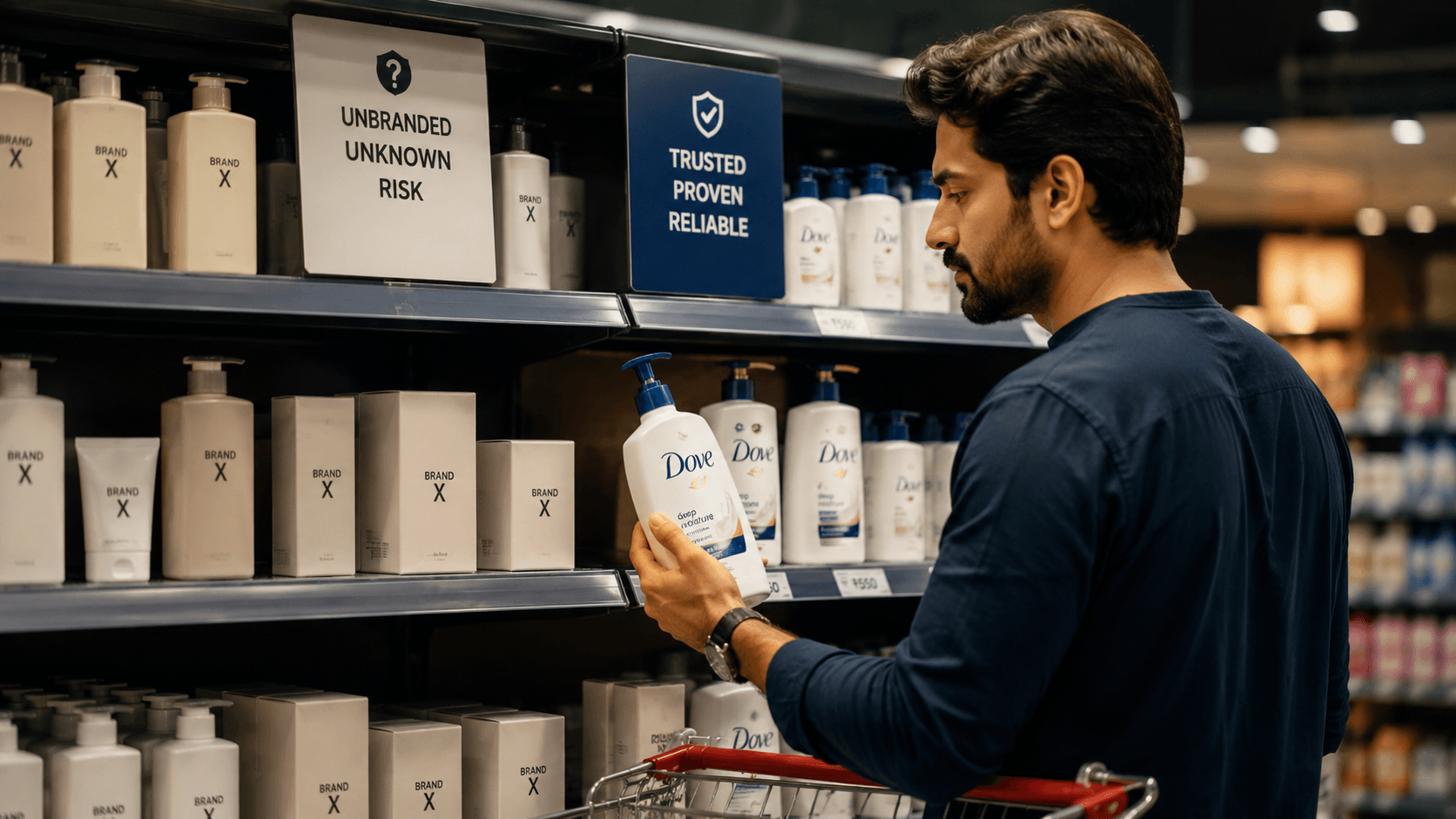




The Brand You’ve Never Heard Of
Imagine you’re walking through a busy street on your way to work.
You’re craving coffee.
On one side of the road is Starbucks.
On the other is a small café you’ve never heard of.
The café looks great.
Beautiful interiors.
A stylish logo.
A menu full of interesting coffees.
And the prices are even lower.
So which one do you choose?
Probably Starbucks.
But here’s the strange part.
You don’t actually know if Starbucks makes better coffee.
You haven’t even tried the other café.
Yet your brain has already made a decision.
Now imagine you’re booking a hotel.
You find two hotels at exactly the same price.
One has 12,000 reviews and a 4.8-star rating.
The other has zero reviews.
No customer photos.
No ratings.
No recommendations.
Which one feels safer?
Or imagine you’re hiring a freelance designer.
One has completed 500 projects.
The other created their profile yesterday.
Even if the new designer is exceptionally talented, you’re probably going to hesitate.
Why?
Because every purchase involves a little risk.
The product might disappoint you.
The service might be terrible.
The company might disappear after taking your money.
You might waste your time.
And when humans face uncertainty, the brain starts looking for evidence that says:
“You’re safe making this decision.”
That’s where trust comes in.
Before customers love your brand…
Before they become loyal…
Before they recommend you…
Before they click Buy Now…
They ask themselves one quiet question:
“Can I trust you?”
If the answer is no, almost everything else becomes harder.
Your product could be excellent.
Your pricing could be attractive.
Your website could look beautiful.
Your advertising could be brilliant.
But if the customer still feels uncertain, they may simply choose the brand they already know.
And that’s one of the biggest disadvantages a new brand faces.
You’re not necessarily competing against a better product.
You’re competing against familiarity.
You’re competing against years of accumulated experiences, reviews, recommendations and memories that already make another brand feel safe.
This is why customers don’t automatically distrust new brands because they’re bad.
They distrust them because they’re unknown.
And there’s an important difference.
A new business might have everything right:
A great product.
Fair prices.
Excellent service.
A talented team.
But the customer hasn’t experienced any of it yet.
From their perspective, you’re still an unanswered question.
So how does a completely unknown brand become the answer people feel confident choosing?
To understand that, we first need to understand what brand trust actually is.
What Is Brand Trust?
Ask someone why they keep buying from the same brand.
Why do they order from the same online store?
Why do they stay at the same hotel?
Why do they continue using the same bank?
Why do they keep going back to the same restaurant?
You’ll probably hear answers like:
“The quality is great.”
“I’ve never had a problem.”
“They’re reliable.”
“I know what to expect.”
Notice something interesting?
They rarely say:
“Because I trust them.”
But that’s exactly what they’re describing.
Trust is often invisible when it’s working.
You don’t think about it.
You simply act.
You order without worrying.
You pay without hesitation.
You recommend the brand to someone else.
You return without comparing ten alternatives first.
You already have a mental expectation of what will happen.
That’s trust.
At its simplest, brand trust is the confidence that a company will do what it says it will do.
Not once.
Repeatedly.
Because anyone can keep one promise.
The real question is whether they’ll keep the next one.
And the one after that.
And the one after that.
That’s why trust isn’t really about believing a brand’s advertising.
Every brand says it’s the best.
Every restaurant says its food is delicious.
Every skincare company promises better results.
Every software company says it will save you time.
If promises alone created trust, every business would be trusted equally.
Clearly, they aren’t.
Trust isn’t built by what brands promise.
It’s built by what customers experience after the promise is made.
A brand says:
“We’ll deliver tomorrow.”
Trust is built when the package actually arrives tomorrow.
A brand says:
“Easy returns.”
Trust is built when returning the product really is easy.
A brand says:
“We’re here to help.”
Trust is built when someone actually answers when the customer needs help.
This leads to a much more useful definition:
Trust Is Predictability
Customers don’t need you to be perfect.
They need to feel reasonably confident about what will happen next.
That’s why a brand that consistently delivers an 8/10 experience can sometimes be more trusted than a brand that delivers a 10/10 experience once and a 5/10 experience the next time.
The trusted brand is predictable.
The customer knows what they’re getting.
And predictability removes something customers hate:
uncertainty.
That brings us to the real psychological problem facing every new brand.
You’re asking someone to trust you before you’ve given their brain enough evidence to do so.
Why Familiar Brands Feel Safer
Imagine you’ve moved to a new city.
You’re hungry.
Two restaurants are standing next to each other.
One is crowded.
You’ve seen its advertisements before.
Your friends have mentioned it.
You recognise the logo.
The other restaurant looks equally good.
But you’ve never heard of it.
Which one feels safer?
Most people will probably choose the familiar one.
Not because they’ve compared every dish.
Not because they’ve studied the chef’s qualifications.
Not because they know the food is objectively better.
The familiar restaurant simply feels less uncertain.
And this happens everywhere.
We choose a known bank over an unfamiliar one.
A recognised hotel over an unknown property.
A familiar e-commerce website over a brand we’ve never heard of.
A known car manufacturer over a company we’ve only just discovered.
A familiar brand gives the brain something valuable:
a history.
You have seen it before.
You may have used it before.
Someone you know may have used it.
You may have seen other people using it.
All of those experiences reduce the feeling that you’re stepping into the unknown.
This doesn’t mean familiar brands are always better.
It means familiarity gives customers more information to work with.
And when information is limited, the brain often uses familiarity as a shortcut.
The Mere Exposure Effect
There’s a psychological principle behind this called the Mere Exposure Effect.
The basic idea is that repeated exposure to something can make it feel more familiar and, in some situations, more likeable.
You’ve probably experienced this without noticing.
You hear a song for the first time.
You don’t care much about it.
You hear it again.
Then again.
Eventually, you find yourself humming it.
The song hasn’t necessarily become better.
You’ve simply become familiar with it.
Brands can benefit from the same effect.
The first time you see a new brand’s name, it means almost nothing.
You see it again on Instagram.
Then on YouTube.
Then someone mentions it.
Then you see it while searching online.
Eventually, the name starts feeling familiar.
The brand hasn’t necessarily earned your trust yet.
But it no longer feels completely unknown.
That’s an important distinction.
Familiarity is not the same as trust.
But familiarity can make the first step towards trust easier.
This is one reason established brands continue investing in advertising even when customers aren’t immediately buying.
Not every advertisement is trying to create a sale today.
Some are simply making the brand more familiar so that when the customer eventually needs the category, the brand doesn’t feel like a stranger.
Imagine someone wants to buy running shoes six months from now.
They may not buy anything today.
But if one brand has appeared consistently in their world for months, that brand may feel easier to consider when the need eventually arrives.
For a new business, this means visibility matters.
Not because seeing a logo automatically creates trust.
But because being completely unknown creates friction.
The first job is to become recognisable.
The next job is to give that recognition a reason to become trust.
Why New Brands Start With a Trust Deficit
Here’s something every new business needs to understand.
A new brand doesn’t begin with the same level of confidence as an established brand.
It begins with very little evidence.
Imagine meeting someone at a networking event.
They seem friendly.
They tell you they’re reliable.
They tell you they’ve worked with hundreds of businesses.
Would you immediately lend them ₹50,000?
Probably not.
Not necessarily because you think they’re dishonest.
You simply don’t know them well enough.
A relationship hasn’t had time to produce evidence.
Brands work the same way.
A new business might have an excellent product.
Outstanding customer service.
Fair pricing.
A beautiful website.
But it has one major disadvantage:
Nobody has experienced it yet.
No reviews.
No testimonials.
No case studies.
No recommendations.
No success stories.
Customers aren’t necessarily thinking:
“This brand is bad.”
They’re often thinking:
“I wish someone else had tried it first.”
That’s why earning the first few customers can be one of the hardest stages of building a business.
The first customer takes the biggest leap.
The second customer has the first customer’s experience to look at.
The tenth customer has nine experiences.
The thousandth customer has hundreds or thousands of pieces of evidence.
This creates a powerful compounding effect.
Social Proof: Let Other People Reduce the Risk
Imagine you’re looking for a restaurant you’ve never tried.
One restaurant has three reviews.
Another has 8,000 reviews and a 4.7-star rating.
You don’t know every reviewer.
You haven’t personally verified every claim.
Yet the large number of positive experiences makes the second restaurant feel safer.
This is social proof.
When we’re uncertain, we often look at what other people have done.
If thousands of people have bought something, perhaps it’s safe.
If hundreds of people recommend a service, perhaps it’s reliable.
If a friend tells you a restaurant is excellent, you’re more likely to try it.
Social proof works because other people’s behaviour becomes evidence.
It answers a question the customer can’t answer through personal experience:
“Has this worked for people like me?”
That’s why reviews, ratings, testimonials, case studies and recommendations matter so much to new brands.
They’re not simply decoration.
They’re borrowed confidence.
The new customer hasn’t experienced the product yet.
But they can look at the experiences of people who have.
Why One Happy Customer Can Create the Next Sale
Think of trust as a bridge.
The first customer has to cross it carefully.
They’re taking the biggest risk.
But if they reach the other side safely, they can tell someone else:
“It’s fine. You can cross.”
The second customer feels more confident.
Then the third.
Then the hundredth.
Eventually, people stop questioning whether the bridge is safe.
They simply walk across.
Great brands grow in much the same way.
Each successful customer experience becomes evidence for the next customer.
Each review reduces uncertainty.
Each recommendation strengthens credibility.
Each case study makes the next sale slightly easier.
Over time, trust begins creating more trust.
This is one reason established brands have an enormous advantage.
Their reputation does some of the selling for them.
A new brand has to explain why customers should believe it.
An established brand can sometimes rely on customers explaining it for them.
Your Happiest Customers Become Your Marketing Team
Think about the last time a restaurant genuinely impressed you.
Maybe the food was excellent.
Maybe the staff handled a problem brilliantly.
Maybe the experience was much better than you expected.
What happened next?
You probably told someone.
A friend.
A colleague.
A family member.
Perhaps you left a review.
Without realising it, you became part of the restaurant’s marketing.
That’s the power of word of mouth.
People don’t experience recommendations in the same way they experience advertising.
If a company says:
“We’re the best restaurant in town.”
you know it’s marketing.
If your friend says:
“You have to try this place.”
it feels different.
Your friend isn’t trying to sell you a table.
They’re sharing an experience.
That’s why a genuinely happy customer can be more persuasive than a polished advertisement.
And the reverse is also true.
A disappointed customer can become an anti-advertisement.
They can warn friends.
Leave a poor review.
Share the experience online.
Tell colleagues.
This is why customer experience isn’t separate from marketing.
Customer experience is marketing.
Every delivery, interaction and support conversation can either strengthen or weaken the story people tell about your brand.
Advertising Creates Awareness. Experience Creates Trust.
A brilliant advertisement can make someone notice you.
It can make them curious.
It can make them click.
But the advertisement cannot prove everything.
Suppose a new online store says:
“Fast delivery. Easy returns. Premium quality.”
Those are promises.
The customer still has to find out whether they’re true.
The first order becomes a test.
Did it arrive when promised?
Was the product actually what the website showed?
Was the quality good?
Was the packaging appropriate?
Was customer support available?
Was the return process genuinely easy?
Every one of these moments produces evidence.
And that evidence changes the customer’s future behaviour.
If the experience is good, the next purchase requires less thought.
If the experience is bad, uncertainty returns.
This is why the first transaction isn’t the finish line.
It’s the beginning of the trust-building process.
Trust Is Built One Promise at a Time
Most businesses think trust is earned through one big moment.
A brilliant advertisement.
A viral post.
A celebrity endorsement.
A spectacular launch.
Those things can create attention.
But trust is usually built through much smaller moments.
Imagine a friend asks to borrow ₹1,000.
You agree.
A week later, they return every rupee exactly when they promised.
A month later, they borrow again.
They repay you on time.
Then again.
And again.
After several repetitions, you stop worrying.
You don’t think:
“I hope they return the money.”
You already expect them to.
Nothing dramatic happened.
They simply kept one promise after another.
Brands work the same way.
Every interaction is an opportunity to confirm or weaken the customer’s expectation.
Your website promises professionalism.
Your advertising promises value.
Your pricing promises fairness.
Your packaging promises quality.
Your delivery promises reliability.
Your customer support promises help.
Your refund policy promises confidence.
The real question isn’t whether your brand makes promises.
Every brand does.
The question is:
Do you keep them?
Consistency Is the Secret Ingredient
A brand doesn’t become trustworthy by being excellent once.
It becomes trustworthy by being consistently reliable.
Imagine your favourite café.
One visit is excellent.
The next is disappointing.
Then excellent again.
Then disappointing again.
Eventually, you stop knowing what to expect.
You may still like the café.
But you hesitate before going.
That’s because trust needs predictability.
Customers can tolerate an occasional imperfect experience.
What they struggle with is uncertainty about which version of the brand they’ll get.
Will the delivery arrive on time?
Will the product quality be the same?
Will customer support answer?
Will the price suddenly change?
Will the return policy still work?
Will the website say one thing while the staff says another?
Each inconsistency adds uncertainty.
And uncertainty makes decisions harder.
This is why consistency is not boring in branding.
Consistency is reassuring.
It allows customers to stop thinking about whether the brand will deliver and simply enjoy the experience.
Trust Doesn’t Mean Everything Must Stay the Same
Consistency doesn’t mean a brand should never change.
Customers want better products.
They want innovation.
They want improved features.
They want new experiences.
The problem is not change.
The problem is unexplained unpredictability.
Imagine your bank suddenly introduces a major fee without clearly communicating it.
Or a streaming service removes a feature you relied on without explanation.
Or a software company doubles its price overnight.
The issue isn’t simply that something changed.
It’s that the customer no longer knows what to expect.
A trusted brand can change.
But it communicates the change clearly.
It explains why.
It gives customers time to adjust where appropriate.
And it tries to keep the underlying relationship predictable.
Trust Is Tested After the Sale
Many businesses put enormous effort into getting the first purchase.
The advertisement works.
The customer clicks.
The payment goes through.
Everyone celebrates.
But the real test has just begun.
Did the product arrive on time?
Was it exactly as described?
Did it work?
Was the packaging damaged?
Was customer support helpful?
Was the refund processed properly?
Did the company take responsibility when something went wrong?
These moments matter because customers now have something advertising can never provide:
evidence.
Before the purchase, the customer has expectations.
After the purchase, they have experience.
That experience either confirms the promise or contradicts it.
If the promise is confirmed, trust strengthens.
If it is broken, trust weakens.
And that has consequences beyond the current transaction.
A customer who trusts you is more likely to buy again without extensive research.
They are more likely to recommend you.
They may be more forgiving of small mistakes.
They may be willing to try your new products.
In other words:
Trust lowers the friction of future purchases.
Trust Is More Powerful Than Brand Love
Ask a business owner what they want customers to feel.
They’ll often say:
“We want customers to love our brand.”
That sounds wonderful.
But love isn’t enough.
Think about a close friend you’ve known for years.
You’ve shared memories.
You care about them.
You enjoy spending time together.
Now imagine they repeatedly lie to you.
They break promises.
They hide important information.
You might still care about them.
But the relationship changes.
You stop relying on them.
The affection may remain for a while.
The trust doesn’t.
Brand relationships work similarly.
A customer can love your product, your design, your personality or your advertising.
But if they stop believing that your company will do the right thing, that emotional connection becomes fragile.
Trust is what makes the relationship dependable.
That’s why trust is particularly important in categories involving higher risk.
You may love a chocolate brand.
But you need to trust your bank.
You may enjoy a clothing brand.
But you need to trust an airline with your safety.
You may like a skincare brand.
But you need to trust its claims about what you’re putting on your skin.
Trust combines emotion with evidence.
The customer doesn’t simply feel good about the brand.
They believe the brand will continue to behave reliably in the future.
One Bad Experience Can Change the Relationship
Trust is difficult to build partly because customers remember negative experiences.
Imagine someone orders from an unknown website and never receives the product.
The next time they encounter an unfamiliar online store, they’re more cautious.
Or someone books a hotel that looks beautiful online but is completely different in reality.
The next hotel booking gets more scrutiny.
Or someone hires a contractor who takes an advance and then disappears.
The next contractor has to overcome that previous experience.
Customers don’t arrive at your brand with completely empty minds.
They carry memories.
Some are positive.
Some are negative.
This means your brand isn’t being judged only against your competitors.
It’s also being judged against every disappointing experience your customer has had before.
That makes the job of a new brand harder.
But it also reveals the solution.
You don’t need customers to believe that you’re perfect.
You need to give them enough evidence to believe that you’re reliable.
Distrust Isn’t Personal
This is an important distinction for entrepreneurs.
If a customer hesitates to buy from your new business, it doesn’t automatically mean they dislike your brand.
They may not think your product is poor.
They may not think your price is wrong.
They may simply be thinking:
“I don’t know what will happen if I give this company my money.”
That’s uncertainty.
And uncertainty is something a business can reduce.
You can provide clear information.
Show real customers.
Display genuine reviews.
Explain your policies.
Make contact details easy to find.
Show who is behind the company.
Answer questions.
Offer guarantees where appropriate.
Communicate clearly.
Deliver what you promised.
Every one of these actions removes a little uncertainty.
The goal isn’t to convince people to “take a chance”.
The goal is to give them fewer reasons to feel that they’re taking a chance.
Trust Signals Are Everywhere
Customers constantly look for clues before making a purchase.
Some are obvious.
Customer reviews.
Star ratings.
Testimonials.
Case studies.
Others are much more subtle.
A professional website.
Clear pricing.
Real contact information.
Helpful FAQs.
A visible returns policy.
Responsive customer support.
An active and credible social media presence.
Clear product information.
A secure and straightforward checkout.
Even the way a company responds to a negative comment can become a trust signal.
Each detail quietly answers the same question:
“Can this business be trusted?”
No single signal has to do all the work.
Think about a new restaurant.
The website looks professional.
The menu is clear.
The location is real.
The restaurant has genuine photographs.
There are recent customer reviews.
The staff respond to questions.
The prices are transparent.
The booking process works.
Individually, none of these proves that the food will be excellent.
Together, they reduce uncertainty.
That’s how trust signals work.
They create a collection of small pieces of evidence.
Show the Humans Behind the Brand
A new brand has one disadvantage that established brands have often overcome:
People don’t know who’s behind it.
That can make the business feel abstract.
A website can look polished while still feeling anonymous.
One way to reduce that distance is to show the humans behind the business.
Introduce the founders.
Show the team.
Explain why the company exists.
Share the people responsible for the product.
Show the process where relevant.
This doesn’t mean publishing someone’s life story just to appear authentic.
It means making the business feel accountable.
There’s a difference between:
“We are a customer-focused company.”
and:
“We’re a small team based in Pune. We started this business because we couldn’t find a reliable option for X. Here’s the team responsible for building and supporting it.”
The second gives the customer something concrete to believe.
The brand has become less anonymous.
Be Honest About What You’re Not
New brands sometimes try too hard to appear perfect.
They claim:
Best in India.
Number one.
World-class.
Revolutionary.
Guaranteed to change your life.
The problem is that customers have heard these claims hundreds of times.
Big promises don’t automatically create confidence.
Sometimes honesty is more persuasive.
Imagine a new productivity app saying:
“We’re still a small team, so we don’t have 24-hour phone support yet. But every customer can email us directly, and we aim to respond within one business day.”
That limitation doesn’t necessarily reduce trust.
It can increase it.
Why?
Because the company isn’t pretending to be something it isn’t.
Trust grows when expectations and reality match.
A brand doesn’t need to look enormous.
It needs to look credible.
Reduce the Risk of the First Purchase
Think about what makes customers hesitate before buying from a new brand.
“What if the product isn’t good?”
“What if it doesn’t arrive?”
“What if I don’t like it?”
“What if I need a refund?”
“What if customer support ignores me?”
A new brand can address these fears directly.
Clear return policies reduce risk.
Money-back guarantees can reduce risk.
Free trials can reduce risk.
Samples can reduce risk.
Easy cancellation can reduce risk.
Cash on delivery, where appropriate, can reduce perceived payment risk.
Customer reviews reduce informational risk.
Case studies reduce performance risk.
Responsive support reduces service risk.
The goal is not to remove every possible risk.
That’s impossible.
The goal is to make the decision feel safe enough to try.
This is particularly important for new businesses because they don’t yet have years of reputation to do the reassuring for them.
They need to compensate with evidence and risk reduction.
Trust Can Be Built Faster Than You Think
New brands often assume trust simply requires time.
Time helps.
But time alone isn’t enough.
A business could exist for ten years and still be poorly trusted if its experiences are inconsistent.
What matters is the number and quality of trustworthy interactions.
A new brand can accelerate this process by deliberately creating more opportunities for customers to see evidence.
Collect genuine reviews.
Publish useful case studies.
Make the founders visible.
Answer questions publicly.
Show the product clearly.
Explain policies before customers have to ask.
Deliver consistently.
Respond quickly when something goes wrong.
Ask satisfied customers to share their experiences.
Every one of these creates evidence.
And evidence compounds.
The First Purchase Should Not Be the Goal
A common mistake is designing everything around the first sale.
The advertisement is built to get the click.
The landing page is built to get the payment.
The discount is built to remove hesitation.
Then the business starts looking for the next customer.
But trusted brands think further ahead.
They ask:
“What will make this customer comfortable buying from us again?”
That changes the entire experience.
The product needs to work.
The packaging needs to match expectations.
The delivery needs to be reliable.
Support needs to be accessible.
Problems need to be handled properly.
The follow-up should be useful rather than annoying.
The second purchase should feel easier than the first.
The third should feel almost automatic.
This is how trust becomes an economic advantage.
Once customers trust you, you don’t have to rebuild credibility from scratch every time.
Difficult Moments Reveal Character
It’s easy to appear trustworthy when everything is going perfectly.
The real test comes when something goes wrong.
A delivery is delayed.
A product arrives damaged.
A payment is charged twice.
A customer receives the wrong item.
A service goes down.
A public complaint appears.
These moments reveal what the brand actually values.
Some businesses disappear.
Some blame the customer.
Some hide behind automated messages.
Others acknowledge the problem.
They explain what happened.
They apologise where appropriate.
They fix what they can.
They keep the customer informed.
Paradoxically, a difficult situation can sometimes strengthen trust.
Not because customers enjoy problems.
Because the brand has demonstrated something important:
“When things go wrong, we will still do the right thing.”
That is a powerful form of trust.
Customers Don’t Expect Perfection
This is worth emphasising.
A trustworthy brand is not a brand that never makes mistakes.
That’s unrealistic.
People know businesses are run by humans.
Products fail.
Deliveries get delayed.
Technology breaks.
Employees make mistakes.
What customers often care about more is how the company responds.
If a business acknowledges a problem and fixes it, the customer may forgive it.
If the business pretends the problem doesn’t exist, trust can collapse.
Silence can be more damaging than the mistake itself.
This is why customer support isn’t merely a cost centre.
It can be one of the most important trust-building functions in the business.
Every complaint is an opportunity to demonstrate whether the company’s promises mean anything when tested.
Customers Buy Character, Not Just Products
Think about the brands you genuinely trust.
You probably believe they will do the right thing even when doing so isn’t the easiest option.
That’s character.
Customers can forgive mistakes.
What they struggle to forgive is dishonesty.
Fake reviews.
Hidden fees.
Misleading claims.
Manipulated testimonials.
Promises that disappear once payment is made.
If customers begin questioning the character of a business, every future promise becomes harder to believe.
That’s because trust doesn’t live inside individual claims.
It lives in the pattern.
One honest interaction supports the next.
One misleading interaction can make the customer question everything else.
Reputation Is Built Every Day
Many companies think reputation is something created through advertising.
It isn’t.
Reputation is what people say about your brand when you’re not in the room.
Every delivery adds something.
Every support conversation adds something.
Every refund adds something.
Every invoice adds something.
Every product update adds something.
Every interaction adds another sentence to the story.
Eventually, those thousands of small moments become the reputation of the business.
And that reputation becomes an asset.
Or a liability.
This is why a company’s brand cannot be separated completely from its operations.
Marketing can create a promise.
Operations decide whether the promise survives contact with reality.
How New Brands Can Build Trust Faster
If you’re building a new brand, you don’t need to wait years before customers trust you.
You need to make uncertainty easier to overcome.
Start with the basics.
1. Make your business easy to verify
Show your company information.
Make contact details easy to find.
Explain who you are.
Be clear about where you’re based and how customers can reach you.
An anonymous business creates unnecessary doubt.
2. Show real evidence
Use genuine customer reviews.
Show case studies.
Display testimonials where appropriate.
Share actual product photographs.
Let customers see what other people have experienced.
Don’t manufacture proof.
Real evidence is more valuable than impressive-looking evidence.
3. Make your promises specific
“Excellent service” is vague.
“Orders placed before 2 pm are dispatched the same day” is specific.
“Easy returns” is vague.
“Returns accepted within 30 days, with no questions asked” is specific.
Specific promises give customers something they can evaluate.
4. Then keep those promises
This is the part that cannot be outsourced to branding.
If you promise same-day dispatch, dispatch the order.
If you promise a response within 24 hours, respond within 24 hours.
If you promise easy returns, make returns easy.
The fastest way to build trust is to repeatedly prove that your promises are real.
5. Reduce the customer’s risk
Ask:
“What is the customer most afraid might happen?”
Then address that fear.
Offer a clear return policy.
Provide a guarantee where it makes commercial sense.
Give customers enough information to make an informed decision.
Make cancellation straightforward.
Make support accessible.
Reducing uncertainty is often more effective than simply telling people to trust you.
6. Show the people behind the business
Let customers know who they’re dealing with.
Founders.
Team members.
Experts.
Creators.
The people responsible for the product.
This makes the business feel accountable rather than anonymous.
7. Don’t pretend to be bigger than you are
You don’t need to look like a multinational company.
A small business can be highly trustworthy.
Be honest about your size.
Be clear about your capabilities.
Explain what you can and cannot do.
Credibility is more valuable than artificial grandeur.
8. Turn happy customers into storytellers
When someone has a genuinely good experience, make it easy for them to share it.
Ask for reviews.
Encourage referrals.
Collect case studies.
Invite customers to share their experiences.
Your customers can often explain your value more convincingly than your advertising can.
9. Treat complaints as trust moments
Don’t hide negative feedback.
Respond to it.
Acknowledge genuine problems.
Explain what you’re doing about them.
Fix the issue where possible.
Future customers are watching how you behave when things go wrong.
10. Build for the tenth purchase
Don’t design the entire business around getting the first order.
Ask what would make the second order easier.
Then the third.
Then the tenth.
The goal isn’t simply to convince someone to try you once.
It’s to create enough positive evidence that eventually they stop needing to think about whether they can trust you.
The Trust Flywheel
A new brand often starts with little evidence.
Little evidence creates hesitation.
Hesitation makes the first sale difficult.
But once the first customers have good experiences, something changes.
Good experiences create reviews.
Reviews create social proof.
Social proof reduces uncertainty.
Reduced uncertainty creates more purchases.
More purchases create more experiences.
More experiences create more reviews and recommendations.
And the cycle continues.
You can think of it as a trust flywheel:
Good experience → positive evidence → lower uncertainty → more customers → more good experiences
This is why trust becomes more valuable over time.
The first few customers are difficult.
The next hundred can be easier.
The next thousand can be easier still.
Not because the product magically improved.
Because the market now has more evidence that your promises are real.
Trust Is a Competitive Advantage
A competitor can copy your product.
They can copy your colours.
They can copy your features.
They can sometimes even copy your pricing.
What is much harder to copy is a decade of positive customer experiences.
That’s why trust becomes a genuine competitive advantage.
A trusted brand can launch a new product and have customers willing to try it.
A trusted retailer can make a mistake and still receive another chance.
A trusted service provider can charge more because customers believe the experience will be worth it.
A trusted business spends less energy convincing people that it exists and more energy serving people who already believe in it.
Trust therefore has an economic effect.
It can reduce the friction of acquisition.
Increase repeat purchases.
Strengthen word of mouth.
Reduce hesitation.
Increase tolerance for minor mistakes.
And make customers more willing to try something new from the same company.
The longer trust survives, the more valuable it becomes.
The Difference Between Being Known and Being Trusted
This is where many brands get confused.
Being famous isn’t the same as being trusted.
Being familiar isn’t the same as being trusted.
Having followers isn’t the same as being trusted.
Having a beautiful website isn’t the same as being trusted.
Trust requires evidence.
A customer needs to believe that the business will behave reliably when their money, time, expectations or reputation are involved.
That’s why a small business with 500 genuinely happy customers can be more trusted by its niche than a much larger company with millions of followers but poor customer experiences.
Reach creates awareness.
Familiarity reduces uncertainty.
Experience creates evidence.
Consistency turns evidence into trust.
That’s the progression.
Final Thoughts
A new brand has an obvious problem.
Nobody knows you yet.
But the deeper problem isn’t that customers don’t know your name.
It’s that they don’t yet know what will happen if they choose you.
Will the product arrive?
Will it be good?
Will the service match the promise?
Will you answer when something goes wrong?
Will the company still exist when they need help?
Those questions create hesitation.
And hesitation is where many purchases disappear.
The solution isn’t simply louder advertising.
It isn’t pretending to be bigger.
It isn’t filling your website with words like “premium”, “trusted” and “world-class”.
Trust doesn’t come from saying you’re trustworthy.
It comes from creating enough evidence that the customer no longer needs to wonder.
A professional website helps.
Reviews help.
Recommendations help.
Clear policies help.
Good customer service helps.
Showing the humans behind the business helps.
But none of these can replace the most important thing:
keeping your promises.
Because every customer interaction is another test.
Every delivery.
Every payment.
Every support ticket.
Every refund.
Every complaint.
Every product.
Every follow-up.
Each one asks the same question:
“Can I rely on you?”
Answer that question well enough, often enough, and something remarkable happens.
The customer stops evaluating you.
They stop comparing you with every alternative.
They stop wondering whether you will deliver.
They simply choose you.
That is what trust does.
And that’s why the strongest brands don’t spend their lives trying to convince customers to trust them.
They give customers reasons to trust them.
Then they keep giving them reasons.
One promise at a time.
One experience at a time.
One customer at a time.
Leave a Reply