
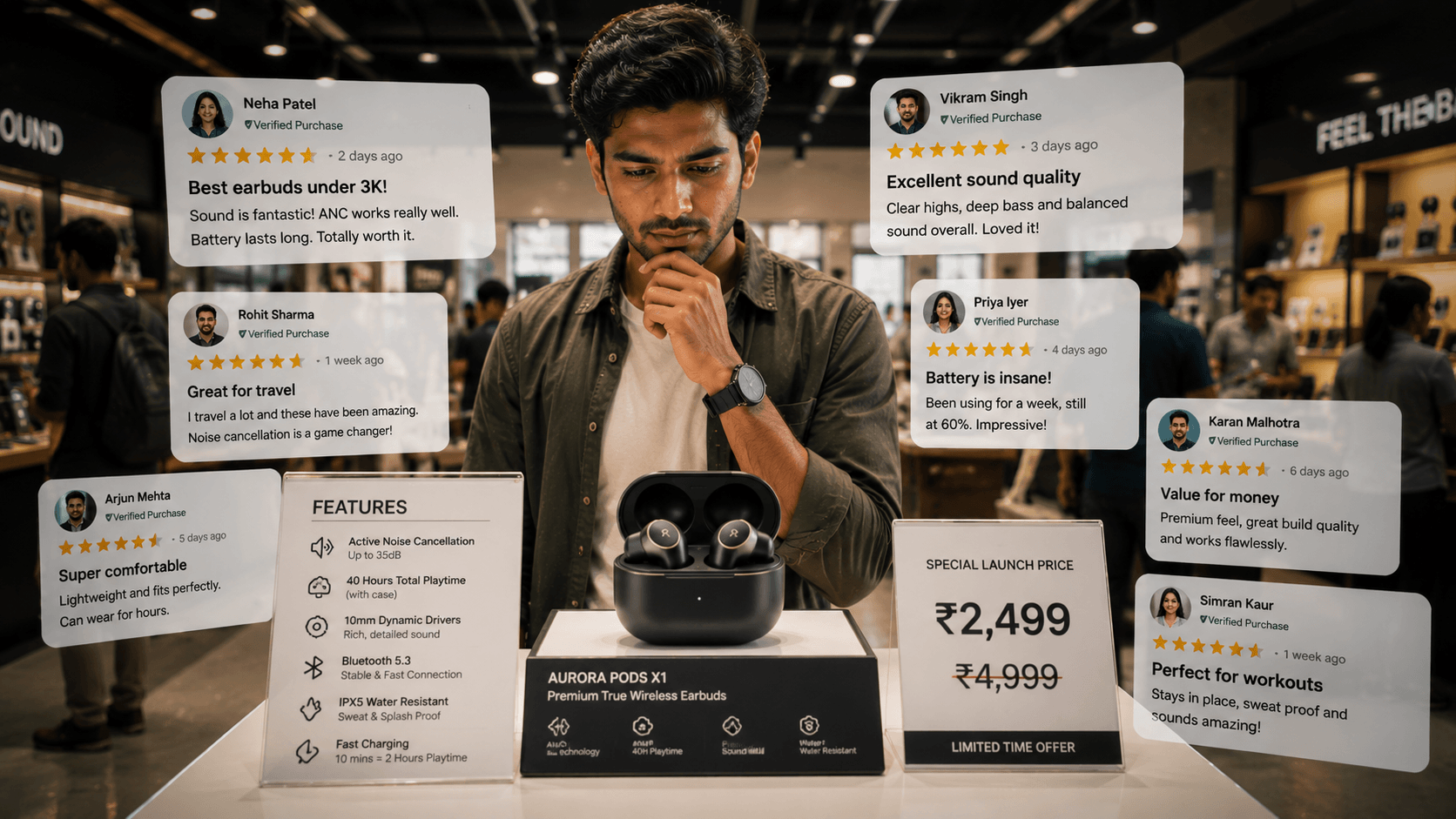




Imagine you’re shopping online for a new pair of wireless headphones.
After an hour of searching, you’ve narrowed your choices down to two.
The first costs ₹2,999.
Its product page looks impressive:
- 40-hour battery life
- Active Noise Cancellation
- Bluetooth 5.4
- Hi-Res Audio
- Fast charging
- IPX5 water resistance
You think, “This looks pretty good.”
Then you open the second pair.
Almost the same features.
Similar battery life. Similar sound quality. Almost the same price.
On paper, there’s barely anything separating them.
So how do you decide?
You scroll down.
The first product has three reviews.
The second has 18,642 reviews with an average rating of 4.8 stars.
And suddenly, the decision feels easier.
You don’t start comparing Bluetooth versions again.
You don’t calculate the exact difference in battery capacity.
You don’t search for another twenty specifications.
You simply feel more confident choosing the second pair.
But here’s the interesting part.
The product didn’t become better because it had more reviews.
Your perception of the risk changed.
You weren’t really asking:
“Which product has better features?”
You were asking:
“Which one am I more likely to regret buying?”
And thousands of strangers had just helped answer that question.
This is why reviews have become such a powerful force in modern marketing.
A company can tell you that its headphones have 40-hour battery life.
A customer can tell you:
“I travelled from Mumbai to Delhi, watched movies throughout the flight and still had enough battery left afterwards.”
The first is a specification.
The second is evidence.
One tells you what the product claims to do.
The other shows you what happened when someone actually used it.
And when we’re uncertain, that distinction becomes incredibly important.
Features Make Promises. Reviews Provide Proof.
Every business has to explain why its product is worth buying.
A smartphone highlights its camera.
A laptop highlights its battery life.
A skincare brand highlights its ingredients.
A restaurant talks about its food.
An online course talks about its outcomes.
That’s normal.
Customers need information.
But there’s a problem.
Every company can make a claim.
Every smartphone can say its camera is exceptional.
Every restaurant can say its food is delicious.
Every course can say it will help you grow your career.
So the customer’s real problem isn’t always a lack of information.
Often, it’s a lack of certainty.
“Is the camera actually that good?”
“Does the food really taste as good as they say?”
“Will this course actually help me?”
“Will I get what I paid for?”
This is where reviews become powerful.
They don’t replace product information.
They validate it.
Think about buying a waterproof backpack.
The product page says:
100% Waterproof
Useful.
But still abstract.
Now imagine a customer writes:
“I carried this backpack during a three-hour trek in heavy rain. Everything inside stayed completely dry. The only thing I’d improve is the side pocket, which feels a little small.”
Suddenly, the claim has context.
You can picture the rain.
You can picture the trek.
You can picture the backpack on someone’s shoulders.
More importantly, you can imagine yourself using it.
That’s the real power of a review.
Features explain what a product can do. Reviews show what that means in real life.
Why Do We Trust Reviews So Much?
Now we get to the more interesting question.
Why should the opinion of a stranger influence your decision?
You don’t know them.
You don’t know whether their standards are the same as yours.
You don’t know whether you’ll have the exact same experience.
And yet, you may trust their opinion more than the company’s own marketing.
Why?
Because the company has an obvious reason to persuade you.
The customer doesn’t appear to have one.
Imagine you’ve just moved to a new city and need a dentist.
One dentist has a beautiful website, professional photographs, impressive qualifications and a long list of achievements.
Another has a simpler website.
But three people you trust tell you:
“Go to her. She’s fantastic.”
Which one feels safer?
For most people, the recommendation carries enormous weight.
This is an old human behaviour.
Long before Google, people asked friends, neighbours and family:
“Who’s good?”
“Who should I avoid?”
“Have you tried them?”
The internet didn’t invent this behaviour.
It scaled it.
Instead of asking one friend, we can now learn from hundreds or thousands of previous customers.
That’s why online reviews are essentially word of mouth at scale.
Social Proof: When Other People Help Us Decide
Imagine walking through a food court.
One restaurant is completely empty.
The restaurant next to it has a queue stretching outside.
You haven’t tasted either one.
You don’t know whether the crowded restaurant is actually better.
Yet the queue makes you hesitate before choosing the empty one.
Why?
Because when we’re uncertain, we naturally look at what other people are doing.
This is known as social proof.
The basic psychological shortcut is simple:
“If lots of other people chose this, it probably isn’t a terrible choice.”
Reviews create the same effect.
Every rating.
Every customer photograph.
Every detailed experience.
Every recommendation.
Every success story.
Gives the next customer another reason to think:
“People like me have already tried this.”
And that matters because buying something unfamiliar always carries a small amount of psychological risk.
The Hidden Product You’re Really Selling: Confidence
Imagine you’re about to spend ₹50,000 on a laptop.
You’ve researched it.
You’ve compared alternatives.
You’ve watched videos.
You’ve read the specifications.
You’ve finally added it to your cart.
Then your finger stops above Buy Now.
A small question appears:
“What if I choose the wrong one?”
That question is where many purchases slow down.
The customer isn’t necessarily confused about the product.
They’re worried about the consequences of being wrong.
What if the battery isn’t good enough?
What if it overheats?
What if the screen looks different in person?
What if customer support is terrible?
What if another laptop would have been better?
What if I regret spending the money?
Reviews help answer these questions.
They don’t eliminate risk.
They make the risk feel more manageable.
That’s an important distinction.
A review doesn’t guarantee that you’ll have a perfect experience.
It simply gives you evidence about what happened to people who took the risk before you.
In that sense, reviews act like a bridge between uncertainty and confidence.
You are not thinking:
“This definitely cannot go wrong.”
You’re thinking:
“Thousands of people bought it, and most seem to have had a good experience. I feel comfortable taking the chance.”
And sometimes, that’s all a customer needs to move forward.
Reviews Translate Features Into Experiences
A specification tells you what something has.
A review tells you what it was like to live with it.
Consider:
Feature:
24-hour battery life.
Review:
“I used it throughout a full day of meetings, travelled home and still didn’t need to charge it.”
Or:
Feature:
Water resistant.
Review:
“I got caught in a heavy Mumbai downpour on the way home. The phone was completely fine.”
Or:
Feature:
Comfortable running shoes.
Review:
“I wore them for my first 10K and didn’t get the usual foot pain I normally experience.”
The technical specification hasn’t changed.
But the meaning has.
The customer has translated an abstract feature into a situation you understand.
And that makes it easier to evaluate.
More importantly, it makes it easier to imagine ownership.
You’re no longer thinking about the product sitting on a product page.
You’re picturing it in your own life.
That is a much more powerful mental experience.
Reviews Answer Questions Product Pages Often Miss
Product pages usually answer the questions a company wants to answer.
Reviews often answer the questions customers actually care about.
“Does it feel cheap?”
“Is the size accurate?”
“Is the colour the same as the pictures?”
“How long did delivery actually take?”
“Was customer support helpful?”
“Does the battery really last all day?”
“Would you buy it again?”
These aren’t necessarily technical questions.
They’re experience questions.
And experience questions are difficult for a brand to answer about itself.
A company saying “Our customer service is excellent” is still a claim.
A customer saying:
“My package arrived damaged. I contacted support and they sent a replacement the next day.”
is evidence.
That difference is subtle.
But psychologically, it is enormous.
Real People Make Products Feel Real
This becomes even more powerful when reviews include photographs and videos.
Imagine you’re buying a sofa online.
The brand’s website shows a beautifully styled living room.
Perfect lighting.
Perfect cushions.
Perfect angle.
It looks fantastic.
Then you see a customer’s photograph.
It’s sitting in an ordinary Indian living room.
Different lighting.
A slightly messy table in the background.
A normal-sized room.
Suddenly, the photograph becomes more useful.
Not necessarily more beautiful.
More believable.
You can see the actual colour.
You can estimate the size.
You can understand how it looks outside a professionally designed photoshoot.
This is why user-generated content has become so valuable.
Customers aren’t only asking:
“Does this product look good?”
They’re asking:
“What will this look like in my world?”
Real photographs, videos and unboxing experiences help answer that question.
They reduce the distance between seeing a product and imagining owning it.
The Strange Power of Imperfection
Here’s where reviews get even more interesting.
You might assume the most persuasive review profile is one with hundreds of five-star ratings.
Not necessarily.
Imagine you’re looking at a coffee machine.
It has a perfect 5.0 rating.
Every review says:
“Amazing!”
“Perfect!”
“Best purchase ever!”
“Absolutely flawless!”
At first, it sounds wonderful.
Then you read twenty of them.
And something feels off.
You start wondering:
“Can anything really be this perfect?”
A few balanced reviews can actually make the entire profile feel more believable.
For example:
“The machine makes excellent coffee and has worked perfectly for six months. The only downside is that cleaning it takes a little longer than expected.”
That sounds human.
Real people have mixed experiences.
Real products have strengths and weaknesses.
Real customers notice different things.
So when reviews contain specific details, small complaints and honest trade-offs, they can feel more credible.
Trust doesn’t require perfection. It requires believability.
A Negative Review Isn’t Always a Bad Review
This is another reason businesses should be careful about treating negative reviews as enemies.
Imagine someone writes:
“The backpack is too large for everyday office use.”
Is that a bad review?
For someone looking for a compact office bag, perhaps.
But for someone planning a week-long trek, it might sound perfect.
The review hasn’t necessarily made the product worse.
It has made the fit clearer.
This is an important distinction.
A review doesn’t simply tell customers whether a product is “good” or “bad”.
It helps them decide:
“Is this right for me?”
And that can be more valuable than a perfect five-star rating.
What Businesses Do After a Bad Review Matters
Now imagine two businesses receive the same complaint.
The first ignores it.
The second replies:
“We’re sorry you had this experience. Thank you for bringing it to our attention. We’ve looked into the issue and are working to fix it.”
Future customers are watching too.
They aren’t only reading the original complaint.
They’re reading the company’s response.
And that response tells them something important:
“If something goes wrong, this company won’t disappear.”
Customers don’t expect businesses to never make mistakes.
They expect businesses to take responsibility when they do.
Sometimes, the way a company handles a bad experience can reveal more about its character than a page full of positive reviews.
Fake Reviews Create the Opposite of Trust
This is where businesses get tempted to take shortcuts.
Buy reviews.
Create fake accounts.
Ask people who never used the product to post five-star ratings.
At first, it seems like an easy solution.
More reviews.
Higher rating.
Better conversion.
But there’s a problem.
Customers aren’t just evaluating the product anymore.
They’re evaluating whether they can believe the evidence.
When reviews start looking suspicious, the entire credibility system collapses.
Dozens of reviews posted within a few days.
Generic comments.
Identical wording.
No meaningful details.
No customer photographs.
Almost nothing below five stars.
People may not consciously analyse every pattern.
But they notice when something doesn’t feel human.
And once doubt enters the decision, the brand has a much bigger problem than a low review count.
It has a credibility problem.
The Biggest Mistake: Optimising for Five Stars
Many businesses ask:
“How do we get more five-star reviews?”
That’s the wrong question.
A better question is:
“How do we create an experience customers genuinely want to talk about?”
Because reviews are not the cause.
The customer experience is the cause.
Reviews are the result.
If your product works.
If delivery is reliable.
If the packaging is thoughtful.
If support actually helps.
If problems are resolved quickly.
If the experience is better than expected.
Customers have something worth talking about.
The best review strategy therefore starts long before the review request.
It starts with the product.
Happy Customers Still Need a Reminder
There’s another practical problem.
Even genuinely happy customers often don’t leave reviews.
Not because they disliked the product.
They simply forget.
They receive the order.
Use it.
Move on with their lives.
A week later, they’ve forgotten about the review.
That’s why asking for feedback isn’t inherently pushy.
The important thing is how and when you ask.
Ask before they’ve used the product and they have nothing meaningful to say.
Ask immediately after delivery and they may only be able to comment on packaging.
Ask after they’ve had enough time to experience the product and their feedback becomes much more useful.
Then make the process easy.
One tap.
One clear request.
Minimal friction.
You’re not begging for praise.
You’re giving a satisfied customer an easy opportunity to share their experience.
Reviews Are More Than Marketing Content
There’s one final shift businesses need to make.
Stop treating reviews only as testimonials.
Start treating them as customer research.
Suppose twenty customers complain that the instructions are confusing.
That’s not just twenty unhappy reviews.
It’s a product problem.
Suppose thirty customers repeatedly praise your fast delivery.
That’s not just nice feedback.
That’s a potential competitive advantage.
Suppose customers constantly describe your product using a phrase you never use in your advertising.
Pay attention.
Your customers may have found your strongest marketing message for you.
Reviews reveal:
- What customers value
- What frustrates them
- What language they naturally use
- Which features actually matter
- Which expectations you’re meeting
- Which expectations you’re failing to meet
- Why people choose you
- Why people hesitate
In other words, reviews tell you what it was actually like to be your customer.
That’s information most businesses would spend serious money trying to discover through research.
Reviews Are Becoming a New Source of Customer Intelligence
The future of reviews isn’t just more stars.
It’s more data.
Imagine a laptop with 28,000 reviews.
No human is going to read all of them.
But AI can analyse thousands of reviews and identify patterns:
Customers consistently praise the battery.
Gamers complain about fan noise.
The keyboard receives strong feedback.
Most complaints are actually about customer support rather than the laptop itself.
The value isn’t in reading 28,000 opinions.
It’s in understanding the patterns hidden inside them.
This changes how businesses can use reviews.
Reviews can influence not only marketing, but product development, customer service, positioning and strategy.
And for customers, reviews themselves are evolving too.
Written reviews.
Customer photographs.
YouTube demonstrations.
Short-form videos.
Community recommendations.
AI-generated summaries.
The format will continue changing.
The underlying psychology won’t.
When we don’t know what to believe, we look for evidence from people who have already experienced it.
The Real Lesson
Businesses often think they’re competing on price.
Or features.
Or technology.
Or advertising.
But underneath all of that, many businesses are competing for something more fundamental:
belief.
A customer needs to believe that the product will deliver.
Believe that the company is trustworthy.
Believe that the experience will match the promise.
Believe that the purchase won’t become a mistake.
Features can make the promise.
Advertising can make the promise visible.
But reviews help make the promise believable.
That’s why a customer saying:
“I’ve used it for six months and I’d buy it again.”
can be more persuasive than an entire page of carefully written marketing copy.
Because the customer isn’t saying:
“Trust this brand.”
They’re saying:
“I took the risk first. Here’s what happened.”
And for the person considering the purchase, that can be exactly the evidence they needed.
Key Takeaways
1. Features make promises. Reviews provide proof.
Features tell customers what a product is designed to do. Reviews show what happened when real people used it.
2. Reviews reduce uncertainty.
Customers aren’t only looking for information. They’re trying to reduce the risk of making the wrong decision.
3. People trust people.
Reviews are the modern version of word of mouth. Social proof helps customers feel safer when they don’t know which choice to make.
4. Reviews turn specifications into experiences.
“24-hour battery” is information. “I used it all day without charging” gives that information meaning.
5. Real photos and videos create context.
Customers want to know what a product looks and feels like in ordinary life, not only inside a perfect marketing photograph.
6. Imperfection can increase credibility.
A few genuine criticisms can make an entire review profile feel more believable. Customers don’t expect perfection. They expect honesty.
7. Negative reviews can help customers find the right fit.
A weakness for one customer may be a benefit for another. Reviews help people judge whether the product is right for their particular needs.
8. How a business responds matters.
A thoughtful response to criticism shows future customers that the company listens and takes responsibility.
9. Fake reviews damage the thing they’re supposed to create.
The goal isn’t to manufacture a perfect rating. It’s to build genuine credibility through genuine experiences.
10. Reviews are customer research.
Every review contains information about what customers love, dislike, expect and value.
11. The best review strategy starts with the experience.
Don’t ask, “How do we get more five-star reviews?”
Ask:
“How do we give customers something worth recommending?”
Final Thoughts
Marketing has changed dramatically.
Platforms change.
Algorithms change.
Advertising formats change.
Artificial intelligence is changing how customers discover, compare and evaluate products.
But one principle remains remarkably powerful:
People trust human experience more than corporate claims.
That’s why reviews matter.
They are not just stars beneath a product.
They are evidence.
They are context.
They are stories.
They are reassurance.
And sometimes, they are the final push that turns “I’m not sure” into “I’ll buy it.”
The strongest brands understand this.
They don’t try to manufacture trust after the purchase.
They build experiences that earn it before the next customer arrives.
Because in the end:
Features tell customers what your product can do.
Reviews help them believe it can.
And in marketing, belief is what turns a promise into a purchase.
Frequently Asked Questions
1. Why are customer reviews so important?
Customer reviews help people understand how a product or service performs in real-world situations. They reduce uncertainty, provide social proof and help potential customers feel more confident about their decision.
2. Are reviews more important than product features?
Not always. Features are essential because they explain what a product offers. Reviews add something different: evidence of how those features perform in real life. The two work best together.
3. Why do people trust reviews from strangers?
Reviews provide experiences from people who have already taken the purchasing risk. When customers are uncertain, these experiences act as social proof and can feel more credible than a company’s own promotional claims.
4. What is social proof in marketing?
Social proof is the tendency to look at other people’s behaviour or opinions when deciding what to do, particularly when we’re uncertain. Reviews, ratings, testimonials, recommendations and customer-generated content are common examples.
5. Why do customer photos and videos matter?
They show products in real-world environments rather than carefully controlled marketing settings. This helps customers understand things such as actual size, colour, appearance, usability and quality.
6. Can negative reviews actually help a business?
Yes. A small number of genuine negative reviews can make a review profile feel more authentic. They can also help potential customers understand the product’s limitations and decide whether it suits their needs.
7. Should businesses delete negative reviews?
Genuine criticism should generally not be removed simply because it is negative. Businesses should respond professionally and use recurring complaints as opportunities to improve. Reviews that violate a platform’s rules are a different matter.
8. Why are fake reviews harmful?
Fake reviews can create temporary credibility but damage trust when customers discover them. They can also create unrealistic expectations, leading to disappointment and genuine negative reviews later.
9. How can businesses get more genuine reviews?
Create a good customer experience, ask for honest feedback at an appropriate time, make the process easy and respond to reviews professionally. The goal should be to make reviewing convenient, not to pressure customers into giving a particular rating.
10. When should a business ask for a review?
Ideally, after the customer has had enough time to actually experience the product or service. The right timing depends on the purchase. A restaurant might ask soon after the meal, while a software product or appliance may need considerably longer.
11. Do reviews help businesses improve their products?
Yes. Reviews can reveal recurring problems, popular features, customer expectations and the language customers naturally use to describe the product. This makes them valuable sources of customer research.
12. Can AI analyse customer reviews?
Yes. AI can process large volumes of reviews and identify recurring themes, patterns, sentiment and common complaints or compliments much faster than a person reading them individually.
13. Do reviews help SEO?
Reviews can contribute useful customer-generated content and are particularly relevant to local search and online business visibility. Their exact SEO impact depends on the platform, business and broader search factors.
14. What’s the biggest lesson about reviews?
Proof is more powerful than promises.
Features tell customers what a business says its product can do. Reviews provide evidence of what happened when real customers used it.
And when customers are uncertain, that evidence can make all the difference.
Leave a Reply