
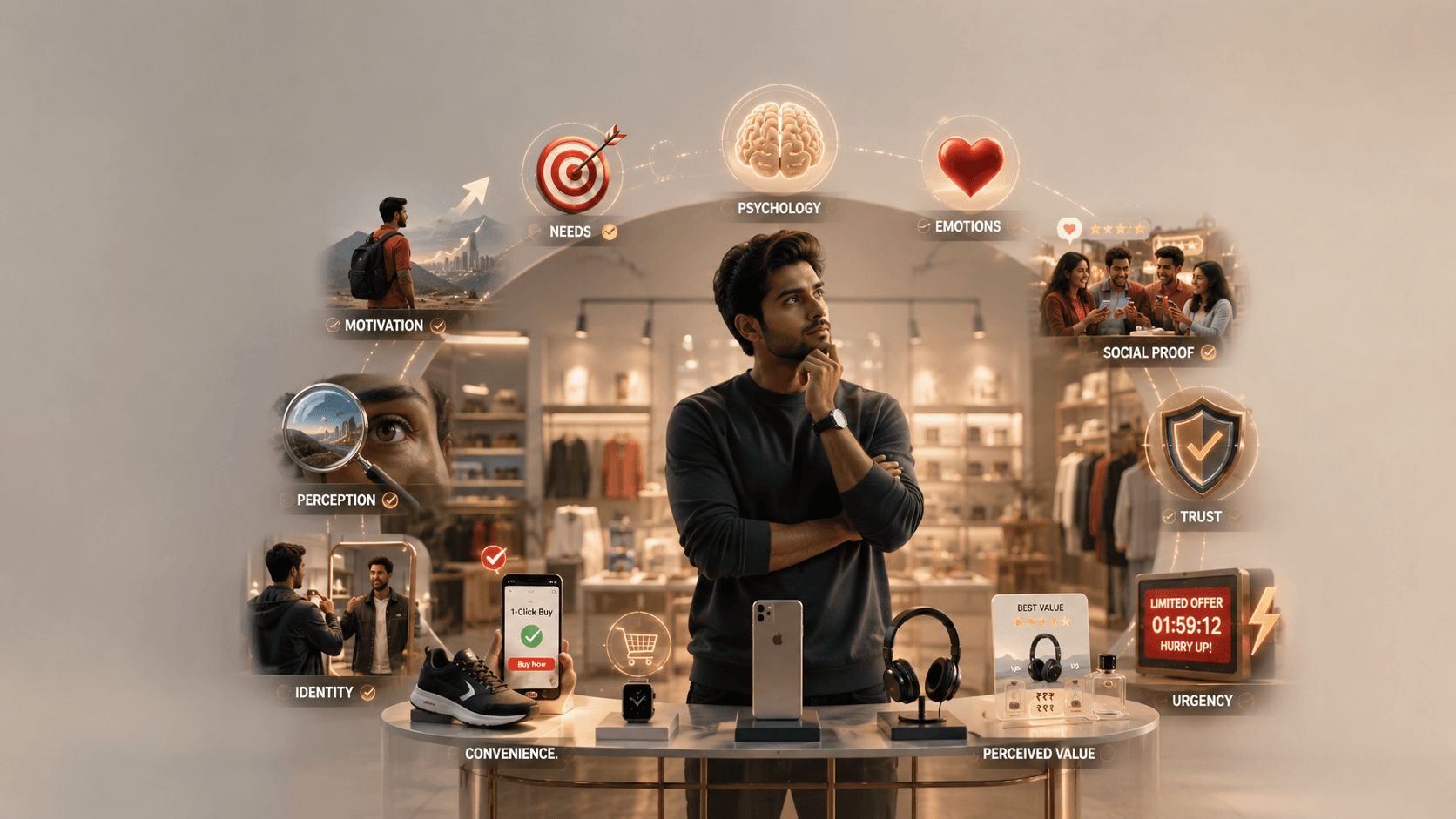




Have you ever gone to a supermarket to buy just one thing…
and somehow walked out with five?
Aap milk lene gaye the.
Entrance pe chocolate dikhi. Aage chips pe “Buy 1 Get 1 Free” laga tha. Billing counter pe chewing gum rakhi thi.
You didn’t plan to buy any of them.
But you did.
Now ask yourself:
Why?
Did you suddenly need chocolate?
Probably not.
Did you suddenly need chewing gum?
Probably not.
Something else influenced your decision.
And that “something else” is where Consumer Psychology begins.
Consumer psychology is the study of how people’s thoughts, emotions, perceptions, habits and social influences affect the way they make decisions as consumers.
And if you genuinely understand it, you’ll start looking at marketing differently.
Aap advertisement ko sirf advertisement ki tarah nahi dekhoge.
You’ll start asking:
Why is this message written this way?
Why is this product placed here?
Why is this celebrity associated with the brand?
Why does this offer feel attractive?
Why does this brand make me feel a certain way?
And most importantly:
What is this brand trying to make me think, feel or do?
That’s consumer psychology.
People Don’t Always Buy Products
Let’s start with something very simple.
Why do millions of people trust Dettol for hygiene and protection?
Why are people happy to spend ₹300-₹400 on a coffee at Starbucks, when coffee is available almost everywhere?
Why can a Rolex cost thousands of times more than a basic watch that also tells the time?
And why does Nike sell much more than just shoes?
The answer isn’t simply product quality.
People often buy what a product means to them, not only what it physically does.
A Rolex can represent status.
Nike can represent performance, confidence or achievement.
Starbucks can represent experience and lifestyle.
Dettol can represent safety and trust.
This doesn’t mean every customer buys for exactly the same reason.
It means the functional product is only one part of the customer’s decision.
There can also be an emotional, social or psychological layer.
The product is visible.
The meaning attached to the product is not.
And marketers spend a lot of time building that meaning.
Let’s Understand This With a Simple Example
Imagine Aman launches a new earbuds brand.
The product is genuinely good.
Great sound.
Good battery life.
Comfortable.
Affordable.
The website looks fine.
But sales aren’t coming.
Why?
Because nobody knows Aman.
Nobody knows whether the product is actually good.
Nobody has a reason to trust the brand.
Now imagine a popular tech creator starts using the earbuds.
Customers begin leaving positive reviews.
The packaging looks premium.
The website shows detailed product information.
People start seeing the brand repeatedly.
Their friends start recommending it.
Now ask yourself:
Did the earbuds suddenly become better?
No.
The physical product didn’t change.
But something else changed.
Perception changed.
Trust changed.
Uncertainty reduced.
And because the customer’s perception changed, the buying decision could change too.
This is one of the most important things to understand about consumer psychology:
Customers don’t experience your product only through the product itself. They experience it through everything they see, hear and believe about it.
So How Do Brands Create These Perceptions?
This is where consumer psychology becomes useful for marketers.
Knowing that people care about emotions isn’t enough.
You need to understand how brands create and reinforce those associations.
Let’s take Apple.
You’ve probably heard someone say:
“Yaar, iPhone mein features comparatively kam hain. Phir bhi itna expensive kyun hai?”
It’s a fair question.
Because Apple isn’t competing only on a specification sheet.
Over many years, Apple has built strong associations around design, simplicity, innovation, premium experience and status.
And those associations are reinforced through many touchpoints.
You see the products in films and entertainment.
You see creators using them.
You see public figures using them.
You see the same visual language across products, stores, packaging and advertising.
There have also been documented instances of product placement and celebrity or entertainment-industry use, although the exact commercial arrangement behind any particular appearance isn’t always public.
The important marketing lesson isn’t simply:
“Celebrities use Apple.”
It’s what repeated exposure can do to perception.
If you repeatedly see a product associated with successful, creative or aspirational people, that product can start carrying some of those associations in your mind.
The phone hasn’t changed.
The meaning attached to the phone has.
That’s consumer psychology at work.
Another Example: Zomato
Now let’s look at something very different.
It’s late at night.
You’re hungry.
You open Zomato.
You might see:
50% OFF
Someone else might see:
FREE DELIVERY
Another customer might see:
Recommended for you
Someone else might see restaurants they’ve ordered from before.
Why?
Because customers don’t behave in exactly the same way.
Imagine one customer frequently responds to discounts.
Another rarely cares about discounts but regularly orders when delivery is free.
Another frequently orders premium restaurants.
Another mostly orders late at night.
If a platform understands these behavioural patterns, it can make its communication more relevant to different customers.
The basic process looks like this:
Customer behaviour → Data → Insight → Personalised communication → Potentially more relevant experience
That is where consumer psychology and data-driven marketing meet.
The marketer isn’t simply asking:
“What offer should we show everyone?”
They’re asking:
“What have we learned about this customer, and what might be most relevant to them?”
What Actually Influences a Buying Decision?
Now let’s get into the psychology itself.
There isn’t one magic reason why people buy.
Different situations activate different influences.
A person buying a ₹20 chocolate is making a very different decision from someone buying a ₹2 lakh car.
But there are some psychological forces marketers repeatedly encounter.
1. Emotion
Imagine two advertisements for the same running shoes.
The first says:
“Lightweight. 280 grams. Breathable mesh. EVA midsole.”
The second shows someone training every morning, struggling, improving and eventually crossing the finish line.
Both communicate something about the product.
But the second one is trying to connect the product with an emotion:
Achievement.
Confidence.
Determination.
This is why brands often sell more than functional benefits.
They connect products with feelings.
The important lesson for a marketer is not:
“Always use emotion.”
It’s:
Understand what your customer wants to feel or achieve, then decide whether your communication should connect with that motivation.
2. Social Proof
You’re looking for a new restaurant.
One restaurant has 3 reviews.
Another has 4.7 stars from thousands of customers.
Which one feels safer?
You haven’t personally tested either restaurant.
So you use other people’s behaviour and opinions as information.
That’s social proof.
Reviews, ratings, testimonials, customer numbers, creator recommendations and user-generated content can all provide signals that other people have already chosen and experienced the product.
This becomes particularly useful when the customer is uncertain.
Research on consumer psychology and persuasion has long examined how social information can influence judgement, while marketing practice commonly uses reviews and testimonials to reduce uncertainty.
The marketer’s question becomes:
“What evidence can I give customers that makes choosing us feel safer?”
3. Scarcity
Now imagine two products.
Product A:
“Available anytime.”
Product B:
“Only 3 left.”
The second one can suddenly feel more urgent.
Why?
Because limited availability can change how we perceive an opportunity.
Scarcity can increase desirability and purchase intention, but it isn’t a universal magic button. Research shows that its effect varies depending on the type of scarcity, product and situation.
That’s an important lesson.
A marketer shouldn’t blindly add:
“Only 2 left!”
to every product page.
The question should be:
“Is there a genuine reason for urgency or limited availability, and does communicating it help the customer make a decision?”
False scarcity might create a short-term click.
It can also destroy trust.
4. Anchoring
Now imagine you see:
₹9,999
struck through.
And next to it:
₹4,999
The ₹4,999 price may immediately feel like a great deal.
But why?
Because the first number gives you a reference point.
That first number is an anchor.
The second number is then judged relative to it.
This is why the way prices are presented can affect how customers perceive value.
The same principle can appear in:
- Discounted prices
- Product comparisons
- Premium plans
- Pricing tables
- “Starting from” prices
The marketer’s job isn’t simply to decide:
“What price should we charge?”
It’s also to understand:
“What reference point will customers use when judging this price?”
5. Loss Aversion
Imagine someone tells you:
“You can save ₹500 today.”
Now compare it with:
“You’ll lose your ₹500 discount if you wait until tomorrow.”
The information is similar.
But the second message frames the decision around a potential loss.
This connects to loss aversion, the well-studied idea that losses can have a stronger psychological impact than equivalent gains in many situations. Research also shows that the strength of this effect varies depending on context, so it shouldn’t be treated as an absolute rule.
This is one reason marketers use messages around:
“Don’t miss out.”
“Offer ends tonight.”
“Your free delivery expires today.”
Again, the lesson isn’t to scare customers into buying.
It’s to understand how the framing of a decision can influence perception.
6. Familiarity
Now think about two brands.
You’ve seen Brand A hundreds of times.
You’ve never heard of Brand B.
Even before comparing their products, Brand A may feel more familiar.
And familiarity can reduce the mental effort involved in choosing.
This is one reason consistent branding matters.
The same logo.
The same colours.
The same tone.
The same type of experience.
Repeated exposure helps create recognition.
And recognition can matter when customers are making quick decisions.
This is one reason brands don’t necessarily need to shout:
“BUY NOW!”
in every advertisement.
Sometimes they simply need to remain present and memorable.
7. Convenience and Choice
Here’s another psychological factor marketers often underestimate.
People don’t always want more choices.
Imagine you’re buying headphones and a website shows you 147 nearly identical options.
Instead of feeling excited, you may feel confused.
Now imagine the website says:
Best for Travel
Best for Gaming
Best Value
Best for Calls
Suddenly the decision becomes easier.
The products haven’t changed.
The website has changed how the choice is presented.
This is called choice architecture.
The way options are organised, labelled and presented can influence how people navigate a decision.
That’s why good marketers don’t only ask:
“What products should we offer?”
They also ask:
“How can we make the decision easier for the customer?”
Notice What’s Happening
Now look at all these examples together.
Emotion changes how we feel.
Social proof changes how we judge uncertainty.
Scarcity can change how we perceive availability and urgency.
Anchoring can influence how we perceive value and price.
Loss aversion can change how we frame what is at stake.
Familiarity can make a brand feel recognisable and easier to choose.
Choice architecture can make the decision easier or harder.
None of these works independently in every situation.
And none of them guarantees a purchase.
They’re simply different psychological forces that can influence how people process information and make decisions.
That’s why consumer psychology is so interesting.
Understanding why people buy is only one part of marketing. The real skill is knowing how to turn those insights into better positioning, branding and marketing decisions. Learn how marketers do this in practice with the Positioning.co.in Marketing OS Program.
Consumer Psychology Isn’t About Manipulation
There’s an important line between persuasion and manipulation.
A marketer can use social proof by showing genuine customer reviews.
Or they can fake reviews.
A brand can communicate genuine scarcity.
Or it can create fake scarcity.
A company can simplify choices.
Or it can deliberately hide important information.
These may all influence behaviour, but they’re not equally ethical.
Good marketing should help customers make a decision by making the value clearer, reducing uncertainty and improving the experience.
Not by deceiving them.
Because short-term conversion isn’t the only goal.
Trust is an asset.
And once you lose it, no psychological trigger can permanently fix the problem.
Your Job as a Marketer
From now on, whenever you see an advertisement, don’t just ask:
“Is this a good ad?”
Ask:
What emotion is it trying to create?
When you see thousands of reviews, ask:
“How is social proof reducing uncertainty?”
When you see:
“Only 2 left.”
ask:
“Why is scarcity being used here?”
When you see:
₹9,999 → ₹4,999
ask:
“What is the anchor?”
When a celebrity uses a product, ask:
“What association is the brand trying to build?”
When a website gives you only three recommended options instead of fifty, ask:
“How is the choice being structured?”
This is how you start seeing marketing differently.
You’re no longer just consuming the marketing.
You’re analysing it.
One Simple Exercise
Choose one brand you personally use.
It could be:
Apple.
Nike.
Amul.
Zomato.
Blinkit.
Or any other brand.
Now reverse-engineer it.
Ask yourself:
1. What problem is this brand solving?
2. What emotion does it want customers to associate with the brand?
3. What makes customers trust it?
4. Where do you see social proof?
5. Does the brand use scarcity, urgency or FOMO?
6. How does it present prices or choices?
7. What habits or routines has it built?
8. What does the brand want people to remember?
And finally:
Why would someone choose this brand instead of its competitors?
Don’t just search for the answer.
Observe the brand.
Look at its advertisements.
Look at its website.
Look at its packaging.
Look at its social media.
Look at how customers talk about it.
Try to connect the dots.
Because that’s the real skill we’re trying to build.
You’re not just learning consumer psychology.
You’re learning how to see marketing through the customer’s eyes.
And once you can do that, advertisements, products and brands start looking very different.
That’s when marketing becomes an interesting game.
Leave a Reply