





Imagine two friends, Rahul and Arjun, opening cafés on the same street.
Both invest almost the same amount of money.
Both hire good baristas.
Both serve good coffee.
Both create modern-looking cafés.
But six months later…
Rahul’s café is packed.
People are waiting for tables.
His Instagram is full of customer photos.
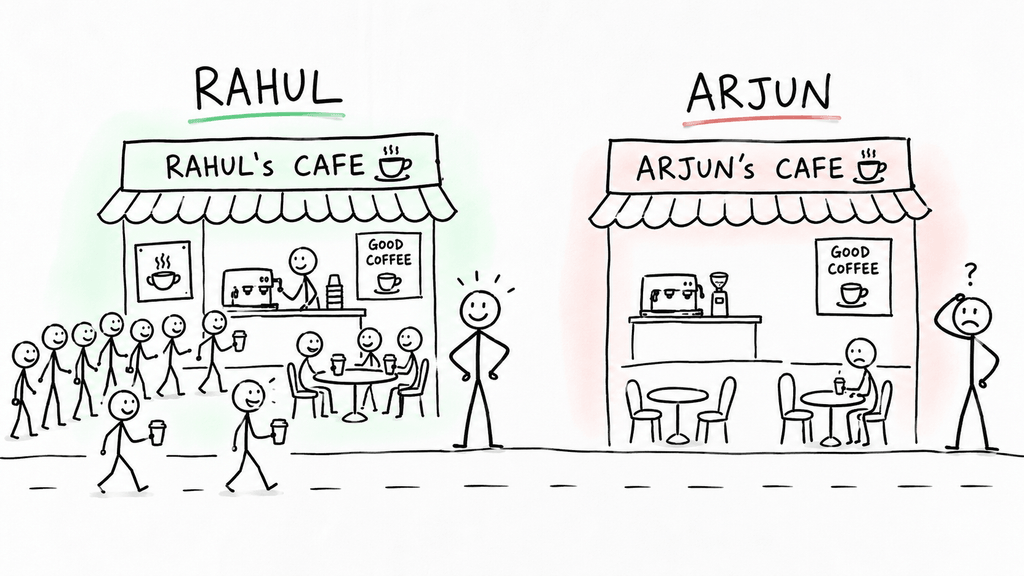
Arjun’s café is struggling.
He’s running advertisements.
Posting on Instagram.
Offering discounts.
But sales still aren’t coming.
So what happened?
Did Rahul have better coffee?
No.
A better coffee machine?
No.
A much bigger budget?
No.
The biggest difference wasn’t the coffee.
It was the strategy behind the business.
Before opening his café, Rahul studied the neighbourhood.
He noticed that many offices were nearby and a lot of young professionals were looking for a comfortable place to work, have meetings and grab good coffee.
So instead of trying to attract everyone, he decided to focus on them.
Fast Wi-Fi.
Charging ports.
Comfortable workspaces.
Affordable weekday lunch combos.
And even his marketing had one clear message:
“Your second office, with better coffee.”
Arjun took a completely different approach.
He believed:
“Agar coffee acchi hai, customers automatically aa jayenge.”
So he opened the café.
Posted occasionally.
Ran some ads.
Gave random discounts.
But none of these activities had a clear direction.
Rahul wasn’t simply doing marketing.
He was making marketing decisions based on a strategy.
And that’s what we’re going to understand in this chapter.
What Is a Marketing Strategy?
Ask someone:
“How do you market a business?”
You might hear:
“We run Google Ads.”
“We’re active on Instagram.”
“We do SEO.”
“We post content.”
“We work with influencers.”
These are all marketing activities.
But they aren’t the strategy.
Before choosing any tool, a marketer needs to answer much bigger questions:
Who are we trying to serve?
What problem are we solving?
Why should they choose us?
Who are we competing with?
Where can we win?
What do we want to achieve?
How are we going to grow?
The answers to these questions start forming your marketing strategy.
In simple words:
A marketing strategy is the thinking behind how a business will reach the right customers, create value for them, stand out from alternatives and achieve its business goals.
Notice something.
It doesn’t start with Google Ads.
It doesn’t start with Instagram.
It starts with decisions.
Strategy Starts With the Goal
Before deciding how to market something, you need to know:
What are we actually trying to achieve?
Imagine a company says:
“We want more customers.”
That’s a start.
But it’s not specific enough.
More customers for what?
Maybe the business wants to:
Increase revenue.
Increase market share.
Launch a new product.
Enter a new market.
Improve profitability.
Increase repeat purchases.
These goals can lead to completely different strategies.
Imagine two companies.
Company A wants to acquire as many new customers as possible.
Company B already has millions of customers but wants to increase repeat purchases.
Both have the same marketing tools available.
But should they use the same strategy?
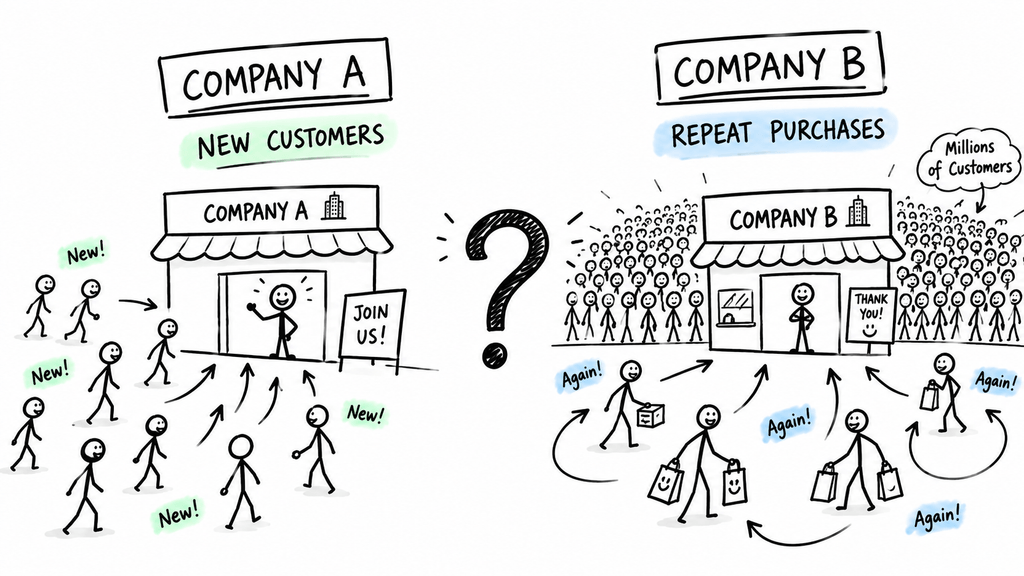
Obviously not.
Company A may focus heavily on acquisition.
Company B may focus on retention, loyalty and customer experience.
So the first question in strategy is:
“What are we trying to achieve?”
Because without a clear objective, you can’t even decide whether your strategy is working.
Strategy vs Plan vs Tactics vs Tools
This is one distinction I want you to remember throughout this course.
Let’s use a simple example.
Imagine Aman launches an earbuds brand.
His strategy is:
Become the preferred earbuds brand for young professionals who want premium sound and reliable call quality without paying flagship prices.
Now he needs a plan.
Maybe:
Launch in three major cities.
Build awareness over six months.
Use creators for product demonstrations.
Capture high-intent searches.
Sell through the website and marketplaces.
Then come the tactics.
YouTube comparison videos.
Google Search campaigns.
Instagram Reels.
Retargeting.
Email campaigns.
And finally, the tools.
Google Ads.
Meta Ads Manager.
GA4.
Google Tag Manager.
Canva.
CRM.
And so on.
So remember:
Strategy
↓
Plan
↓
Tactics
↓
Tools
And here’s the important part:
If you change the tool, your strategy may stay exactly the same.
If you change the strategy, almost everything underneath it can change.
That’s why marketers should never start with:
“Which tool should I learn?”
Start with:
“What are we trying to achieve?”
Strategy Means Choosing
Here’s another thing beginners often misunderstand.
They think a strategy means:
“Let’s do everything.”
SEO.
Google Ads.
Instagram.
YouTube.
Influencers.
Email.
Content.
Affiliate marketing.
Everything.
But that’s not strategy.
That’s a shopping list.
Strategy involves choices.
If you decide to target young professionals, you’re choosing not to prioritise everyone else.
If you decide to compete on premium experience, you’re choosing not to compete primarily on the lowest price.
If you decide to focus on SEO, you may choose to invest less in certain paid channels.
If you decide to sell only through your own website, you’re making a different distribution choice from a brand that wants to be available everywhere.
A strategy therefore answers two questions:
What are we going to do?
And equally importantly:
What are we not going to do?
That’s where strategy gets difficult.
Because saying yes to everything feels safe.
But a business with limited money, time and people can’t do everything equally well.
Strategy is not just choosing what to pursue. It’s choosing what to prioritise.
Step 1: Understand the Market
Now let’s actually build a strategy.
The first step is understanding the market.
Before investing money, a marketer needs to ask:
Is there demand?
What problems are customers facing?
What trends are changing the market?
Who are the competitors?
What are competitors doing well?
Where are customers still unhappy?
The goal isn’t simply to collect information.
The goal is to find opportunities.
Imagine every food delivery app in your market has customers complaining about slow delivery.
That’s not just a complaint.
For a marketer, it could be an opportunity.
Maybe a new brand can compete around speed.
Or imagine every skincare brand is targeting women between 18 and 35.
Maybe there’s an underserved customer group that nobody is speaking to properly.
That’s where research becomes useful.
Strategy built without research is mostly assumption.
And assumptions become expensive when you start spending money on them.
Step 2: Understand the Customer
Once you understand the market, ask:
Who exactly are we trying to serve?
This is where many businesses make a mistake.
They say:
“Our product is for everyone.”
But when you try to speak to everyone, your message often becomes generic.
Let’s go back to Aman.
He’s launching earbuds.
His potential market includes:
Students.
Gamers.
Travellers.
Fitness enthusiasts.
Music lovers.
Young professionals.
Parents.
Almost everyone could technically use earbuds.
But that doesn’t mean Aman should market to everyone in the same way.
Suppose his research shows that young professionals have a particular problem:
They spend hours on calls.
They need comfortable earbuds.
They want reliable microphones.
They don’t want to pay flagship prices.
Now the strategy becomes much clearer.
And this is where STP comes in.
STP: Choosing Who You Want to Win
STP stands for:
Segmentation
Targeting
Positioning
Let’s simplify it.
Segmentation
The market isn’t one giant group.
You divide it into groups based on meaningful differences in needs, behaviour, characteristics or preferences.
For earbuds:
Students
Gamers
Travellers
Fitness enthusiasts
Working professionals
Targeting
Now you choose:
Which group do we want to focus on?
Aman chooses:
Young working professionals.
Positioning
Now comes the interesting part.
What do we want this audience to think about our brand?
Maybe:
“Premium earbuds built for your workday.”
Now the product, communication and customer experience can all support that idea.
That’s the power of STP.
It helps a business stop saying:
“We’re for everyone.”
and start saying:
“This is who we’re really building for.”
Step 3: Study the Competition
Now ask:
Who are customers choosing instead of us?
And don’t only look at brands selling exactly the same product.
If Aman sells earbuds, his alternatives could include:
Other earbuds.
Headphones.
Wired earphones.
Or even the product the customer already owns.
The real question is:
“What alternatives can solve the customer’s problem?”
Now study them.
What do they do well?
What do customers like?
What do customers complain about?
What do they charge?
How do they position themselves?
What do customers associate with them?
And then ask:
Where is the gap?
Because your strategy needs a reason to exist.
Step 4: Decide How You Will Win
Now we have:
A market.
A customer.
Competitors.
And customer problems.
The next question is:
Why should this customer choose us?
This is where positioning becomes important.
Let’s say every competitor is shouting:
“More features.”
“Better sound.”
“Best technology.”
Aman doesn’t necessarily need to shout louder.
Maybe he can own a different idea:
“The earbuds designed for your workday.”
Now he’s not trying to win every possible customer.
He’s trying to become highly relevant to a specific customer with a specific need.
That’s strategic thinking.
You don’t always win by being better at everything.
Sometimes you win by becoming the most relevant choice for a particular customer and problem.
Step 5: Build Your Value Proposition
Now answer:
Why should customers care?
This is where your value proposition comes in.
A simple way to understand it is:
Why should I choose you instead of the alternatives?
Let’s use Aman again.
Suppose his earbuds have:
30-hour battery life.
That’s a feature.
What does that mean?
You don’t need to charge them every day.
That’s a benefit.
Now imagine his target customer travels frequently.
The value becomes:
Reliable listening throughout your busy day without constantly worrying about charging.
Now we’re moving through:
Feature
↓
Benefit
↓
Customer value
That’s how marketers should think.
Don’t stop at:
“What does our product have?”
Ask:
“Why does that matter to this particular customer?”
That’s the difference between listing features and communicating value.
Step 6: Build the Marketing Mix
Now we can start making decisions around the famous 4 Ps.
Product
Price
Place
Promotion
But don’t treat them as four separate boxes.
They need to support the strategy.
Imagine Aman wants to build a premium earbuds brand for professionals.
His:
Product needs to feel premium.
Price needs to support the positioning.
Place needs to match the kind of experience he wants customers to have.
Promotion needs to communicate the right value.
Now imagine something completely different.
The company says:
“Premium earbuds for professionals.”
But then:
The product looks cheap.
The price is constantly discounted.
The main message is:
“CHEAPEST EARBUDS ONLINE!”
And the brand is built entirely around bargain hunting.
Nothing is necessarily wrong with any individual decision.
But together, they create a contradiction.
The customer doesn’t know what the brand actually stands for.
That’s why:
The 4 Ps need to work together, not independently.
Step 7: Choose the Right Channels
Only now should we ask:
Where should we reach the customer?
This is where SEO, Google Ads, Meta Ads, YouTube, email, influencers and other channels come in.
But don’t choose them because they’re popular.
Choose them because they make sense for your customer and objective.
Suppose Aman discovers that his audience:
Searches Google before buying electronics.
Watches YouTube reviews.
Uses Instagram regularly.
And compares products on marketplaces.
Now his channel strategy has a reason.
He could use:
Google Ads to capture high-intent searches.
YouTube creators to demonstrate the product.
Instagram to build awareness.
Retargeting to bring interested visitors back.
Email to follow up and retain customers.
Notice the difference.
He isn’t saying:
“Let’s do Instagram because everyone does Instagram.”
He’s saying:
“Our customers behave this way, so these channels make strategic sense.”
That’s marketing thinking.
Step 8: Measure Whether the Strategy Is Working
Launching the strategy isn’t the end.
Now you need to measure it.
But don’t measure everything just because you can.
The metrics should connect to the business objective.
If you’re trying to acquire customers, you might care about:
Customer Acquisition Cost, or CAC.
If you’re focused on long-term customer value, you might look at:
Customer Lifetime Value, or LTV.
Imagine Aman spends ₹500 to acquire one customer.
That customer buys ₹300 worth of products and never returns.
That’s obviously a problem.
But another customer costs ₹500 to acquire and generates ₹4,000 over the next two years.
That’s a very different situation.
This is why marketers need to understand the relationship between acquisition cost and customer value.
A campaign can generate:
Clicks.
Likes.
Followers.
Traffic.
And still be bad for the business.
The real question is:
“Is our marketing helping the business achieve its objective?”
Knowing individual marketing tactics is useful. Knowing how to decide which tactics to use, why to use them and how they fit together is what turns marketing into strategy. Learn this way of thinking through real frameworks and examples in the Positioning.co.in Marketing OS Program.
Now Let’s Build Aman’s Strategy From Start to Finish
Let’s put everything together.
Business Objective
Build a profitable earbuds business and acquire young professional customers.
Market
A crowded earbuds market with established competitors and many budget alternatives.
Customer
Young professionals who spend significant time on calls and want good sound, comfort and reliability without paying flagship prices.
Problem
They want dependable earbuds for work and everyday use, but many options force them to compromise between price, comfort and call quality.
Competition
Established audio brands, budget earbuds and other personal audio products.
Opportunity
Own the space of reliable, premium-feeling earbuds for the workday.
Target
Young working professionals.
Positioning
Premium earbuds designed for your workday.
Value Proposition
Reliable call quality, long battery life and all-day comfort without flagship pricing.
Product
Comfortable fit.
Strong microphones.
Long battery.
Easy device switching.
Premium design.
Price
Premium compared with budget earbuds, but below flagship products.
Place
Brand website.
Major marketplaces.
Selected retail partners.
Promotion
YouTube product reviews.
Search advertising.
Instagram content.
Retargeting.
Email.
Measurement
CAC.
Conversion rate.
Revenue.
Repeat purchases.
Customer retention.
LTV.
Now notice something.
None of these decisions are random.
Each one connects to the decision before it.
That’s what strategy looks like.
The Entire Strategy in One Framework
If you want to simplify everything we’ve learned, remember this:
Business Goal
↓
Market
↓
Customer
↓
Problem
↓
Competition
↓
Opportunity
↓
Target
↓
Positioning
↓
Value Proposition
↓
Product, Price, Place, Promotion
↓
Channels & Tactics
↓
Measurement
↓
Learn & Improve
This isn’t a rigid formula.
Real businesses are messy.
You may discover new information halfway through.
Customer behaviour can change.
Competitors can change their prices.
A new technology can appear.
A new competitor can enter the market.
Your business objective can change.
So strategy needs to evolve.
A marketing strategy isn’t something you write once, put in a presentation and forget.
It’s a living system of decisions that changes as the market changes.
Common Marketing Strategy Mistakes
1. Starting with the tools
“Should we run Google Ads or Meta Ads?”
Wrong first question.
Start with:
“Who are we trying to reach and what are we trying to achieve?”
2. Trying to target everyone
If everyone is your target customer, you probably haven’t made a real targeting decision.
3. Copying competitors
Your competitor’s strategy was built for their customers, their resources and their market position.
Copying their tactics doesn’t give you their strategy.
4. Confusing activity with progress
Posting every day doesn’t automatically mean you’re building a brand.
Running 20 campaigns doesn’t automatically mean you’re growing.
Activity is not the same as results.
5. Changing tactics without questioning the strategy
Sometimes marketers keep changing:
Creative.
Audience.
Headline.
Landing page.
Campaign.
But the real problem is much deeper.
Maybe the positioning is wrong.
Maybe the target customer is wrong.
Maybe there isn’t enough demand.
Maybe the value proposition isn’t strong enough.
Don’t keep optimising the engine when the destination is wrong.
Your Assignment
Now choose any business.
It can be:
A café.
An earbuds brand.
A clothing company.
A SaaS product.
A local business.
Or even your own business.
And build a simple strategy.
Answer these questions:
1. What is the business trying to achieve?
2. Who is the target customer?
3. What problem are they facing?
4. What alternatives are they using today?
5. What are competitors doing?
6. Where is the opportunity?
7. Who are you choosing to target?
8. How do you want them to perceive your brand?
9. Why should they choose you?
10. What should your Product, Price, Place and Promotion look like?
11. Which channels make sense and why?
12. How will you measure success?
And one final question:
What are you deliberately choosing NOT to do?
Because that’s where you really start thinking strategically.
Strategy First
Let’s go back to Rahul and Arjun.
At the beginning, both cafés looked almost identical.
Similar money.
Similar products.
Similar locations.
But Rahul understood something Arjun didn’t.
Good marketing isn’t about doing more marketing activities.
It’s about making better decisions.
Understanding the market.
Understanding people.
Choosing who you want to serve.
Finding an opportunity.
Deciding how you want to win.
Then choosing the right tools to execute that decision.
That’s why we don’t start with:
“Which tool should I learn?”
We start with:
“What are we trying to achieve, who are we trying to help, and why should they choose us?”
Because:
Tools tell you how to do something.
Strategy tells you what to do, when to do it, and why you’re doing it.
Strategy first.
Tools later.
Leave a Reply