
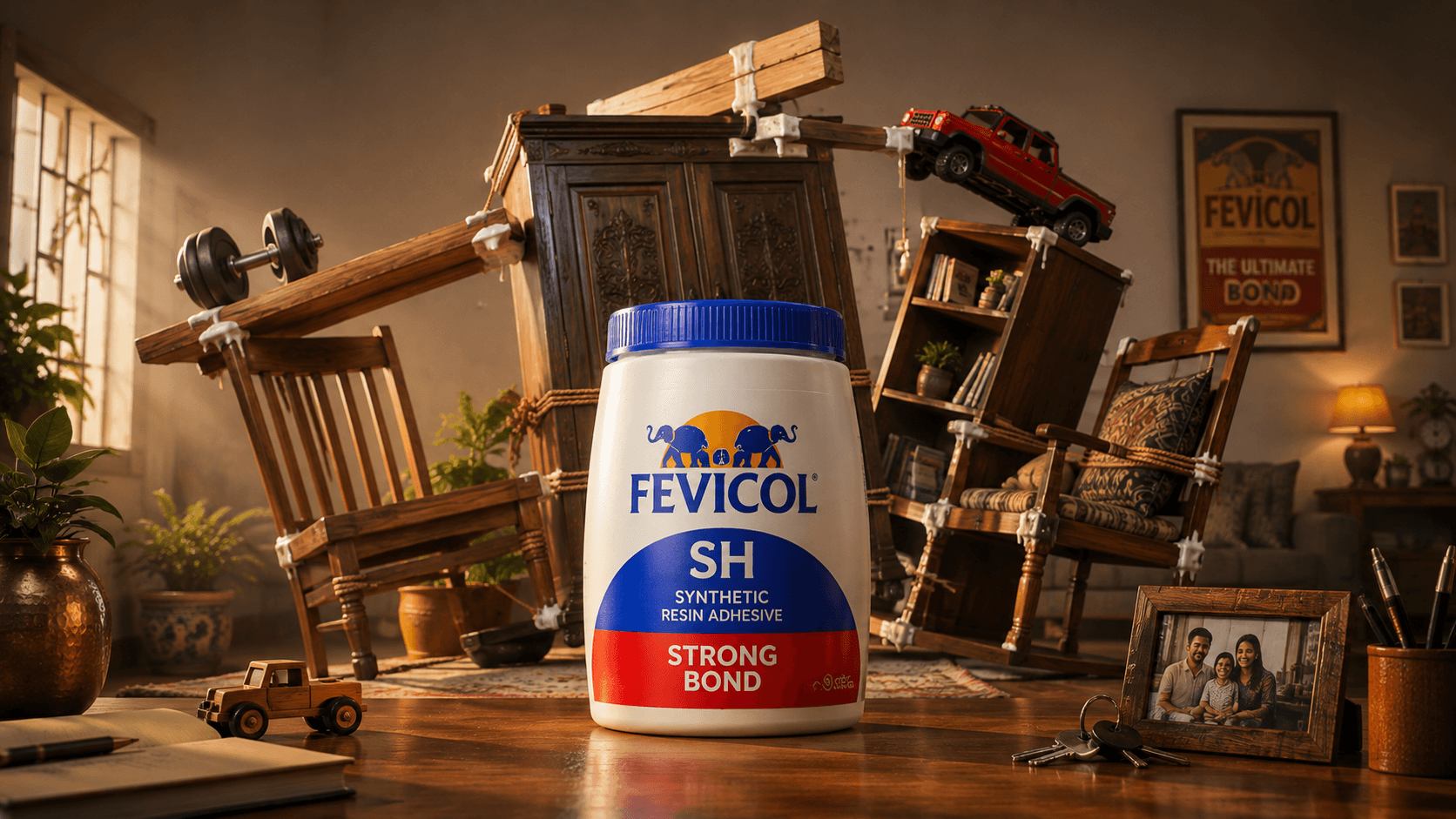




Imagine Rahul has just moved into a new house.
His parents have bought a beautiful wooden dining table. A few months later, one of its legs becomes loose.
Rahul calls a carpenter.
The carpenter opens his toolbox.
Inside are hammers, screwdrivers, measuring tapes, nails and one familiar white bucket.
Fevicol.
Rahul smiles.
“Why does every carpenter use Fevicol?”
The carpenter laughs.
“Because I can’t afford to make mistakes.”
Rahul watches as the carpenter gets to work.
He doesn’t compare five different adhesive brands.
He doesn’t ask which one is the cheapest.
He simply reaches for Fevicol.
A few minutes later, the table is repaired.
Before leaving, the carpenter looks at Rahul and says:
“This table will outlive both of us.”
Rahul laughs.
“It’s just glue.”
The carpenter smiles.
“No. It’s Fevicol.”
That evening, Rahul switches on the television.
A funny advertisement appears.
A bus is so overcrowded that people are hanging from every side.
Yet somehow, nobody falls.
The camera moves toward the back of the bus.
A Fevicol poster.
Rahul laughs.
A few days later, he sees another Fevicol advertisement.
This time, the story is completely different.
But once again, the joke revolves around something refusing to break or separate.
Rahul notices something strange.
The advertisements aren’t explaining:
- Chemical composition
- Drying time
- Adhesive technology
- Bonding specifications
They’re telling stories.
And making people laugh.
So Rahul asks his grandfather:
“Why would a glue company spend so much money making people laugh?”
His grandfather looks at the repaired dining table.
“Because Fevicol isn’t really selling glue.”
Rahul looks confused.
“Then what is it selling?”
His grandfather replies:
“Confidence.”
“The confidence that once something is joined, it will stay together.”
And suddenly, the strategy becomes clearer.
People don’t wake up excited about buying adhesive.
They want a chair that doesn’t wobble.
A cupboard that doesn’t fall apart.
A table that lasts.
A piece of furniture that survives years of daily use.
The glue is simply the product that makes that promise possible.
Fevicol’s real marketing opportunity was never the glue itself.
It was the trust surrounding the glue.
And that’s what makes Fevicol such a fascinating marketing case study.
Fevicol Doesn’t Sell Glue. It Sells Trust.
Let’s go back to Rahul.
A few days after the dining table is repaired, Rahul visits his uncle’s furniture workshop.
Wood is stacked everywhere.
Half-finished cupboards stand against the wall.
Tables, chairs, beds and shelves fill the room.
And everywhere Rahul looks, he sees the same thing.
Fevicol buckets.
Not one.
Dozens.
Rahul asks:
“Do you really use this much glue?”
His uncle laughs.
“No.”
“I use this much trust.”
Rahul looks confused.
His uncle picks up two pieces of wood.
“When I build a cupboard, I’m not just selling wood.”
“I’m selling my reputation.”
That’s the important part.
If the cupboard breaks after six months, the customer doesn’t blame the adhesive.
They blame the carpenter.
The carpenter therefore has a very different relationship with the product.
For him, the adhesive isn’t an insignificant component.
It’s part of the risk he is taking.
And when failure is costly, trust becomes valuable.
Customers Don’t Think About Glue
Imagine Rahul buys a new dining table.
He doesn’t think:
“I hope the adhesive inside this table is good.”
He simply expects the table to last.
Customers usually notice the adhesive only when something goes wrong.
That makes the category unusual.
The best adhesive isn’t necessarily the one customers think about every day.
It’s the one they never have to worry about.
That’s where Fevicol’s brand strength becomes powerful.
It turns an invisible component into a visible promise:
This will hold.
Trust Can Beat Features
Imagine Rahul visits two furniture makers.
The first says:
“Our adhesive dries in 20 minutes.”
The second says:
“I’ve been using Fevicol for 25 years.”
Which statement creates more confidence?
The second.
Not because the first statement is useless.
But because the second contains something more powerful:
experience.
Years of successful use become evidence.
This is one of the most important principles in marketing:
People don’t trust claims simply because brands make them. They trust evidence that reduces their perceived risk.
For a professional whose reputation depends on the finished product, that matters enormously.
When the Brand Becomes the Category
Now Rahul notices something even more interesting.
Customers entering furniture shops don’t always ask:
“Which adhesive did you use?”
Sometimes they ask:
“Is it made with Fevicol?”
That’s a very different level of brand recognition.
The customer isn’t merely recognising the company.
The brand has become a shortcut for a desired outcome:
Strong. Reliable. Long-lasting.
In India, “Fevicol” is also commonly used as a generic-sounding shorthand for white adhesive, which shows how deeply the brand has entered everyday language.
Very few brands achieve that level of mental availability.
The Brand Became a Shortcut for Trust
Think about your own behaviour.
If someone you trust recommends a product, you don’t start from zero.
You don’t research every possible alternative.
Their recommendation reduces uncertainty.
Brands can create a similar shortcut.
A strong brand tells the customer:
“You don’t need to worry as much about whether this will work.”
That is enormously valuable when the consequences of failure are high.
A carpenter doesn’t want to discover six months later that the adhesive he chose was a mistake.
He wants confidence before the mistake can happen.
That’s what Fevicol’s reputation provides.
Fevicol’s First Big Advantage: Solve a Real Problem
Now let’s go back to the beginning.
Imagine India in the early days of modern furniture manufacturing.
Carpenters faced practical challenges with the adhesives available to them.
Some traditional options were inconvenient to prepare and unpleasant to work with.
Fevicol entered the market with a ready-to-use synthetic adhesive that made the carpenter’s job easier.
This matters because strong brands don’t begin with advertising.
They begin with a useful solution to a real problem.
The question isn’t:
“How do we sell more?”
It’s:
“What problem can we solve better?”
If the product genuinely improves someone’s work, marketing has something real to communicate.
Win the Person Who Influences the Decision
Here’s where Fevicol’s strategy becomes especially clever.
Imagine Rahul wants to buy a custom wardrobe.
Who decides which colour it should be?
Rahul.
Who decides the design?
Rahul and the carpenter.
Who decides which adhesive is used inside?
Usually, the carpenter.
Rahul may never think about it.
But the carpenter does.
That means Fevicol doesn’t have to convince every household individually.
It can build preference among the professionals who influence thousands of furniture purchases.
This is a powerful B2B2C dynamic.
Win the professional, and you can influence the consumer.
The Smartest Influencer May Not Have Followers
Today, brands talk constantly about influencers.
Followers.
Reach.
Engagement.
Creator partnerships.
But influence existed long before Instagram.
Imagine Rahul wants to buy a laptop.
An advertisement says:
“This is the best laptop.”
Then his friend, who has worked with computers for ten years, says:
“I’ve used this one for five years. Buy it.”
Which recommendation feels more credible?
Probably the friend’s.
Because expertise creates authority.
Carpenters occupy a similar position.
They work with adhesives every day.
They know what works.
They carry the risk if the finished product fails.
Their recommendation therefore carries weight.
Fevicol understood this long before “influencer marketing” became a buzzword.
Every Finished Product Can Become Proof
Imagine Rahul’s carpenter builds a wardrobe using Fevicol.
The wardrobe lasts twenty years.
Rahul is happy.
His neighbours see it.
Someone asks who built it.
Rahul recommends the carpenter.
The carpenter continues using Fevicol.
Now the brand has travelled from one customer to another without requiring a new advertisement at every step.
That’s powerful.
The product itself becomes evidence.
Every successful table.
Every stable chair.
Every durable cupboard.
Every piece of furniture that survives years of use adds another layer to the brand’s reputation.
This is earned trust.
And earned trust is difficult for competitors to buy overnight.
Why Fevicol’s Advertisements Are So Funny
Now comes the part most people remember.
The advertisements.
Rahul is watching television with his family.
A Fevicol commercial begins.
An absurd situation unfolds.
Something is ridiculously difficult to separate.
The audience understands the joke.
And then comes the brand.
Fevicol.
Rahul laughs.
But notice what the advertisement doesn’t do.
It doesn’t spend thirty seconds explaining chemistry.
It doesn’t list technical specifications.
It doesn’t say:
“Our polymer technology provides superior bonding performance.”
Instead, it shows you an exaggerated situation that makes one idea obvious:
Once Fevicol joins something, separating it becomes difficult.
That’s a much more memorable way to communicate a functional benefit.
Fevicol Doesn’t Explain Strength. It Makes You Feel It.
Imagine two advertisements.
The first says:
“Our adhesive is extremely strong.”
The second shows an absurd situation where everything refuses to come apart.
Which one communicates strength more effectively?
The second.
Because you’re not being asked to believe a claim.
You’re being given a mental picture.
That’s the classic principle:
Show, don’t just tell.
Fevicol turned product performance into entertainment.
And that was a brilliant creative choice.
Why Humour Works So Well for Fevicol
Glue isn’t naturally exciting.
That’s the problem.
A smartphone can demonstrate a new camera.
A car can show speed.
A beverage can show refreshment.
But how do you make adhesive strength entertaining?
Fevicol answered that question with exaggeration.
Take one simple product truth:
Strong bonding.
Then push it to an absurd extreme.
The result becomes funny.
And because the joke is built around the product truth, the entertainment and the branding reinforce each other.
That’s much smarter than adding a random celebrity or funny character to an unrelated advertisement.
The Joke Is the Product Demonstration
This is one of the cleverest parts of the strategy.
The humour isn’t separate from the product.
The humour demonstrates the benefit.
An overcrowded bus that doesn’t fall apart.
Something that refuses to separate.
A ridiculous situation held together by Fevicol.
The viewer laughs.
But underneath the joke, the same product message keeps getting reinforced:
Strong bonds.
That’s why the advertising can remain entertaining without losing strategic consistency.
Different Stories. One Brand Idea.
Rahul notices something else.
Fevicol advertisements don’t all look identical.
Different characters.
Different settings.
Different situations.
Different jokes.
But underneath them is the same core idea.
Things joined with Fevicol stay together.
That’s brand consistency.
Consistency doesn’t mean repeating the same advertisement.
It means repeating the same strategic meaning in fresh ways.
This is an important distinction.
A brand can constantly create new content while still communicating one recognisable promise.
The Advertisement Becomes Entertainment
Think about a typical advertisement.
People may tolerate it because they want to watch the programme around it.
But a genuinely entertaining advertisement can reverse the relationship.
People want to watch the advertisement itself.
They may talk about it.
Share it.
Remember it.
Show it to someone else.
At that point, the advertisement stops feeling like an interruption.
It becomes content.
That’s a powerful position for any brand.
Instead of asking:
“How do we make people watch our advertisement?”
Fevicol’s approach effectively asks:
“How do we make an advertisement people actually want to watch?”
That’s a very different creative challenge.
From Product Benefit to Cultural Symbol
Now something even more interesting happens.
The brand’s core idea escapes the advertisement.
People begin using “Fevicol ka jod” to describe things that are difficult to separate.
Close friends.
Couples.
Families.
Business partnerships.
Anything unusually strong or inseparable.
At this point, Fevicol isn’t merely communicating a product benefit.
It’s providing people with a cultural shorthand.
That’s a much higher level of brand success.
Great Brands Can Become Part of Language
Think about Google.
People don’t always say:
“Search for it online.”
They say:
“Google it.”
Think about Xerox.
The brand name became associated with photocopying in everyday speech.
Language is one of the deepest forms of brand penetration.
When people voluntarily use your brand name to describe something beyond your actual product, your brand has moved from advertising into culture.
Fevicol achieved something similar with the idea of an unbreakable bond.
“Fevicol Ka Jod” Became Bigger Than Glue
This is where the positioning becomes particularly powerful.
Fevicol could have owned:
“Strong adhesive.”
Instead, it came to own a much broader idea:
“Unbreakable bonds.”
That idea can apply to wood.
But it can also apply to relationships.
Friendships.
Families.
Partnerships.
That gives the brand far more emotional territory.
The product remains functional.
The meaning becomes emotional.
And emotional meaning tends to be much harder to copy.
The 60-Year-Old Sofa: When Durability Becomes a Story
Now imagine Rahul visits his grandparents’ house.
Everything feels familiar.
The old cupboard.
The dining table.
The rocking chair.
And a sofa that has been in the family for decades.
Rahul asks:
“Dadaji, why don’t you buy a new sofa?”
His grandfather smiles.
“Because this one still works.”
Rahul looks at the old wooden frame.
The fabric has changed.
The cushions have been replaced.
But the structure is still strong.
His grandfather taps the armrest.
“This sofa has seen your father grow up.”
“Now it has seen you grow up too.”
That changes how Rahul looks at the furniture.
It’s no longer simply a sofa.
It’s part of the family’s history.
And this is where durability becomes more than a technical feature.
It becomes legacy.
Most Brands Sell Today’s Problem
A typical adhesive message might be:
“Strong adhesive for furniture.”
That’s a functional benefit.
It solves today’s problem.
But imagine positioning the same product around something larger:
“Build something that lasts long enough to become part of your family’s story.”
Now the product has emotional meaning.
The adhesive is still doing the same job.
But the customer is no longer thinking only about the adhesive.
They’re thinking about what the adhesive helps preserve.
Furniture Holds More Than Wood
Think about your dining table.
It’s where birthdays happen.
Families eat together.
Children do homework.
Parents make decisions.
Grandparents tell stories.
Over time, the furniture becomes part of the family’s life.
If it lasts for decades, it carries those memories with it.
That’s the deeper value behind durability.
A product that lasts isn’t simply saving you money.
It may become part of your identity and your history.
That is much more emotionally powerful.
Let Time Become the Proof
Rahul asks his grandfather:
“How does Fevicol prove that it’s strong?”
His grandfather smiles.
“It lets time do the advertising.”
That’s a powerful marketing idea.
Most brands make claims about quality.
Long-term performance can make the claim feel real.
Every old cupboard still standing.
Every chair still being used.
Every table that has survived decades.
The product’s continued existence becomes evidence.
Advertising can tell people:
“We’re reliable.”
A product that keeps working can quietly demonstrate it.
Durability Can Create Emotional Value
Imagine Rahul buys two dining tables.
The first lasts five years.
The second lasts thirty.
Which one created more value?
The second.
Not simply because it lasted longer.
Because over those thirty years, it became part of the family’s story.
This is where functional performance can create emotional value.
Durability creates continuity.
Continuity creates memories.
Memories create meaning.
And meaning strengthens brands.
7 Marketing Lessons Every Business Can Learn From Fevicol
At this point Rahul turns to his grandfather.
“That’s amazing. But I don’t sell glue.”
His grandfather laughs.
“Neither do most successful businesses.”
The lessons behind Fevicol aren’t really about adhesive.
They’re about how to build a brand that people trust, remember and recommend.
Here are seven lessons worth stealing.
1. Sell the Outcome, Not Just the Product
Rahul initially describes his furniture by talking about:
- Premium wood
- Excellent finish
- Strong construction
Customers listen.
Then they compare prices.
Instead, he changes the conversation:
“This is furniture built to last for decades.”
Now he’s selling an outcome.
The lesson:
Don’t stop at what your product is. Explain what it allows the customer to achieve.
People rarely care about the product in isolation.
They care about the result.
A gym doesn’t sell equipment.
It sells progress.
A security company doesn’t sell cameras.
It sells peace of mind.
A coaching business doesn’t sell lectures.
It sells a better chance of achieving a goal.
The closer your message gets to the customer’s desired outcome, the more meaningful it becomes.
2. Win the Professionals Who Influence the Customer
Fevicol didn’t need to convince every homeowner individually.
It built trust among carpenters.
Those professionals were already influencing furniture decisions.
Think about your own industry.
Who does your customer trust?
It might be:
- A doctor
- A consultant
- A mechanic
- An architect
- A teacher
- A contractor
- A designer
- A technician
Sometimes the shortest path to the customer is through the person whose recommendation already carries authority.
3. Make People Feel Something
Glue isn’t an emotional category.
Fevicol made it memorable through humour.
That’s a useful lesson.
People can understand your product intellectually and still forget it five minutes later.
Emotion gives information somewhere to stick.
You don’t necessarily need comedy.
You can use:
- Curiosity
- Surprise
- Pride
- Nostalgia
- Relief
- Belonging
- Aspiration
The important question is:
“What should people feel when they encounter my brand?”
4. Build Cultural Relevance, Not Just Awareness
Awareness means people know your brand exists.
Cultural relevance means the brand becomes part of how people talk, think or behave.
Those are very different levels of brand strength.
Fevicol’s “Fevicol ka jod” became a phrase people could use in everyday situations.
That’s much more powerful than simply remembering an advertisement.
A brand becomes truly strong when customers start carrying the brand idea into situations the company didn’t create.
5. Be Consistent About the Idea
Fevicol’s advertisements can change completely from campaign to campaign.
But the underlying message remains remarkably consistent.
Strong bonds.
That’s the secret.
Consistency doesn’t mean:
“Use the same colours and slogan forever.”
It means:
“Keep reinforcing the same core meaning.”
Your campaign can change.
Your content can change.
Your product can evolve.
But customers should still recognise what your brand stands for.
6. Let the Product Prove the Promise
The best advertising eventually becomes the product itself.
If you claim excellent service, deliver excellent service.
If you claim reliability, be reliable.
If you claim speed, be fast.
If you claim durability, build things that last.
Marketing can create expectations.
Only the actual customer experience can sustain them.
That’s why strong brands don’t treat marketing as a layer placed on top of the business.
The business itself has to deliver the promise.
7. Build a Reputation That Compounds
Fevicol didn’t become trusted because of one advertisement.
It accumulated trust over years.
A carpenter uses the product.
The furniture performs well.
The customer is satisfied.
The carpenter continues using it.
Another customer sees the result.
Another recommendation happens.
Another successful project follows.
Trust compounds.
This is why long-term brand building can become such a powerful competitive advantage.
Competitors can copy a campaign.
They can’t instantly copy decades of accumulated confidence.
Fevicol’s Real Competitive Advantage
At first glance, Fevicol’s advantage appears to be simple:
Strong adhesive.
But that isn’t enough to explain the strength of the brand.
Competitors can create adhesive products.
They can launch advertisements.
They can offer discounts.
They can imitate packaging.
What is much harder to copy is the system Fevicol built:
Product performance
→ Professional trust
→ Customer confidence
→ Memorable advertising
→ Cultural association
→ Long-term reputation
Each layer strengthens the next.
That’s a much stronger competitive advantage than a single product feature.
This Is What Good Positioning Looks Like
Here’s the most important lesson for Positioning.co.in.
Fevicol could have positioned itself around:
“Strong glue.”
That’s functional.
Useful.
But easy to imitate.
Instead, the brand built associations around:
Strength.
Trust.
Reliability.
Unbreakable bonds.
Now competitors aren’t merely trying to beat a glue product.
They’re trying to take away a meaning that has been built over decades.
That’s the power of positioning.
Don’t just ask what your product does. Ask what you want your brand to mean.
So, Is Fevicol Really Selling Glue?
Of course it is.
The product matters.
Performance matters.
Quality matters.
But the marketing story is much bigger.
Fevicol took an invisible product and attached it to visible outcomes.
It took a functional benefit and connected it to an emotional idea.
It took professional trust and turned it into consumer confidence.
It took advertisements and turned them into entertainment.
It took a slogan and turned it into a cultural expression.
And it took durability and turned it into a story about generations.
That’s why the brand became much bigger than the bucket sitting inside a carpenter’s workshop.
Frequently Asked Questions
Why is Fevicol so successful?
Fevicol built more than a strong adhesive product. It built a strong brand around trust, reliability, memorable advertising, professional recommendation and long-term performance.
Its success comes from the combination of these elements rather than from advertising alone.
What is Fevicol’s marketing strategy?
Fevicol’s marketing strategy revolves around a simple product truth, strong bonding, and communicates that idea through humour, storytelling, professional trust and consistent branding.
Instead of filling advertisements with technical specifications, the brand makes the benefit memorable.
Why are Fevicol advertisements so funny?
Humour gives an otherwise ordinary product an entertaining way to communicate its core benefit.
Instead of simply saying that Fevicol is strong, its advertisements create exaggerated situations that make the idea of “unbreakable bonding” easy to understand and remember.
Why does Fevicol focus so much on carpenters?
Carpenters are important professional users and influencers in furniture construction.
When they trust an adhesive, their recommendation can influence the customer’s final experience even if the customer never personally evaluates the adhesive.
Winning professional trust can therefore create influence across many end customers.
What does “Fevicol ka Jod” mean?
“Fevicol ka Jod” literally refers to a Fevicol bond.
In everyday Indian usage, the phrase can describe something that is extremely strong, close or difficult to separate, including relationships and partnerships.
It demonstrates how the brand’s product promise became part of popular language.
Why is Fevicol considered a great advertising brand?
Fevicol consistently turns a functional product benefit into entertaining stories.
Its advertisements are often memorable because they make people laugh while reinforcing the same underlying brand idea: strong, lasting bonds.
What can small businesses learn from Fevicol?
Small businesses can learn to:
- Sell outcomes rather than features
- Build trust with influential professionals
- Use emotion to become memorable
- Create a consistent brand idea
- Deliver the promise through the actual product
- Encourage recommendations
- Think long-term about reputation
The budget may be different, but the principles remain relevant.
What makes Fevicol’s positioning different?
Instead of competing only as another adhesive brand, Fevicol has built associations around strength, reliability, trust and unbreakable bonds.
That gives the product a broader emotional meaning beyond its basic function.
Final Thoughts
Let’s go back to Rahul one last time.
When he first saw that familiar white bucket in the carpenter’s workshop, he thought it was just glue.
Nothing more.
Now he sees it differently.
Fevicol didn’t become one of India’s most recognised brands simply because it sold adhesive.
It built a meaning around that adhesive.
It solved a real problem.
It earned the trust of professionals.
Those professionals influenced customers.
Its advertisements made people laugh.
Its stories made the product memorable.
Its core idea stayed consistent.
Its reputation accumulated over decades.
And eventually, “Fevicol ka jod” became bigger than the product itself.
That’s the real marketing lesson.
A product can give customers a reason to buy.
But a brand gives them a reason to trust.
Features can be copied.
Prices can be undercut.
Advertisements can be imitated.
But reputation takes years to build.
So don’t only ask:
“How can I make my product better?”
Ask:
“What do I want people to believe about my brand?”
Then build the product, experience, communication and customer relationships that make that belief true.
Because the strongest brands don’t merely occupy a space on a shelf.
They occupy a space in people’s minds.
And sometimes, if they do it really well…
They become part of the language people use to describe the world.
That’s how Fevicol turned glue into a brand.
Leave a Reply