
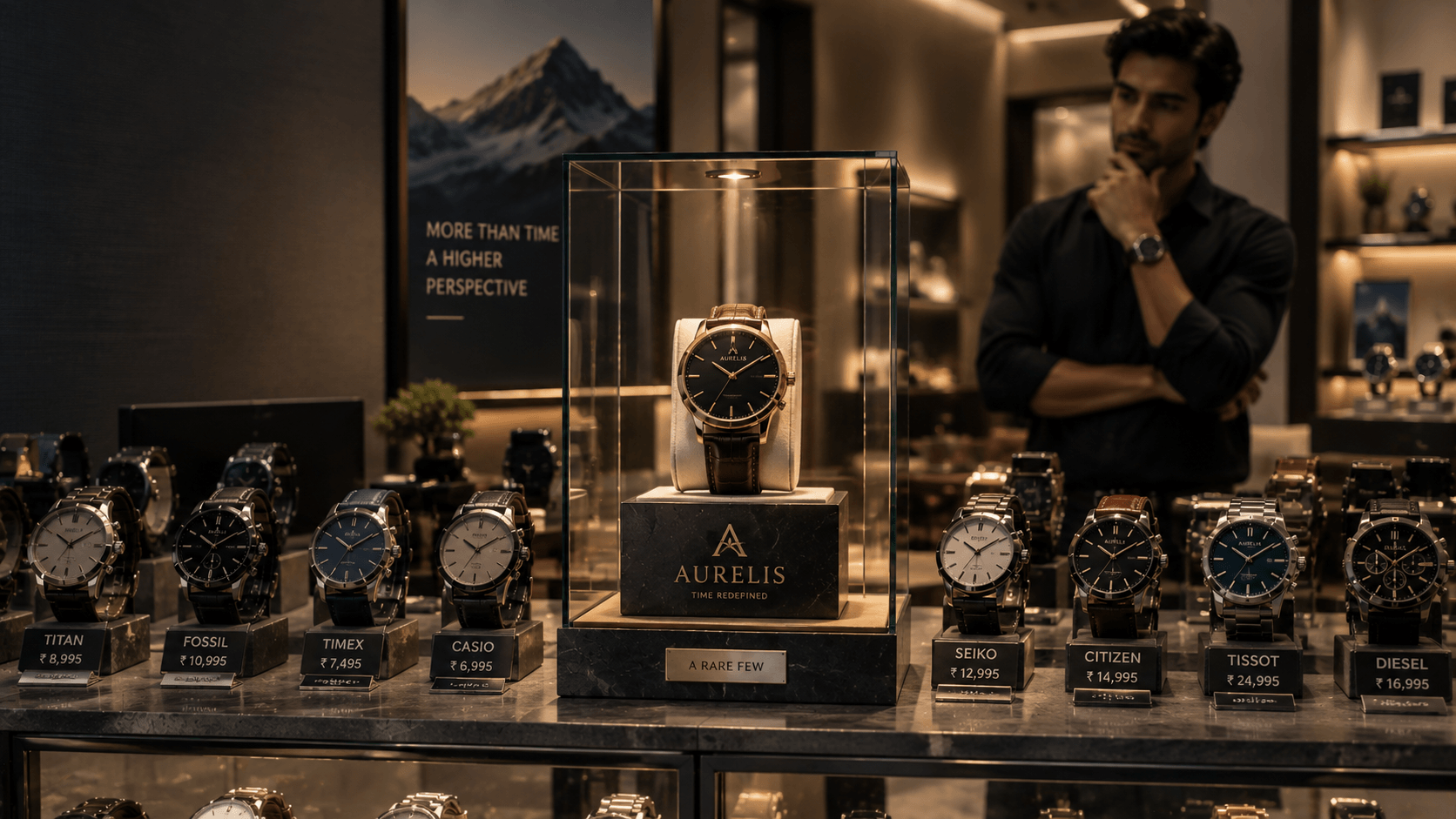




A ₹10,000 watch and a ₹10 lakh watch can both tell the time.
So why does someone willingly pay 100 times more for one?
If the answer were simply “better materials,” luxury would be easy to explain.
But it isn’t.
Because people don’t buy luxury products only for what they do.
They buy what those products mean.
A watch can tell time.
But it can also mark an achievement.
A car can get you from one place to another.
But it can also represent success.
A handbag can carry your belongings.
But it can also communicate taste, status, or identity.
A holiday can take you somewhere.
But it can also become a memory you’ll value for years.
The physical product is visible.
The real value can be invisible.
And that is what makes luxury so fascinating.
Luxury begins when a product becomes more than a product.
Expensive Is Not the Same as Luxury
Let’s start with the easiest mistake to make.
Expensive does not automatically mean luxurious.
A badly made product can be expensive.
A rare product can be expensive.
A product can be overpriced.
None of these automatically make it luxury.
Luxury requires something more.
The customer needs to perceive a level of value that goes beyond basic utility.
That’s why three products can be understood differently:
Expensive:
“This costs a lot.”
Premium:
“This is worth paying more for.”
Luxury:
“This means something to me.”
Premium and luxury overlap, but they aren’t identical.
A premium brand usually gives customers a compelling reason to pay more through better quality, performance, design, service, or convenience.
Luxury adds another dimension:
symbolic and emotional value.
The customer isn’t only asking:
“What am I getting?”
They’re also asking:
“What does owning this say about me?”
Luxury Is About Perceived Value
Every purchase contains an internal calculation.
Not necessarily a mathematical one.
More like a feeling:
“Is this worth it?”
That’s the real question.
A ₹5,000 product can feel cheap if the customer believes it’s worth ₹10,000.
A ₹5 lakh product can feel reasonable if the customer believes the experience, craftsmanship, heritage, exclusivity, and meaning justify it.
This gives us a simple principle:
Price is what you charge.
Value is what customers believe they’re receiving.
Luxury exists when perceived value rises far beyond the product’s basic functional utility.
That’s why luxury pricing cannot be created by simply increasing a number.
Price can signal luxury. It cannot create luxury by itself.
The Invisible Product
This is where luxury becomes different from ordinary products.
Imagine someone buying an expensive watch after building a successful business for ten years.
What did they buy?
A watch, technically.
But perhaps also:
A reminder of what they achieved.
A symbol of a particular chapter of their life.
A piece of craftsmanship they appreciate.
A reward for years of work.
A story they can pass on.
The physical product is still a watch.
But the emotional product is much larger.
This is the invisible product.
And luxury brands are exceptionally good at creating it.
The visible product is what you own. The invisible product is what you feel you own.
Why Do People Want Luxury?
Luxury makes sense when we stop looking at people as perfectly rational buyers.
Humans don’t buy only to solve problems.
We buy to express ourselves.
To reward ourselves.
To belong.
To feel successful.
To feel secure.
To feel different.
To preserve memories.
To become the person we aspire to be.
Luxury taps into many of these motivations at once.
Status
People have always used possessions to communicate achievement.
The symbols change.
The psychology doesn’t disappear.
A luxury car, watch, fashion item or home can communicate:
“I’ve made it.”
That doesn’t necessarily mean the customer is trying to impress everyone.
Sometimes the audience is simply themselves.
Identity
Our consumption choices become part of our self-image.
The brands we wear.
The places we visit.
The objects we surround ourselves with.
The experiences we choose.
They all tell a story about who we are.
Or who we want to become.
That’s why luxury can be aspirational.
A person may buy something not only because it fits their current identity, but because it represents the identity they’re moving toward.
Sometimes we buy a product because it reflects who we are. Sometimes because it reflects who we want to become.
Belonging
Luxury can also create membership in a particular cultural or social world.
People recognise certain brands, styles, watches, cars, hotels, restaurants, and experiences.
The product becomes a signal.
“People like me appreciate this.”
That feeling of recognition can be valuable in itself.
Achievement
Luxury can function as a reward.
A promotion.
A successful business.
A graduation.
A wedding.
A personal milestone.
The object becomes a physical marker of an invisible achievement.
And that can make the purchase deeply emotional.
Luxury Is Often About Meaning, Not Utility
Consider two watches.
Both are accurate.
Both are reliable.
Both tell time.
One costs ₹5,000.
The other costs ₹5 lakh.
If utility were the only factor, there would be very little reason to choose the second.
But utility isn’t the only factor.
The expensive watch may offer:
- Craftsmanship
- Design
- Heritage
- Materials
- Mechanical complexity
- Exclusivity
- Reputation
- Story
- Status
- Emotional significance
The customer is paying for a bundle of meanings, not just a timekeeping function.
That’s why the same logic appears across luxury categories.
The customer isn’t merely buying:
a handbag
but perhaps:
craftsmanship + identity + heritage + status.
Not merely:
a car
but:
performance + design + achievement + experience.
Not merely:
a hotel room
but:
privacy + service + comfort + memory.
Luxury expands the product’s meaning.
Craftsmanship Gives Luxury Substance
Perception matters.
But perception without substance eventually collapses.
The strongest luxury brands have something real underneath the story.
Craftsmanship.
Materials.
Precision.
Skill.
Time.
Attention to detail.
Consistency.
That matters because customers need reasons to believe the premium is justified.
A beautifully designed advertisement can make someone curious.
It cannot permanently make a poorly made product luxurious.
Eventually, the customer experiences the product.
And reality gets its vote.
Luxury can be communicated through perception, but it has to be supported by substance.
Why Details Matter So Much
Luxury is often found in details customers don’t consciously analyse.
The weight of a product.
The texture of a material.
The sound of a mechanism.
The feel of packaging.
The way a salesperson speaks.
The speed of service.
The design of a store.
The unboxing experience.
The follow-up after purchase.
None of these necessarily creates luxury on its own.
Together, they create an impression.
And impressions accumulate.
A customer may never say:
“The lighting contributed 4% to my perception of brand value.”
They simply walk away thinking:
“That felt special.”
That’s how perception works.
Luxury Is Designed Before the Customer Buys
The experience often begins long before the transaction.
A luxury boutique may have carefully controlled:
- Lighting
- Space
- Music
- Scent
- Product placement
- Staff behaviour
- Packaging
- Language
Why?
Because the environment changes expectations.
If a product is presented in a chaotic environment, it can feel ordinary.
If it is presented carefully, surrounded by signals of craftsmanship and exclusivity, customers may interpret it differently.
The product hasn’t necessarily changed.
The context has.
And context influences perceived value.
Heritage Turns History Into Value
Why do luxury brands talk so much about their history?
Because history is difficult to fake.
A brand with decades or centuries of craftsmanship can point to something competitors cannot instantly manufacture:
accumulated credibility.
Its story might involve:
- Founders
- Artisans
- Techniques
- Workshops
- Generations
- Important customers
- Cultural moments
- Signature designs
Heritage makes the product feel connected to something larger than the present transaction.
But being old isn’t enough.
A hundred years of existence doesn’t automatically create luxury.
The history has to mean something.
Heritage is valuable when history becomes evidence of mastery, not merely evidence of age.
Storytelling Makes Products Meaningful
Facts tell customers what a product contains.
Stories tell them why it matters.
Suppose you’re selling a handcrafted leather bag.
You can say:
“Made from premium full-grain leather.”
Useful.
But you could also explain:
Who made it.
Where the leather came from.
How the design evolved.
How long it takes to construct.
Why a particular detail exists.
What tradition inspired it.
Suddenly, the customer isn’t looking at leather anymore.
They’re looking at craftsmanship.
Time.
Skill.
History.
Human effort.
The product hasn’t changed.
Its meaning has.
Features explain the product. Stories explain its value.
The Best Luxury Stories Become the Customer’s Stories
Luxury storytelling becomes even more powerful when the brand becomes part of the customer’s own story.
A watch bought after a major career milestone.
A ring given on a wedding day.
A car purchased after years of hard work.
A family holiday celebrating an anniversary.
The product becomes attached to a memory.
And once that happens, its value is no longer determined only by materials.
The customer now owns a piece of their own history.
This is one reason luxury products can become emotionally difficult to replace.
You’re not replacing an object.
You’re replacing something connected to a memory.
Scarcity Makes Desire Stronger
Now we come to one of luxury’s most powerful tools:
scarcity.
When something is everywhere, it can feel ordinary.
When access is limited, it can feel special.
Luxury brands may use:
- Limited editions
- Numbered products
- Waiting lists
- Private appointments
- Exclusive collections
- Invitation-only events
- Restricted distribution
Scarcity changes the psychology of ownership.
The customer isn’t simply thinking:
“I bought this.”
They may also feel:
“Not everyone can have this.”
That difference matters.
But scarcity has a limit.
Scarcity amplifies desire. It doesn’t manufacture value.
If the product isn’t desirable in the first place, making it difficult to obtain won’t magically make it luxurious.
Waiting Can Increase Desire
Most businesses try to remove friction.
Luxury sometimes turns waiting into part of the experience.
A waiting list creates anticipation.
Anticipation creates mental investment.
The customer researches.
Follows announcements.
Talks about the product.
Imagines owning it.
By the time the purchase finally happens, the product has already existed in the customer’s mind for weeks or months.
The waiting itself has become part of the story.
That’s why luxury sometimes makes access feel earned rather than immediate.
Loud Luxury vs Quiet Luxury
Luxury isn’t one visual language.
Some brands want to be seen.
Large logos.
Distinctive patterns.
Bold designs.
Recognisable symbols.
This is often described as loud luxury.
Its appeal can be:
“I want the world to recognise what this represents.”
Other customers prefer something much more subtle.
Minimal branding.
Exceptional materials.
Understated design.
Details recognised mainly by people familiar with the category.
That’s quiet luxury.
Its appeal may be closer to:
“I know what I’m wearing, and I don’t need everyone else to know.”
Neither is inherently better.
They simply appeal to different motivations.
Loud luxury can satisfy visible status.
Quiet luxury can satisfy private confidence, taste, craftsmanship, or insider knowledge.
Luxury Changes as the Customer Changes
A person’s relationship with luxury can evolve.
Early in a career, someone may want visible symbols of success.
Later, they may care more about craftsmanship, comfort, privacy, quality, or experiences.
The object hasn’t necessarily changed.
The customer’s psychological needs have.
This is why luxury brands need to understand not only what people buy, but why their reasons for buying change.
Authenticity Is Becoming More Valuable
Luxury customers increasingly care about what happens behind the product.
Who made it?
Where was it produced?
What materials were used?
How long will it last?
Are the brand’s claims believable?
Does the company actually behave according to its stated values?
This is where authenticity matters.
A beautifully written story is not enough if customers discover that the story is largely fiction.
The more a brand promises, the more evidence it needs to provide.
The stronger the story, the more important the truth behind it.
The New Luxury Is Also Experience
Luxury was once strongly associated with possessions.
Today, luxury increasingly includes experiences.
Private dining.
Remote travel.
Wellness retreats.
Personalised hospitality.
Cultural experiences.
Exclusive access.
Time with family.
Privacy.
Freedom.
These cannot necessarily be placed in a cupboard.
But they can become some of the most valuable things a person owns:
memories.
This is why modern luxury increasingly overlaps with experience design.
The customer isn’t always asking:
“What can I take home?”
Sometimes they’re asking:
“What will I remember?”
Time May Be the Ultimate Luxury
Think about what people often want once they have enough money.
More time.
More freedom.
More privacy.
More peace.
Better health.
Time with family.
The ability to choose how they spend a day.
Money can buy convenience.
It can buy access.
It can buy experiences.
But it cannot manufacture more hours in a day.
That makes time extraordinarily valuable.
And it explains one of the most interesting shifts in luxury:
Luxury is increasingly moving from owning more to experiencing better.
Personalisation Makes People Feel Seen
There is another form of luxury that has nothing to do with gold or diamonds.
Being understood.
A hotel remembers your preferences.
A tailor knows your measurements.
A restaurant remembers your favourite table.
A salesperson understands your taste without forcing you through a generic script.
These moments create a powerful feeling:
“This experience was made for me.”
Personalisation turns a transaction into recognition.
And recognition can be deeply valuable.
The New Luxury Consumer Wants Meaning
Modern luxury customers may still care about:
- Quality
- Craftsmanship
- Heritage
- Exclusivity
- Design
- Status
But many also care about:
- Authenticity
- Sustainability
- Purpose
- Personalisation
- Wellbeing
- Experiences
- Responsible production
This doesn’t mean traditional luxury has disappeared.
It means the definition of luxury is expanding.
The luxury customer increasingly wants to know not only:
“Is this beautiful?”
but also:
“Is this meaningful?”
The Dark Side of Luxury Marketing
Luxury has a psychological advantage.
It can create desire by making customers feel that they are buying something rare, important, or identity-defining.
But this creates a responsibility for marketers.
Artificial scarcity.
Fake heritage.
Manufactured exclusivity.
Overblown claims.
Empty sustainability promises.
These tactics may create short-term excitement.
But they cannot create long-term trust.
The more sophisticated the customer becomes, the easier it is to expose a gap between the story and the reality.
And once that gap becomes visible, luxury perception can collapse quickly.
What Actually Makes a Luxury Brand?
There isn’t one magic ingredient.
The strongest luxury brands usually combine several:
Exceptional Product
There must be something genuinely worth valuing.
Craftsmanship
Skill and attention to detail create tangible substance.
Heritage
History can create credibility and depth.
Story
Meaning makes the product emotionally memorable.
Exclusivity
Limited access can increase desirability.
Identity
The brand becomes part of how customers express themselves.
Experience
Every interaction contributes to perceived value.
Consistency
Luxury cannot depend on one spectacular moment.
Authenticity
The story needs evidence behind it.
Emotional Value
The customer needs to feel that the purchase means something.
Put these together and the customer begins to experience something beyond utility.
The product becomes a symbol.
The Luxury Brand Test
Here’s a simple test for any brand claiming to be luxurious.
Remove the logo.
Remove the advertising.
Remove the celebrity endorsement.
Remove the price tag.
Then ask:
“What remains that makes this worth more?”
If the answer is:
Nothing, you may have an expensive product.
If the answer is:
Better materials, craftsmanship, performance, experience, heritage, meaning and emotional value, you’re getting closer to genuine luxury.
Because a luxury brand shouldn’t need the price tag to explain its value.
The price should be the result of the value equation, not the entire argument.
What Every Business Can Learn From Luxury Brands
Here’s the most useful part of the lesson.
You don’t have to sell a ₹20 lakh watch to learn from luxury.
A café can learn from luxury.
A salon can learn from luxury.
A software company can learn from luxury.
A consultant can learn from luxury.
A neighbourhood grocery store can learn from luxury.
The lesson isn’t:
“Charge more.”
The lesson is:
“Give customers more reasons to value you.”
That could mean:
Better design.
Better service.
Better storytelling.
Better packaging.
More thoughtful details.
Greater consistency.
More personalisation.
A stronger identity.
A more memorable experience.
None of these requires a billion-dollar company.
Don’t Compete Only on Price
Price is easy to compare.
Value is harder to compare.
If two businesses offer almost identical products and one competes only by being cheaper, another competitor can always attempt to go lower.
But if customers choose you because they trust you, appreciate your quality, love your experience, identify with your brand, or believe you are worth paying more for, the relationship becomes harder to copy.
This is one of the most important lessons luxury brands teach.
Don’t ask, “How can we charge more?” Ask, “Why would customers believe we’re worth more?”
That question changes everything.
Don’t Sell Features Alone
Every business can list features.
Very few businesses create meaning around them.
A restaurant can list ingredients.
A great restaurant can create an experience.
A furniture company can describe materials.
A great brand can explain the craftsmanship behind them.
A hotel can list room facilities.
A great hotel can make the customer imagine how they will feel there.
The difference is not always in what is being sold.
It is in how the customer understands and experiences what is being sold.
The Real Definition of Luxury
So what makes a luxury brand?
Not simply a high price.
Not simply expensive materials.
Not simply a famous logo.
Not simply exclusivity.
And not simply wealthy customers.
A luxury brand creates exceptional perceived value by combining tangible excellence with emotional, symbolic, experiential, and cultural meaning.
It gives customers reasons to believe the product is special.
And then it gives them reasons to feel that owning it says something about who they are.
That’s why luxury is fundamentally psychological.
The product exists in the physical world.
Its deepest value exists in the mind of the customer.
The Bottom Line
Luxury teaches marketers something far more important than how to sell expensive products.
It teaches us how people assign value.
We don’t evaluate everything purely through function.
We interpret.
We compare.
We remember.
We attach stories.
We seek identity.
We celebrate achievement.
We want belonging.
We respond to scarcity.
We value craftsmanship.
We care about experiences.
And sometimes, we buy things because they help us become the person we want to be.
That’s why the strongest luxury brands don’t simply manufacture beautiful products.
They manufacture reasons to care.
A watch can tell time.
A car can provide transportation.
A handbag can carry belongings.
A hotel can provide a room.
But add craftsmanship, heritage, story, exclusivity, identity, experience and emotion, and the customer’s perception changes.
The product becomes more than functional.
It becomes meaningful.
And that is where luxury begins.
Not at the price tag.
Inside the mind of the customer.
Leave a Reply