
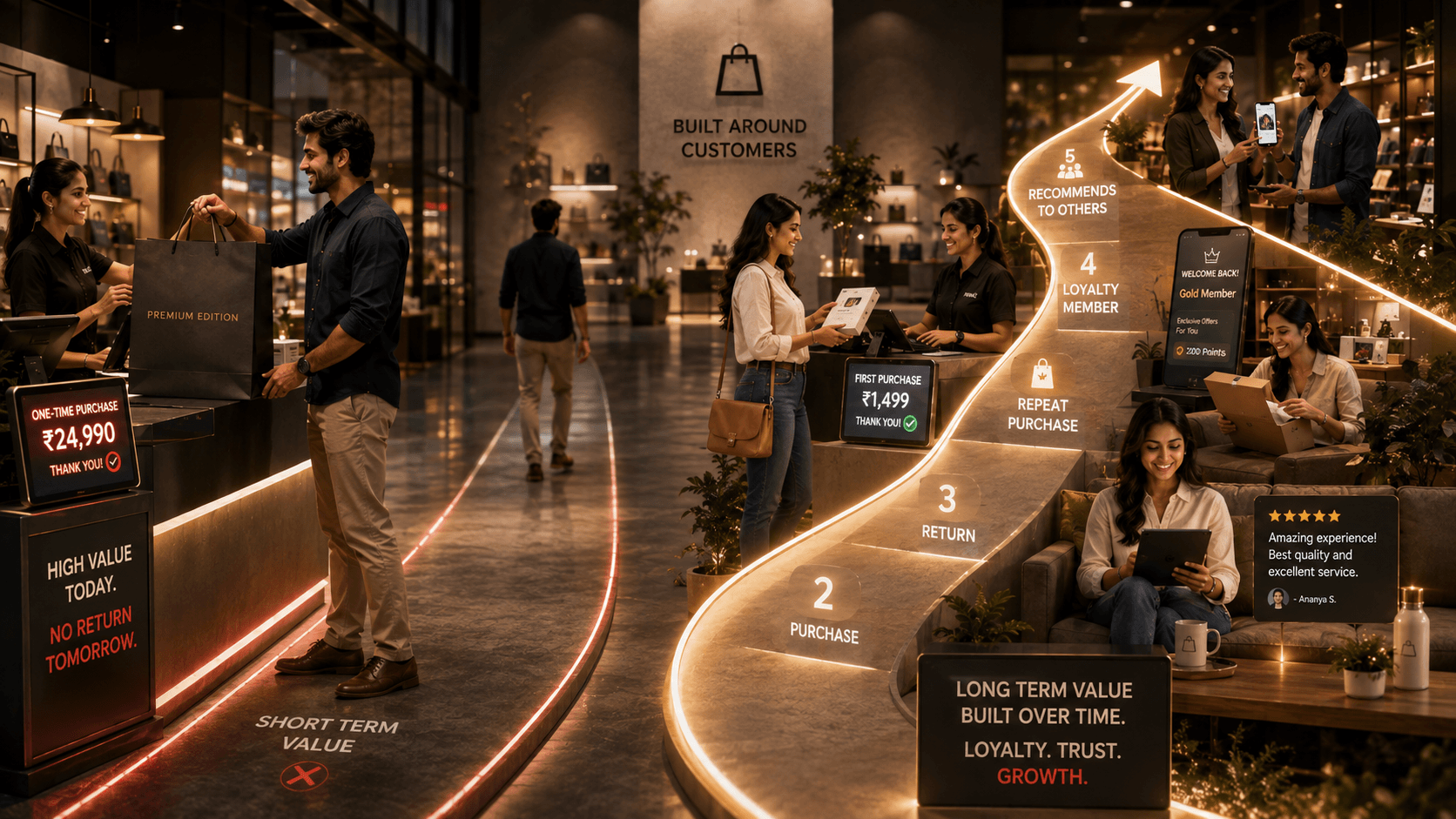




Imagine two people buy the same pair of earbuds from your brand.
Both pay ₹2,000.
Customer A buys the earbuds and disappears.
Customer B comes back six months later and buys another pair for their partner.
Then they buy a smartwatch from you.
They recommend your brand to two friends.
And they continue buying from you for the next few years.
Now ask yourself:
Are these two customers worth the same to the business?
No.
They made the same purchase today.
But their value to the business is completely different.
And this is exactly what Customer Lifetime Value, or CLV, helps us understand.
What is Customer Lifetime Value?
In simple words:
Customer Lifetime Value is the total value a customer is expected to generate for a business throughout their relationship with the brand.
Instead of looking at:
“How much did this customer spend today?”
CLV asks:
“How much value can this customer create over time?”
This is a very important shift in thinking.
Because a customer’s first purchase is only one part of the story.
A customer might buy from you once.
Or they might stay with you for five years.
And those two customers should not be treated as equally valuable.
Why Is the First Purchase Not Enough?
Imagine you run an online clothing store.
A customer buys a T-shirt for ₹1,000.
You acquire them through an Instagram ad.
They never return.
Another customer also buys a T-shirt for ₹1,000.
But they come back next month and buy jeans.
Then they shop during the festive sale.
Then they buy clothes for their family.
Three years later, they’re still shopping with you.
The first purchase was exactly the same.
But the relationship wasn’t.
This is why smart businesses don’t only ask:
“How many customers did we acquire?”
They also ask:
“How many of those customers stayed?”
And:
“How much value did they create over time?”
That’s where CLV becomes important.
CLV Changes How You Think About Marketing
Let’s say you spend ₹1,000 to acquire a customer.
They make one purchase worth ₹500 and never return.
That’s a problem.
Now imagine another customer also costs you ₹1,000 to acquire.
But over the next three years, they spend ₹15,000 with your business.
Suddenly, that same ₹1,000 acquisition cost looks very different.
This is why looking only at the first transaction can give you the wrong picture.
A customer who looks unprofitable today might become extremely valuable over time.
And a customer who looks profitable today might never return.
So CLV helps marketers think beyond the next sale.
How Do You Calculate CLV?
The basic formula is actually very simple:
CLV = Average Purchase Value × Purchase Frequency × Customer Lifespan
Let’s break that down.
1. Average Purchase Value
How much does a customer spend each time they buy?
Imagine your average customer spends ₹500 per purchase.
That’s your average purchase value.
2. Purchase Frequency
How often does that customer buy?
Imagine they purchase 12 times a year.
That’s your purchase frequency.
3. Customer Lifespan
How long does the average customer stay with you?
Imagine they remain a customer for 3 years.
Now calculate:
₹500 × 12 × 3 = ₹18,000
So the estimated CLV is:
₹18,000
That means the average customer is expected to generate around ₹18,000 in revenue during their relationship with the business.
Simple.
But there is something important to understand.
CLV Is an Estimate
You can’t predict exactly what every customer will spend.
You don’t know exactly when every customer will leave.
You don’t know whether someone will suddenly start buying more or stop buying completely.
So CLV is usually an estimate based on customer behaviour and historical data.
That’s completely fine.
The purpose isn’t to predict the future perfectly.
The purpose is to make better decisions using the information you have.
Even a reasonable estimate is much more useful than simply saying:
“We don’t know.”
CLV vs CAC
Now we need to introduce another important marketing metric:
Customer Acquisition Cost, or CAC.
CAC answers:
“How much does it cost us to acquire one new customer?”
CLV answers:
“How much value does that customer generate over time?”
For example:
CAC = ₹2,000
CLV = ₹12,000
That means you’re spending ₹2,000 to acquire a customer who is expected to generate ₹12,000 in revenue over their relationship with you.
Now imagine another business:
CAC = ₹2,000
CLV = ₹2,500
That’s a very different business.
There’s very little room left after acquisition costs.
So remember:
CAC tells you what it costs to win the customer.
CLV tells you what that customer can generate over time.
One looks at the cost of acquisition.
The other looks at the long-term value of the relationship.
But Don’t Make One Common Mistake
A beginner might see:
CLV = ₹12,000
CAC = ₹2,000
and say:
“Great! We make ₹10,000 profit.”
Not necessarily.
CLV is usually based on revenue unless you’re specifically calculating a profit-based CLV model.
You still have:
Product costs.
Delivery costs.
Salaries.
Technology.
Customer support.
Returns.
Operational expenses.
So don’t confuse:
Revenue
with
Profit.
CLV is a useful metric, but it should be interpreted alongside your margins and other business costs.
That’s where real marketing thinking begins.
The best marketers don’t look at customers as one-time transactions. They understand how positioning, psychology, customer experience and strategy work together to create long-term value. Learn this way of thinking in the Positioning.co.in Marketing OS Program.
So How Do You Increase CLV?
Now comes the part I care about most.
Knowing CLV is useful.
But knowing how to influence it is much more useful.
There are three simple levers.
You can encourage customers to:
Buy more.
Buy more often.
Stay longer.
That’s it.
Let’s break them down.
1. Increase the Value of Each Purchase
Imagine you sell laptops.
A customer comes to buy a laptop.
They also need a mouse.
A laptop bag.
Maybe additional storage.
If these products genuinely help the customer, recommending them can increase the value of that purchase.
This is cross-selling.
You can also offer a better version of the product.
For example:
8GB RAM → 16GB RAM
If the upgrade genuinely makes sense for the customer, that’s upselling.
But here’s an important distinction.
Cross-selling and upselling shouldn’t mean:
“How can I make this customer spend more?”
The better question is:
“What else can I offer that genuinely makes the customer’s experience better?”
That’s the difference between useful recommendations and aggressive selling.
2. Increase Purchase Frequency
Now imagine someone normally buys coffee once a month.
What would make them come back every week?
Maybe:
A loyalty programme.
Personalised offers.
New products.
Subscriptions.
Useful reminders.
Better convenience.
A stronger overall experience.
The goal isn’t simply to bombard customers with discounts.
It’s to create a genuine reason to return.
For example, Starbucks has built strong habits around frequent visits through its rewards programme, mobile experience and seasonal products.
A ₹300 purchase may not look huge.
But when the customer makes that purchase several times every month for years, the total value becomes significant.
That’s CLV in action.
3. Increase Customer Lifespan
This is probably the biggest one.
If customers leave after three months, their lifetime value will be limited.
If they stay for three years, the picture changes completely.
So ask:
Why are customers leaving?
Maybe the product isn’t good enough.
Maybe customer support is poor.
Maybe onboarding is confusing.
Maybe competitors offer a better experience.
Maybe customers simply don’t see enough value anymore.
Retention isn’t about forcing customers to stay.
It’s about giving them enough reasons to want to stay.
This is why customer experience has a direct connection with CLV.
Customer Experience → Retention → CLV
Think about a SaaS product.
A customer signs up.
The onboarding is confusing.
They can’t understand how to use the software.
They contact support.
Nobody responds.
They cancel the subscription.
Their CLV stays low.
Now imagine the same product with:
Simple onboarding.
Helpful tutorials.
Fast customer support.
Useful product updates.
Personalised recommendations.
The customer gets value quickly.
They stay longer.
And their lifetime value increases.
Notice what happened.
The business didn’t necessarily increase the price.
It improved the experience.
That’s why CLV isn’t just a finance metric.
It’s also a marketing and customer experience metric.
CLV and Customer Journey
Remember our previous lecture on Customer Journey Mapping?
This is where everything starts connecting.
A customer journey looks at:
What customers do.
What they think.
What they feel.
Where they face friction.
CLV looks at what happens to the value of that relationship over time.
Imagine customers are leaving after the first purchase.
Your journey map might show:
Poor onboarding.
Confusing product instructions.
Slow customer support.
Now you have a clue about why your CLV is low.
Fix those problems.
Customers stay longer.
They buy again.
CLV increases.
So we can think about it like this:
Better Customer Experience
↓
Better Retention
↓
More Repeat Purchases
↓
Higher CLV
This is why marketing isn’t just about acquiring customers.
It’s about creating reasons for them to stay.
CLV vs CSAT vs NPS
You may also come across two other metrics:
CSAT
and
NPS.
They sound similar to CLV, but they measure completely different things.
CSAT
Customer Satisfaction Score
It usually measures how satisfied a customer was with a specific interaction.
For example:
“How satisfied were you with your delivery today?”
CSAT is about a particular experience.
NPS
Net Promoter Score
It asks:
“How likely are you to recommend us to a friend or colleague?”
NPS is more focused on loyalty and willingness to recommend.
CLV
CLV looks at customer behaviour and value over time.
It asks:
“How much value does this customer generate throughout their relationship with us?”
So remember:
CSAT → How satisfied are they?
NPS → Would they recommend us?
CLV → How valuable is the relationship over time?
They’re different metrics.
But they can influence each other.
A poor experience can reduce satisfaction.
Repeated poor experiences can reduce loyalty.
Lower loyalty can lead to customers leaving.
And when customers leave earlier, their lifetime value falls.
So these metrics can tell different parts of the same customer story.
Let’s Look at Apple
Apple gives us an interesting example of CLV.
A customer might start with an iPhone.
Then they may buy:
AirPods.
Apple Watch.
MacBook.
iCloud storage.
Other services and accessories.
The business isn’t only thinking about:
“How do we sell this iPhone?”
There’s a much bigger opportunity.
“How do we create such a strong overall experience that this customer continues choosing Apple?”
This is one reason ecosystems can be powerful.
When different products work well together, customers have more reasons to stay within the same brand.
The lesson isn’t:
“Build an ecosystem.”
The lesson is:
Create enough value that staying with your brand makes sense to the customer.
Let’s Look at Netflix
Netflix has a completely different business model.
You don’t buy Netflix once.
You subscribe every month.
So Netflix has a very clear CLV challenge:
Keep the customer subscribed.
If someone subscribes for one month and leaves, their value is limited.
If they stay for three years, their value is much higher.
That’s why Netflix constantly works on:
Content.
Recommendations.
User experience.
New releases.
Personalisation.
The objective isn’t simply to get someone to subscribe.
It’s to give them reasons to continue subscribing.
That’s a completely different way of thinking about growth.
The Biggest CLV Lesson
Now let’s connect everything.
A business can increase CLV by:
Increasing average purchase value.
Increasing purchase frequency.
Increasing customer lifespan.
But none of these should happen by simply forcing customers to spend more.
The strongest way to increase CLV is to create more value for the customer.
Better products.
Better experiences.
Better service.
Better recommendations.
Better convenience.
Better relationships.
When customers get more value, they have more reasons to stay.
And when they stay longer, the business creates more value from the relationship.
That’s the CLV loop.
Create Value
↓
Customer Stays
↓
Customer Buys Again
↓
Business Creates More Value
↓
Customer Stays Longer
Your Assignment
Let’s make this practical.
Imagine you’re launching your own earbuds brand.
Your average customer spends ₹2,500 per purchase.
They buy 1.5 times per year.
And they stay with your brand for an average of 3 years.
Calculate the CLV.
₹2,500 × 1.5 × 3 = ₹11,250
Now don’t stop there.
Ask yourself:
How could I increase this to ₹15,000?
Could you increase purchase frequency?
Could you introduce another product?
Could you improve retention?
Could you create a better post-purchase experience?
Could you create a useful accessory ecosystem?
Could you build a loyalty programme?
There are many possible answers.
And this is exactly how I want you to start thinking.
Don’t just calculate the number.
Think about what you can do to change the number.
The Real Lesson
Let’s go back to our two customers.
Both bought earbuds for ₹2,000.
Customer A disappeared.
Customer B stayed for years.
If you only looked at today’s transaction, they looked identical.
If you looked at the entire relationship, they were completely different.
That’s the real lesson behind Customer Lifetime Value.
A customer’s value isn’t defined by what they buy today. It’s defined by the value of the relationship over time.
And that’s why great marketers don’t only ask:
“How do we acquire more customers?”
They also ask:
“How do we give customers a reason to stay?”
Because acquiring a customer is only the beginning.
The real value is created when that customer chooses you again.
And again.
And again.
That’s Customer Lifetime Value.
Leave a Reply