




Imagine you own a sweet shop.
Every day, different types of customers walk into your shop.
A college student comes in and says:
“Bhaiya, ek samosa dena.”
A family walks in looking for a beautifully packed box of sweets for a wedding.
An elderly customer asks:
“Sugar-free laddoos hain?”
All three people entered the same shop.
But are they looking for the same thing?
Not really.
The student wants a quick and affordable snack.
The family wants something presentable for gifting.
The elderly customer has a completely different requirement.
Now imagine you give all three customers the exact same product and the exact same offer.
Would that make sense?
Probably not.
And this is where one of the most important ideas in marketing comes in:
Market Segmentation.
In simple language, market segmentation means dividing a large market into smaller groups of people who have similar needs, characteristics or behaviours.
But don’t think of segmentation as simply putting people into different boxes.
The real purpose is much more important.
Understand different groups of customers so you can serve the right people in the right way.
Because here’s the problem with marketing:
Everyone is not your customer.
And even if everyone can buy your product, they don’t necessarily want it for the same reason.
Why Can’t We Just Market to Everyone?
Imagine Rahul opens a restaurant.
His food is genuinely good.
Prices are reasonable.
The ambience is great.
So he creates an advertisement:
“The Best Restaurant for Everyone.”
Sounds like a good advertisement.
But think about it from the customer’s perspective.
A college student might be thinking:
“Is it affordable?”
An office worker might be thinking:
“Can I get a quick lunch here?”
A family might be thinking:
“Is it comfortable for children?”
A fitness-conscious customer might be thinking:
“Do they have healthy options?”
Rahul’s advertisement doesn’t answer any of these questions.
It tries to speak to everyone.
And when you try to speak to everyone, your message often becomes so generic that nobody feels like you’re speaking specifically to them.
Now imagine Rahul changes his approach.
He creates:
Student meal combos
Quick office lunch options
Family meal packages
Healthy meals for fitness-conscious customers
Suddenly, the restaurant feels more relevant.
The food hasn’t necessarily changed.
The relevance has changed.
And that’s the power of segmentation.
The Real Reason Segmentation Works
Let’s say you’re selling earbuds.
You have five different types of potential customers.
A college student might care about:
Price + style
A gamer might care about:
Low latency + gaming performance
A working professional might care about:
Microphone quality + comfort
A fitness enthusiast might care about:
Sweat resistance + secure fit
An audiophile might care about:
Sound quality + audio performance
They’re all buying earbuds.
But they’re not buying them for the same reason.
This is the part I want you to remember.
The product category can be the same while the customer’s reason for buying can be completely different.
And when the reason for buying changes, your:
Product
Message
Offer
Creative
Channel
and even
Positioning
may need to change.
That’s why segmentation is not just a research exercise.
It’s a strategic decision.
The Four Main Types of Market Segmentation
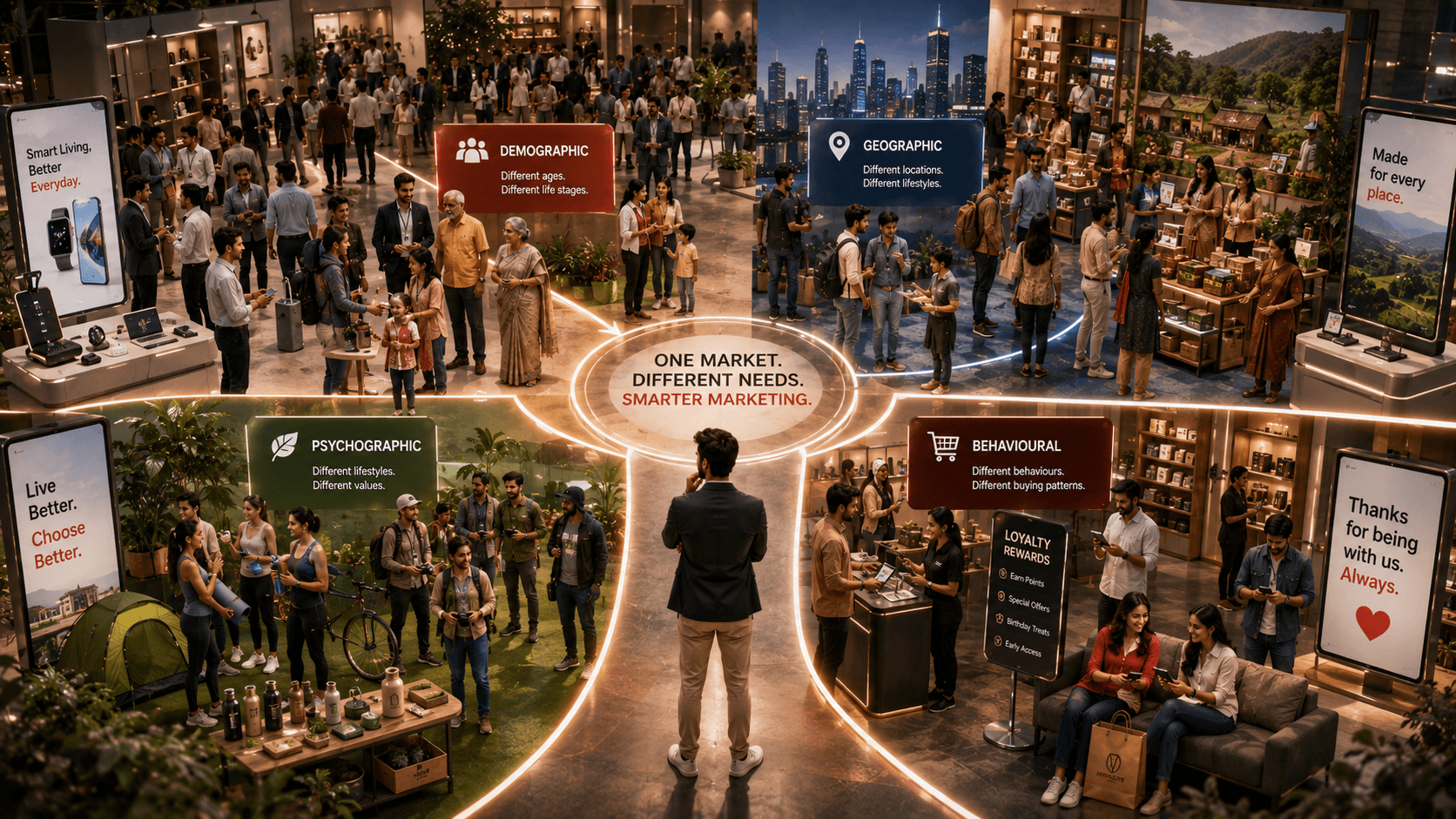
There are four common ways marketers segment a market.
You don’t need to memorise complicated definitions.
Just remember four questions:
Who?
Where?
Why?
What do they do?
Let’s break them down.
1. Demographic Segmentation: WHO?
Demographic segmentation looks at characteristics such as:
Age
Income
Occupation
Education
Gender
Family size
For example, imagine you’re selling smartphones.
A college student and a senior executive may both need a smartphone.
But their budgets, priorities and expectations could be very different.
The student may care more about:
Price + camera + design
The executive may care more about:
Performance + productivity + premium experience
So demographic information can help businesses identify meaningful differences between groups.
But there’s a catch.
Demographics alone don’t tell you everything.
Two people can be the same age, earn the same salary and live in the same city…
…and still make completely different buying decisions.
That’s where the next type becomes interesting.
2. Geographic Segmentation: WHERE?
Geographic segmentation looks at where customers are located.
Country.
State.
City.
Climate.
Urban or rural location.
Why does this matter?
Imagine you’re selling winter jackets.
A customer living in Shimla has a very different need from someone living in Chennai.
The product category is the same.
But the demand can be completely different because of location.
Food businesses use this constantly.
A restaurant in Mumbai may promote completely different offers from a restaurant in Jaipur.
A delivery app shows you restaurants available in your area.
A clothing brand may change its collection depending on climate.
So geographic segmentation is basically asking:
“Where are my customers, and how does their location affect what they need?”
3. Psychographic Segmentation: WHY?
This is where segmentation gets much more interesting.
Psychographic segmentation looks at:
Lifestyle
Interests
Values
Personality
Attitudes
Let’s take two people.
Both are 28 years old.
Both live in Mumbai.
Both earn ₹80,000 a month.
Both work in the same industry.
From a demographic perspective, they look quite similar.
But one spends every weekend trekking, goes to the gym and follows a healthy lifestyle.
The other spends weekends gaming, watching movies and ordering food.
Would you market the same products to both in exactly the same way?
Probably not.
Because demographics tell you who they are.
Psychographics can help you understand how they think and what they value.
And in marketing, understanding why someone buys can be incredibly powerful.
4. Behavioural Segmentation: WHAT DO THEY DO?
Now let’s stop looking at who the customer is and start looking at what they actually do.
Behavioural segmentation looks at things like:
How often they buy
What products they buy
Whether they wait for discounts
How loyal they are
When they purchase
What benefits they are looking for
Imagine two customers want the same smartphone.
Customer A buys the latest model on launch day.
Customer B waits six months and buys during the biggest festival sale.
Same product.
Different behaviour.
That’s behavioural segmentation.
And this is where customer data becomes extremely useful.
If a customer repeatedly buys during discounts, you may communicate offers differently.
If someone frequently buys premium products, their communication may look different.
If someone hasn’t purchased in six months, you may create a different re-engagement strategy.
You’re not guessing anymore.
You’re using behaviour to understand the customer.
An Easy Way to Remember the Four Types
Just remember:
Demographic → WHO
Geographic → WHERE
Psychographic → WHY
Behavioural → WHAT THEY DO
That’s it.
And in the real world, businesses don’t necessarily use only one.
They often combine them.
For example:
Young working professionals, living in major cities, interested in fitness, who regularly purchase health products online.
Look at how much clearer that customer group is.
Young working professionals → Demographic
Major cities → Geographic
Interested in fitness → Psychographic
Regularly purchase health products online → Behavioural
Now you have something much more useful than:
“People aged 18–35.”
Because age alone doesn’t tell you enough.
But Here’s Where Beginners Usually Get Confused
Let’s say you identify ten different customer groups.
Does that mean you should target all ten?
No.
This is where Segmentation and Targeting become different concepts.
Segmentation asks:
“What different groups exist in this market?”
Targeting asks:
“Which of these groups should we actually focus on?”
And then comes Positioning:
“Why should that group choose us?”
This gives us one of the most important frameworks in marketing:
Segmentation
↓
Targeting
↓
Positioning
Or simply:
Who are the different customers?
↓
Which customers do we want?
↓
Why should they choose us?
And this is where segmentation becomes strategic.
Let’s Put STP Into Our Earbuds Example
Imagine you’ve launched an earbuds company.
After researching the market, you discover five segments:
College students
Want affordability and style.
Gamers
Want low latency and gaming performance.
Working professionals
Want clear calls and comfortable long-term use.
Fitness enthusiasts
Want sweat resistance and a secure fit.
Audiophiles
Want high-quality sound.
Now you’ve completed Segmentation.
But you don’t have unlimited money.
You can’t necessarily build five different products, five completely different marketing strategies and five different campaigns at the same time.
So you decide:
“We’re going to focus on working professionals.”
That’s Targeting.
Now you need to answer:
“Why should working professionals choose our earbuds?”
Maybe your answer is:
Exceptional call quality + all-day comfort + long battery life.
Now you’re building your Positioning.
See how everything connects?
Segmentation helps you understand the market.
Targeting helps you choose where to compete.
Positioning helps you decide how you want to be perceived.
And that’s why segmentation comes before positioning.
You can’t decide what you want to mean to people until you know which people you’re trying to matter to.
Segmentation Doesn’t Mean Excluding Everyone Else
This is another important point.
When a business chooses a target segment, it doesn’t mean:
“Nobody else can buy from us.”
It simply means:
“This is the group we’re going to prioritise.”
Imagine a café decides to position itself as the best café for remote workers.
That doesn’t mean students can’t enter.
Families can’t enter.
Tourists can’t enter.
It simply means the café is deliberately designing its experience around a particular audience.
Fast Wi-Fi.
Charging points.
Quiet seating.
Comfortable tables.
Longer-stay options.
Now the brand has a clear reason to exist.
That’s much stronger than saying:
“We’re a café for everyone.”
Market Segmentation vs Customer Segmentation
These two terms sound very similar, so let’s make them simple.
Market segmentation looks at the broader market.
You’re asking:
“Who could potentially become my customer?”
For example:
College students.
Working professionals.
Parents.
Fitness enthusiasts.
Senior citizens.
You’re studying the market and deciding who you want to target.
Customer segmentation happens after people become your customers.
Now you might divide them into:
First-time customers
Repeat customers
VIP customers
Discount-driven customers
Customers who haven’t purchased recently
The purpose is different.
So remember:
Market segmentation helps you find the right customers.
Customer segmentation helps you understand and serve the customers you already have.
Both are useful.
One helps you acquire.
The other helps you personalise, retain and grow the relationship.
How Do You Actually Segment a Market?
You don’t need to sit in a room and randomly invent customer groups.
Start with research.
Imagine you’re launching a healthy snack brand.
First, understand the market.
Who buys healthy snacks?
Students?
Gym-goers?
Working professionals?
Parents?
Athletes?
Then look for patterns.
What do they want?
What problems do they have?
How much are they willing to spend?
Where do they buy?
What influences their decisions?
How frequently do they buy?
Now group people who have meaningful similarities.
Then evaluate those groups.
Ask:
Is the segment large enough?
Can we reach them?
Do they have a real need?
Can they afford our product?
Is the segment likely to grow?
Can we serve them better than competitors?
Now choose the segment that makes the most strategic sense.
That’s a much better process than saying:
“Our target audience is everyone between 18 and 45.”
The Biggest Segmentation Mistakes
One of the biggest mistakes is trying to target everyone.
We’ve already seen why.
If your message is for everyone, it often becomes too generic to feel relevant.
Another mistake is relying only on demographics.
Age and gender can be useful.
But they don’t tell you everything about a person’s motivations.
Another mistake is creating too many segments.
You could divide people into hundreds of tiny groups.
But if those groups don’t have meaningful differences, the segmentation isn’t helping you.
It’s just creating complexity.
Another mistake is using assumptions instead of actual customer data.
You might think:
“Young people love this product.”
But what does the actual data say?
Maybe your biggest customers are 35–45.
Maybe students click your ads but rarely purchase.
Maybe working professionals have a much higher conversion rate.
That’s why good segmentation combines research, data and actual customer behaviour.
And finally, don’t forget that segments can change.
Customer behaviour changes.
Technology changes.
Competitors change.
Markets change.
So segmentation isn’t something you do once and put into a presentation forever.
You revisit it.
You learn.
You adjust.
A Real Example: Zepto
Think about Zepto.
Its business model is built around convenience and fast grocery delivery.
But does everyone value getting groceries delivered within minutes?
Not necessarily.
Someone who enjoys visiting a local supermarket every weekend may not care.
Someone living far away from a major city may not have access to the same service.
But a busy urban professional who suddenly realises:
“I need milk right now.”
may value that convenience enormously.
This gives us a useful way to look at Zepto’s customer base.
Geographic
It focuses heavily on urban markets where its fast-delivery model can work.
Demographic
Its service can appeal strongly to people such as young professionals, students and busy households.
Psychographic
It attracts people who value convenience, speed and saving time.
Behavioural
It can serve customers who prefer making smaller, frequent purchases rather than one large monthly grocery trip.
The important lesson isn’t:
“Zepto uses four types of segmentation.”
The real lesson is:
Zepto built its proposition around a specific customer need: convenience.
That’s what good segmentation allows businesses to do.
It helps them identify where the strongest opportunity exists.
Your Assignment
Now let’s make this practical.
Imagine you’re launching a new earbuds brand.
Don’t start by saying:
“My target audience is everyone who uses earbuds.”
That’s exactly what I don’t want you to do.
Instead, identify at least five different customer segments.
For example:
College students
Gamers
Working professionals
Fitness enthusiasts
Audiophiles
Now answer:
What does each group care about?
What problem are they trying to solve?
What would make them choose one brand over another?
How might their buying behaviour differ?
Then choose one segment.
And explain:
“Why should we focus on this segment instead of the others?”
Finally, write one sentence describing how you would position the earbuds for that audience.
Don’t worry about creating the perfect answer.
The goal is to start thinking in segments.
The Real Lesson
Let’s go back to our sweet shop.
The student.
The family.
The elderly customer.
Same shop.
Same category.
Completely different needs.
And that’s the real reason we segment a market.
Not because customers are different on paper.
But because they are different in the way they think, behave and buy.
A student might ask:
“Kitne ka hai?”
A fitness enthusiast might ask:
“Is it healthy?”
A working professional might ask:
“How convenient is it?”
Same product category.
Different reasons to buy.
And if you don’t understand that difference, you’ll end up creating one generic product, one generic message and one generic marketing strategy for everyone.
That’s rarely a great strategy.
Because:
You cannot be the perfect choice for everyone.
The smartest marketers don’t ask:
“How can I sell to more people?”
They first ask:
“Which people are most valuable for us to serve?”
And once you understand that…
You can decide who to focus on.
You can understand what they actually need.
You can build the right offer.
You can create the right message.
And eventually…
You can decide what you want your brand to mean to them.
That’s where Segmentation ends.
And Targeting begins.
Leave a Reply