




You’ve probably heard this before:
“Yaar, iPhone mein features comparatively kam hain, phir bhi itna expensive kyun hai?”
A lot of people compare phones this way.
One phone has more RAM.
Another has a bigger battery.
Another has a higher megapixel camera.
Another charges much faster.
And then there’s the iPhone.
Often more expensive.
So why do people still buy it?
Is Apple simply making better phones?
That’s not the interesting question.
The interesting question is:
Why are people willing to pay more for Apple?
And this is where Apple’s marketing becomes interesting.
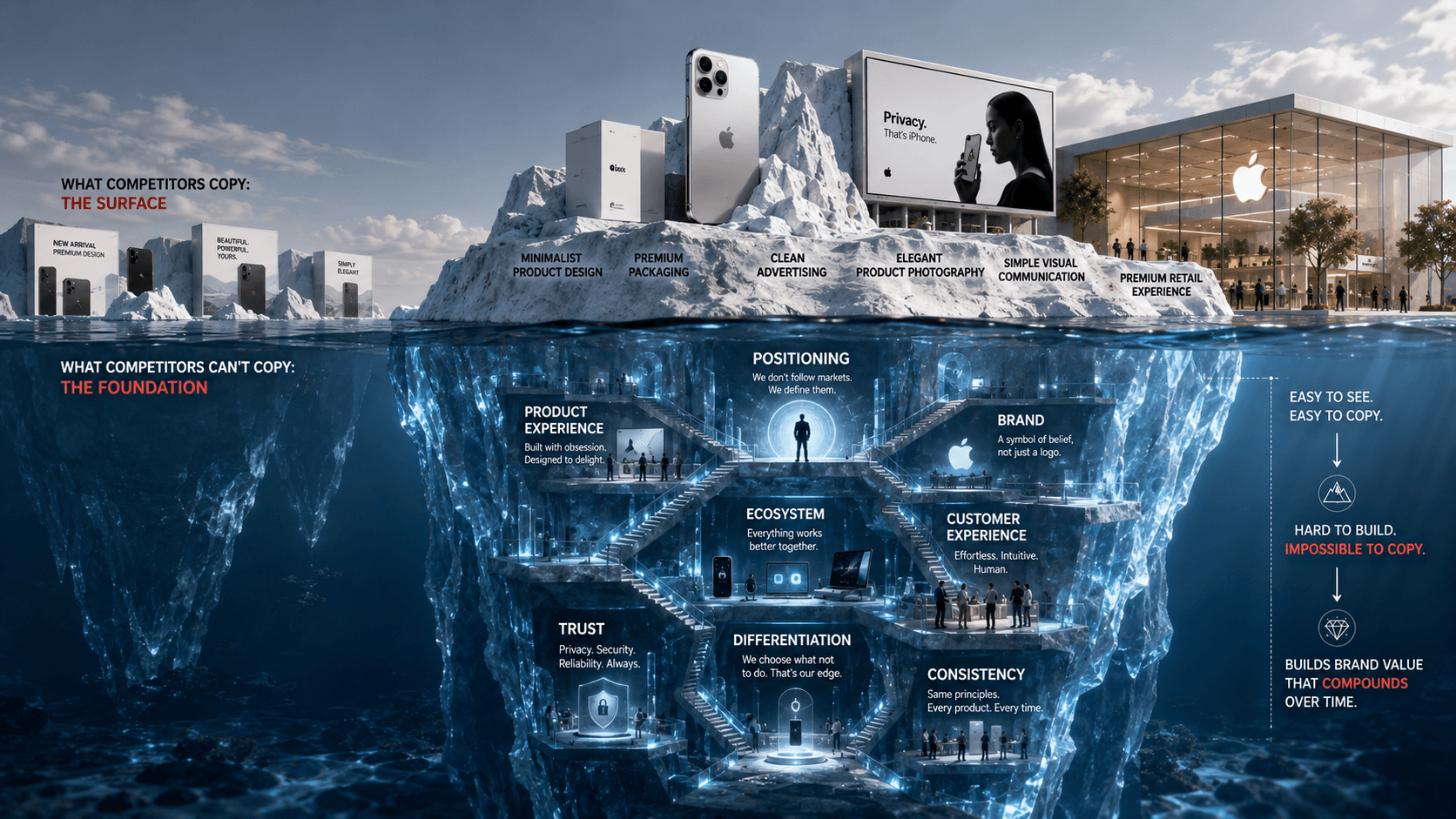
Because Apple doesn’t just sell a phone.
It builds a perception around the phone.
It builds an experience around the product.
It builds an ecosystem around the experience.
And over time, it builds a relationship with the customer.
That’s what we’re going to deconstruct in this article.
Not:
“Why is Apple successful?”
But:
“What marketing decisions has Apple made that created this outcome?”
Because that’s how a marketer should study a successful brand.
Lesson 1: Don’t Sell the Feature. Sell What the Feature Means.
Let’s take the iPhone camera.
Apple could simply say:
“48MP camera.”
That’s a feature.
But the customer doesn’t wake up in the morning thinking:
“I really need a 48MP camera today.”
They want something else.
They want better photos.
They want better videos.
They want to capture their child’s first steps.
Their wedding.
Their holiday.
Their friends.
Their important moments.
That’s the difference between a feature and a customer outcome.
Think about it like this:
Feature
↓
What does it do?
↓
Benefit
↓
Why does that matter?
↓
Outcome
↓
What does the customer actually get from it?
The camera is the feature.
Better photos are the benefit.
Capturing important moments beautifully is the outcome.
And this is something we already discussed in Consumer Psychology.
People don’t always buy the technical specification.
They buy what that specification means to them.
This is why Apple’s marketing often focuses on the experience created by the technology rather than simply throwing specifications at the customer.
The Marketing Lesson
Whenever you’re marketing a product, don’t stop at:
“What does my product have?”
Ask:
“What does this feature help the customer do?”
And then go one step further:
“Why does that matter to them?”
That’s where your marketing becomes much more powerful.
Lesson 2: Positioning Can Change How People See Price
Now let’s return to the original question:
“Why is an iPhone so expensive?”
Here’s the interesting part.
Price doesn’t exist in isolation.
Customers judge price based on the value they believe they’re getting.
Imagine two products.
Product A costs ₹20,000.
Product B costs ₹80,000.
If both are perceived as basic smartphones, Product B looks ridiculously expensive.
But if Product B is perceived as:
Premium
Reliable
Well-designed
A great experience
A strong ecosystem
A status symbol
A trusted brand
the customer may evaluate that ₹80,000 very differently.
The number hasn’t changed.
The perception around the number has changed.
And this is where positioning becomes powerful.
Apple doesn’t try to win the smartphone market by saying:
“We’re the cheapest.”
It has built a very different position.
And that position influences how customers evaluate the price.
The Marketing Lesson
Don’t automatically think:
“My product is expensive. I need to reduce the price.”
First ask:
“Does my customer understand why my product is worth the price?”
Because sometimes the problem isn’t price.
The problem is perceived value.
Lesson 3: Don’t Just Claim Your Positioning. Build Evidence for It.
Imagine I launch a new smartphone tomorrow and put this on my website:
“The most premium smartphone in India.”
Would you believe me?
Probably not.
Because anyone can make a claim.
Apple doesn’t need to constantly say:
“We are premium.”
Look at the entire experience.
The product design.
The packaging.
The Apple Store.
The website.
The advertisements.
The photography.
The product launches.
The customer experience.
All of these touchpoints communicate a similar idea.
Premium.
Simple.
Modern.
Designed.
This is a very important marketing lesson.
Your positioning isn’t only what you say about yourself. It’s what customers repeatedly experience.
Remember Customer Journey Mapping?
Every interaction with your brand is a touchpoint.
An advertisement is a touchpoint.
Your website is a touchpoint.
The checkout process is a touchpoint.
Packaging is a touchpoint.
The product itself is a touchpoint.
Customer support is a touchpoint.
If all of these communicate different things, your positioning becomes weak.
But when they reinforce the same idea, perception becomes stronger.
The Marketing Lesson
Don’t ask:
“What should our brand claim?”
Ask:
“What evidence are we giving customers to believe that claim?”
If you want to be premium, the experience needs to feel premium.
If you want to be affordable, the value needs to feel obvious.
If you want to be innovative, your product needs to demonstrate innovation.
Positioning needs proof.
Lesson 4: One Product Can Create Demand for Another
Now let’s look at one of Apple’s most interesting strategies.
The ecosystem.
Imagine you buy an iPhone.
Then you buy AirPods.
Then perhaps an Apple Watch.
Maybe a MacBook.
You use iCloud.
Maybe Apple Music.
Suddenly, you’re not using one Apple product.
You’re using a connected system.
And this creates something very interesting.
Your first purchase can make the next purchase more attractive.
You already have an iPhone.
AirPods fit naturally into that experience.
You already have an iPhone and AirPods.
An Apple Watch can add another layer.
You already have Apple devices.
A Mac can fit into the same ecosystem.
This creates a loop:
Product A
↓
Creates value
↓
Makes Product B more useful
↓
Product B makes the ecosystem more valuable
↓
Customer has more reasons to stay
This isn’t just an “ecosystem.”
It’s a growth mechanism.
Apple doesn’t need every product to operate as a completely separate business in the customer’s mind.
The products can strengthen each other.
The Marketing Lesson
You don’t need to build an Apple-sized ecosystem.
But you can ask:
“Can one product naturally create demand for another?”
If you sell skincare:
Cleanser → Moisturiser → Sunscreen.
If you sell fitness equipment:
Yoga mat → Resistance bands → Training programme.
If you sell software:
Basic plan → Advanced feature → Add-on → Premium plan.
The point isn’t to force customers to buy more.
The point is to create genuine complementary value.
Lesson 5: Convenience Can Become a Competitive Advantage
There’s another reason ecosystems are powerful.
Convenience.
Think about using Apple devices together.
You can move files between devices.
Your information can sync.
Your devices can communicate with each other.
Your passwords can be stored and used across devices.
Your photos can be available across devices.
None of these individual features necessarily makes someone say:
“I must buy an iPhone!”
But together, they remove a lot of small inconveniences.
And those small conveniences add up.
Think about the customer experience:
Less friction
↓
More convenience
↓
More perceived value
↓
More reasons to stay
This is a very powerful marketing principle.
Sometimes your competitive advantage isn’t:
“We have more features.”
It can be:
“We make the customer’s life easier.”
The Marketing Lesson
Look at your customer journey.
Ask:
Where is the customer wasting time?
Where are they confused?
Where are they repeating work?
Where are they getting frustrated?
Then remove that friction.
You might discover a competitive advantage hiding inside something as simple as convenience.
Lesson 6: Don’t Think Only About the First Purchase
Now let’s connect this with our previous lecture on Customer Lifetime Value.
Imagine Apple sells you an iPhone.
The relationship could end there.
But it doesn’t have to.
You might later buy:
AirPods.
Apple Watch.
MacBook.
iCloud storage.
Apple Music.
AppleCare.
Another iPhone a few years later.
Now look at the customer’s journey differently.
The question isn’t:
“How much money did Apple make from this iPhone?”
The bigger question is:
“How much value can this customer generate throughout their relationship with Apple?”
That’s CLV thinking.
And this is why customer retention matters so much.
If a customer buys once and disappears, the relationship has limited value.
If they stay for years and continue buying products and services, the relationship becomes much more valuable.
So we get:
Better Experience
↓
More Trust
↓
Higher Retention
↓
More Purchases
↓
Higher Customer Lifetime Value
This is where Apple’s ecosystem and CLV connect.
The ecosystem isn’t only about technology.
It’s also a way of extending the customer relationship.
Lesson 7: Build Recurring Relationships, Not Just One-Time Transactions
There’s another interesting part of Apple’s business.
Services.
The customer may pay for:
iCloud
Apple Music
Apple TV+
AppleCare
and other services.
This changes the relationship.
Instead of:
Customer buys product → Transaction ends
it becomes:
Customer buys product → Uses service → Continues relationship → Buys again
That’s a very different growth model.
The hardware can bring the customer into the ecosystem.
Services can keep the relationship active.
And future products can give the customer new reasons to stay.
This doesn’t mean every business needs a subscription.
That’s not the lesson.
The lesson is:
Think beyond the first transaction.
Ask:
What reason does the customer have to come back?
What additional value can we create after the first purchase?
Can we build a long-term relationship instead of constantly chasing new customers?
That’s where sustainable growth starts becoming interesting.
Lesson 8: Consumer Psychology Is Working in the Background
Now let’s connect this back to our Consumer Psychology lecture.
Why does someone want an iPhone?
There isn’t one answer.
For some people:
Camera.
For others:
Design.
For others:
Ecosystem.
For others:
Reliability.
For others:
Status.
For others:
Familiarity.
For others:
They simply prefer the experience.
This is why consumer psychology matters.
The customer isn’t making a decision based only on specifications.
They’re also thinking about:
Identity.
Trust.
Experience.
Convenience.
Status.
Familiarity.
And sometimes:
What does owning this product say about me?
This is why brands can become much more powerful than the products they sell.
A product is functional.
A brand can become meaningful.
What About Celebrities and Influencers?
You’ve probably noticed iPhones in:
Movies.
YouTube videos.
Instagram content.
Celebrity appearances.
Creator content.
Business environments.
When a product repeatedly appears in environments associated with success, creativity or influence, it can contribute to the perception around the brand.
This is a classic psychological principle behind association.
People don’t only see the product.
They can start associating the product with the people, environments and lifestyles around it.
We should be careful about saying:
“Apple pays every celebrity to use an iPhone.”
That would be an unsupported blanket claim.
But the broader marketing lesson is very real:
Who is associated with your brand can influence what people associate with your brand.
That’s why influencer marketing, celebrity endorsements and product placements can be powerful.
The product is the same.
The context changes the perception.
So What Is Apple Really Selling?
Let’s stop for a moment.
Is Apple selling:
Phones?
Yes.
Laptops?
Yes.
Earbuds?
Yes.
Smartwatches?
Yes.
But from a marketing perspective, that’s not the full answer.
Apple is also selling:
Simplicity.
Convenience.
Design.
Experience.
Trust.
Status.
An ecosystem.
And a relationship that can continue across multiple products and services.
That’s why asking:
“What product does this brand sell?”
is often the wrong marketing question.
Ask:
“What value is this brand actually selling?”
That’s a much better question.
Now Let’s Turn Apple Into a Marketing Framework
Here’s the part I really want you to take away.
When you study a successful brand, don’t simply copy what it does.
Deconstruct why it works.
For Apple:
Strong Product
Creates real functional value.
↓
Positioning
Creates a premium and distinctive perception.
↓
Experience
Makes the positioning believable.
↓
Ecosystem
Makes products more valuable together.
↓
Convenience
Reduces friction.
↓
Retention
Gives customers reasons to stay.
↓
CLV
Creates more value from the relationship.
↓
Brand
All of these experiences reinforce what the brand means.
Now that’s a marketing system.
And this is exactly how I want you to study successful brands.
Not:
“Apple ran this campaign.”
But:
“Why did Apple make this decision?”
That’s where the real learning starts.
What Can Your Business Learn From Apple?
Now you might be thinking:
“But I’m not Apple.”
Of course you’re not.
You don’t need Apple’s budget.
You don’t need millions of customers.
You don’t need an ecosystem of ten products.
You need to understand the principles.
If you run a small bakery, you can still create a memorable experience.
If you sell courses, you can create a complete learning ecosystem.
If you sell skincare, complementary products can naturally increase customer value.
If you run a SaaS business, integrations can make your product more useful.
If you sell fashion, your brand experience can create a stronger perception than your competitors.
The point is not:
“Do what Apple does.”
The point is:
“Understand why Apple does it, then find your own version of the principle.”
That’s what strategy actually means.
Your Assignment
Choose any successful brand.
Don’t just write down what they sell.
Deconstruct them.
Ask:
What are they actually selling beyond the product?
What perception have they created?
What psychological triggers are they using?
What does their customer experience look like?
What are their important touchpoints?
Does one product create demand for another?
How do they retain customers?
How do they increase Customer Lifetime Value?
And finally:
What can you learn from this brand that you could apply to a completely different business?
That’s the important part.
Don’t copy the tactic.
Find the principle behind the tactic.
The Real Lesson
Apple’s biggest marketing lesson isn’t:
“Make expensive products.”
It isn’t:
“Build an ecosystem.”
And it isn’t:
“Run beautiful advertisements.”
Those are tactics.
The deeper lesson is this:
Build a system where your product, positioning, customer experience and business model reinforce each other.
Apple’s product creates value.
Its positioning changes perception.
Its experience reinforces that positioning.
Its ecosystem creates convenience.
Its products can create demand for other products.
Its services extend the relationship.
And the relationship can increase Customer Lifetime Value.
None of these things exists in isolation.
They work together.
And that’s the difference between a marketing campaign and a marketing strategy.
A campaign can get attention.
A strategy builds a system.
So the next time you see an Apple advertisement, don’t just think:
“That’s a good ad.”
Stop.
Ask:
Why did they show me this?
What do they want me to feel?
What perception are they building?
Where does this fit into the customer journey?
What does this make me more likely to buy next?
How does this strengthen the relationship?
That’s how a marketer looks at Apple.
And once you learn to look at Apple that way, you can start looking at every successful brand differently.
Don’t copy successful brands.
Learn to deconstruct them.
That’s where strategy begins.
Leave a Reply