
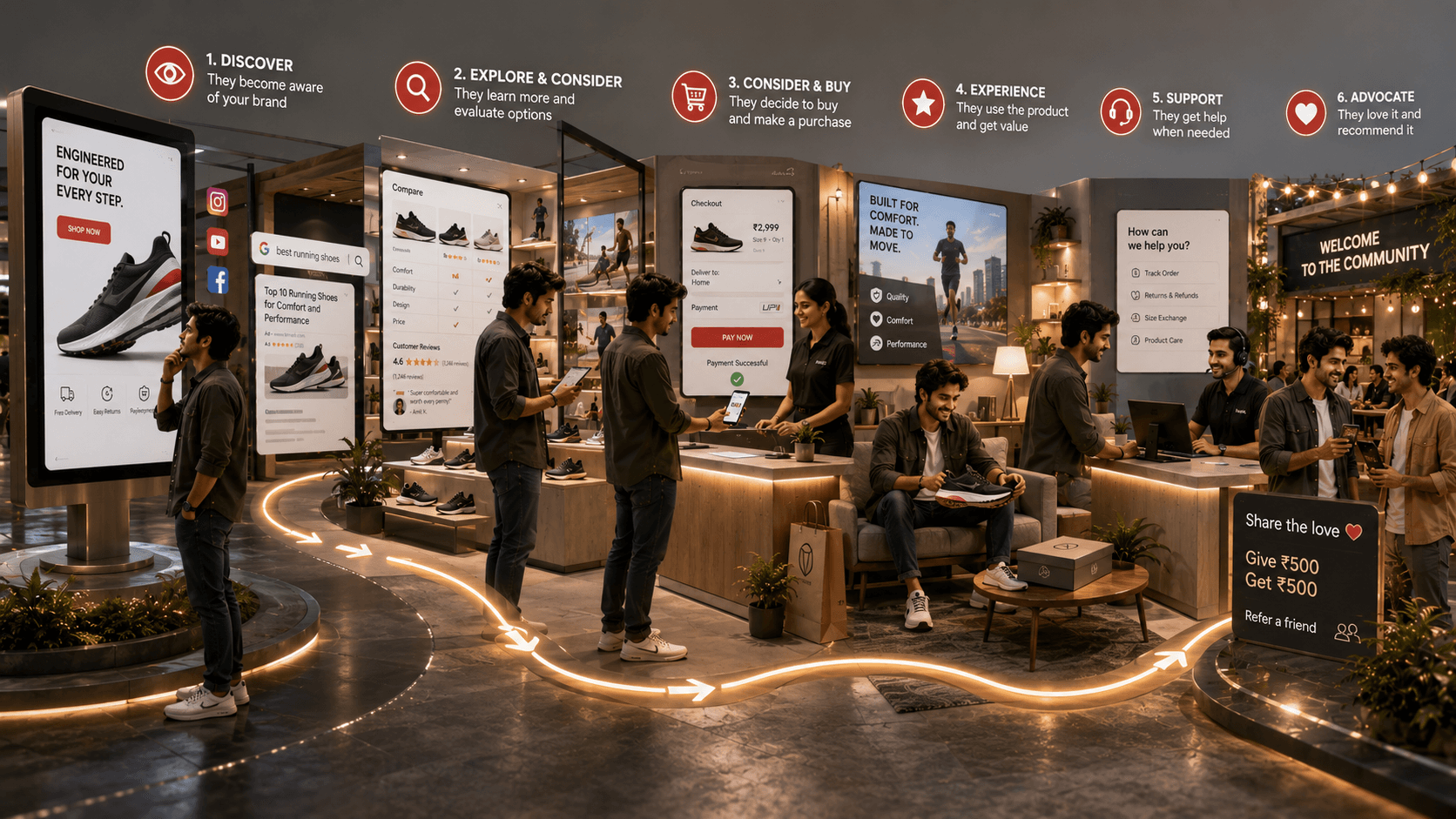




Imagine you want to buy a new pair of earbuds.
Do you open Amazon, see the first product and immediately buy it?
Probably not.
Maybe you first realise your old earbuds are no longer working properly.
Then you start searching.
You watch a few YouTube reviews.
Check Instagram.
Compare different brands.
Read customer reviews.
Ask a friend.
Check the price.
Maybe you add one to your cart and leave.
A few days later, you come back and finally buy it.
But your journey doesn’t end there.
You receive the product.
Open the box.
Set it up.
Start using it.
Maybe you love it.
Maybe you face a problem.
Maybe customer support helps you.
And if everything goes well, a few weeks later your friend asks:
“Which earbuds are you using?”
And you recommend the same brand.
Notice something.
Your journey didn’t start when you visited the brand’s website.
And it didn’t end when you clicked “Buy Now.”
It started when you realised you had a problem.
And it continued long after the purchase.
That complete experience is called the Customer Journey.
What is a Customer Journey?
In simple words:
A customer journey is the complete experience a person has with a business before, during and after a purchase.
It includes what the customer:
Does.
Thinks.
Feels.
Sees.
Experiences.
And every interaction can influence their next decision.
Think about ordering food online.
You might discover a restaurant on Instagram.
Check its ratings.
Open the menu.
Compare prices.
Place an order.
Track the delivery.
Receive the food.
Contact support if something goes wrong.
Leave a review.
Order again later.
All of these are part of the customer journey.
And this is where many businesses make a mistake.
They think:
“Customer journey = advertisement → website → purchase.”
But that’s the company’s view.
The customer doesn’t experience your business like that.
They experience a series of moments.
And those moments shape how they feel about your brand.
The Customer Journey Starts Before Your Brand
This is one of the most important things to understand.
A customer’s journey doesn’t necessarily begin when they discover your brand.
It can begin with a problem, need or desire.
Imagine your phone battery has become terrible.
It dies by lunchtime.
You realise:
“I need a new phone.”
At that moment, your journey has already started.
You haven’t searched for Samsung.
You haven’t visited Apple.
You haven’t opened Amazon.
But you’ve already entered the journey.
Then you start looking for a solution.
This is important for marketers because customers don’t always start by searching for your product.
They often start by searching for their problem.
Someone may not search:
“Best CRM for small businesses.”
They might search:
“How do I manage leads for my business?”
Someone may not search:
“Best running shoes.”
They might search:
“Why do my feet hurt when I run?”
Someone may not search:
“Best digital marketing course.”
They might search:
“How can I learn digital marketing?”
This changes the way you think about marketing.
Your job isn’t always to wait for customers to search for your brand.
You need to understand what happens before your brand enters their mind.
Customer Journey vs Marketing Funnel
Now you might be thinking:
“Didn’t we just learn about the Marketing Funnel?”
Yes.
And this is where the difference becomes important.
A marketing funnel looks at the journey mainly from the business perspective.
It asks:
How many people are aware of us?
How many are considering us?
How many are buying?
How many are returning?
A customer journey looks at the same world from the customer’s perspective.
It asks:
What is the customer trying to achieve?
What are they thinking?
What are they feeling?
What information do they need?
What is frustrating them?
What makes them trust us?
So remember:
The funnel tells you where the customer is.
The customer journey helps you understand what the customer is experiencing.
And that distinction is extremely important.
Imagine 1,000 people reach your checkout page but only 100 purchase.
Your funnel tells you:
There’s a drop-off.
Your customer journey helps you investigate:
Why are people leaving?
Maybe delivery charges appear too late.
Maybe the payment process is confusing.
Maybe the return policy isn’t clear.
Maybe customers don’t trust the website.
The funnel shows you where.
The journey helps you understand why.
The 5 Stages of a Customer Journey
Every customer journey is different.
People don’t always move in a perfectly straight line.
But we can use five simple stages to understand the journey:
Awareness
↓
Consideration
↓
Purchase
↓
Experience & Retention
↓
Loyalty & Advocacy
Let’s understand them from the customer’s point of view.
Stage 1: Awareness
Imagine Priya’s laptop suddenly stops working.
She needs a new one.
So she starts searching online.
She watches YouTube videos.
Reads articles.
Checks Google.
Sees advertisements.
Maybe a friend recommends a brand.
She’s discovering different solutions.
This is the Awareness stage.
The customer is basically asking:
“What options do I have?”
At this stage, businesses can help customers through:
SEO.
Google Ads.
Social media.
YouTube.
Content.
Influencers.
Word of mouth.
But remember:
The customer doesn’t necessarily want to buy yet.
They’re trying to understand the problem and available solutions.
So if you immediately shout:
“BUY NOW!”
you may be asking for a decision before the customer is ready to make one.
Stage 2: Consideration
Now Priya knows about several laptop brands.
She starts comparing them.
She checks:
Price.
Features.
Reviews.
Battery life.
Warranty.
Design.
Customer opinions.
She might watch another five YouTube videos before making a decision.
She’s interested.
But she’s not convinced yet.
This is the Consideration stage.
The customer’s question becomes:
“Which option is right for me?”
This is where businesses need to reduce uncertainty.
Reviews can help.
Testimonials can help.
Comparisons can help.
Product demonstrations can help.
FAQs can help.
Clear pricing can help.
The goal isn’t simply to give customers more information.
It’s to give them the right information to make a confident decision.
Stage 3: Purchase
After comparing everything, Priya chooses a laptop.
She adds it to her cart.
Completes payment.
Receives the confirmation.
She’s now a customer.
This is the Purchase stage.
But here’s something important.
Many businesses think:
“Great. We got the sale.”
And then they move on to the next customer.
That’s a mistake.
Because the customer’s experience is only entering its next stage.
Stage 4: Experience and Retention
Priya receives the laptop.
The packaging is good.
Setup is easy.
The product works as promised.
Customer support responds quickly when she has a question.
Now she’s forming an opinion about the brand.
This is where the gap between what you promised and what you actually delivered becomes important.
You can run the best advertising campaign in the world.
But if the actual product is disappointing, the customer journey breaks.
Retention is about giving customers a reason to stay.
It can come from:
Good product quality.
Excellent support.
Easy returns.
Helpful onboarding.
Personalised communication.
Loyalty programmes.
And simply delivering what you promised.
Stage 5: Loyalty and Advocacy
Six months later, Priya’s friend needs a new laptop.
She asks:
“Which one should I buy?”
Priya says:
“I’ve been using this one for six months. It’s been great. You should check it out.”
Now something interesting has happened.
Priya isn’t just a customer anymore.
She’s become an advocate.
She may leave a review.
Recommend the brand.
Share it with friends.
Buy another product from the same company.
This is the final stage:
Loyalty and Advocacy.
And this is one of the most valuable outcomes of a great customer journey.
Your customers start helping you acquire more customers.
Great marketing starts with understanding what happens in the customer’s mind, not just what the brand wants to communicate. Learn how positioning, consumer psychology, branding and marketing strategy come together in the Positioning.co.in Marketing OS Program.
Touchpoints: Every Moment Matters
Now let’s introduce another important term:
Touchpoint.
A touchpoint is simply any moment when a customer interacts with your business or encounters your brand.
It could be:
A Google search result.
An Instagram advertisement.
A YouTube video.
A website.
A product review.
A salesperson.
A payment page.
A delivery notification.
The packaging.
The product itself.
Customer support.
An email.
A WhatsApp message.
A friend’s recommendation.
Notice something.
Some of these touchpoints are controlled directly by the marketing team.
Some aren’t.
The delivery experience might be controlled by operations.
Customer support by the support team.
Product quality by the product team.
Packaging by another team.
But the customer doesn’t care which department is responsible.
They simply experience one brand.
That’s why customer journey thinking shouldn’t belong only to marketing.
Marketing attracts the customer.
Product delivers the value.
Sales builds confidence.
Operations delivers the promise.
Support handles problems.
Every team contributes to the journey.
So What Is Customer Journey Mapping?
Now we can get to the practical part.
Imagine Rahul runs an online bakery.
Thousands of people visit his website every month.
Hundreds add cakes to their cart.
But very few actually purchase.
Rahul could simply say:
“We need more traffic.”
But what if traffic isn’t the problem?
So he decides to look at the journey from the customer’s perspective.
He follows the process:
Customer sees Instagram ad.
↓
Visits website.
↓
Browses birthday cakes.
↓
Checks delivery information.
↓
Adds cake to cart.
↓
Reaches checkout.
↓
Leaves.
Rahul investigates.
And discovers something interesting.
The delivery charge is shown only at checkout.
Customers thought the cake was ₹999.
Suddenly they see another ₹250 added.
Many leave.
Now Rahul knows the problem.
He can show delivery charges earlier.
The problem wasn’t traffic.
It was friction in the customer journey.
This is what customer journey mapping helps you find.
Customer Journey Mapping is the process of visualising the customer’s experience across different stages and touchpoints so that you can identify problems and opportunities to improve it.
And here’s the most important thing:
The map itself isn’t the goal.
Improving the journey is the goal.
What Does a Customer Journey Map Actually Contain?
A simple journey map can answer six questions.
1. Who is the customer?
Don’t start with:
“Everyone.”
Choose one specific customer.
For example:
A college student buying earbuds.
A first-time home buyer.
A small business owner looking for accounting software.
Different customers can have completely different journeys.
2. What is the customer trying to achieve?
What are they actually trying to accomplish?
The customer buying earbuds may not simply want:
“Earbuds.”
They may want:
Good sound for commuting.
Clear calls during work.
Something comfortable for long listening.
Understanding the real goal changes how you design the experience.
3. What does the customer do?
List the actual actions.
Searches Google.
Watches a review.
Visits the website.
Reads reviews.
Compares prices.
Adds to cart.
Purchases.
Contacts support.
Uses the product.
Recommends it.
4. What is the customer thinking and feeling?
This is where journey mapping becomes more powerful.
At each stage, ask:
What are they thinking?
What are they worried about?
What are they excited about?
What information are they missing?
For example:
At the product page:
“Will these earbuds be comfortable for long calls?”
At checkout:
“Are there any hidden charges?”
After purchase:
“How do I set these up?”
These questions reveal opportunities.
5. Where is the friction?
Friction means anything that makes the customer’s journey harder.
A slow website.
Confusing navigation.
Hidden charges.
Too many checkout steps.
Poor product information.
Complicated returns.
Slow customer support.
A customer doesn’t always tell you:
“Your checkout has too much friction.”
They simply leave.
Your job as a marketer is to find out why.
6. What can we improve?
Now turn the problem into an action.
Hidden delivery charges?
Show them earlier.
Confusing product information?
Simplify it.
Customers don’t trust the brand?
Add genuine reviews and proof.
Customers struggle after purchase?
Improve onboarding and support.
That’s the point of the map.
Understand → Identify → Improve.
Let’s Build a Customer Journey Map
Let’s use our earbuds example.
Imagine Aman has launched a new earbuds brand.
His target customer is a young working professional.
Here’s what the journey could look like:
| Stage | Customer Action | What They Think | Friction | Opportunity |
|---|---|---|---|---|
| Awareness | Sees an Instagram Reel | “These look interesting.” | Doesn’t understand the difference | Clearer positioning |
| Consideration | Reads reviews | “Can I trust this brand?” | Very little social proof | Show genuine reviews |
| Purchase | Reaches checkout | “What will I actually pay?” | Delivery cost appears late | Show total price earlier |
| Experience | Starts using earbuds | “How do I set these up?” | Setup isn’t clear | Better onboarding |
| Retention | Continues using them | “These are actually useful.” | No reason to engage again | Helpful post-purchase communication |
| Advocacy | Recommends them | “My friend might like these.” | No easy referral mechanism | Encourage reviews/referrals |
Now look at what happened.
We didn’t just describe the customer.
We found problems and opportunities.
That’s what makes journey mapping useful.
Your Customer Journey Isn’t Always Linear
There’s one more thing you need to understand.
Don’t imagine every customer moving like this:
Awareness → Consideration → Purchase → Retention → Advocacy
Real people are messy.
A customer might:
See your advertisement.
Ignore it.
See it again two weeks later.
Search Google.
Watch a review.
Compare three competitors.
Leave the website.
Come back through a retargeting ad.
Ask a friend.
Then purchase.
Someone else may discover you through a friend and buy immediately.
Another customer may take three months.
Another may never buy.
That’s normal.
The stages are a framework for understanding behaviour.
They’re not railway tracks.
The customer journey is rarely a straight line.
That’s why marketers need to understand behaviour rather than blindly force everyone through the same process.
Common Customer Journey Mistakes
Thinking only about the purchase
The customer experience doesn’t end at checkout.
Delivery, onboarding, product usage and support can determine whether they return.
Designing the journey from the company’s perspective
You might think:
“Our website is easy.”
But your customer might be thinking:
“I can’t find what I’m looking for.”
Always look at the journey through the customer’s eyes.
Assuming every customer is the same
A first-time buyer and a loyal customer don’t need the same experience.
A customer buying for themselves may also have a completely different journey from someone buying a gift.
Focusing only on digital touchpoints
The customer journey can include:
A physical store.
Packaging.
Delivery.
Salespeople.
Customer support.
Word of mouth.
The website is only one part.
Creating a beautiful map and doing nothing
This is probably the funniest failure.
You spend three days creating a beautiful customer journey diagram.
Everyone in the meeting says:
“Wow. Looks amazing.”
Then nothing changes.
The purpose of the map isn’t to create a presentation.
The purpose is to improve the customer experience.
Real Brands, Real Customer Journey Lessons
Let’s look at a few brands.
Amazon: Reduce Friction
Amazon makes many parts of shopping extremely easy.
Search.
Product comparison.
Reviews.
Delivery information.
Tracking.
Returns.
The lesson isn’t simply:
“Make an app like Amazon.”
It’s:
Look for unnecessary friction and remove it.
Apple: Continue the Experience After Purchase
The Apple experience doesn’t end when you buy the device.
Setup.
Support.
Stores.
Software.
Accessories.
These continue the relationship.
The lesson:
The post-purchase experience is part of the product experience.
Zomato: Reduce Uncertainty
When you order food, you want answers.
Is the restaurant open?
What does the food look like?
How long will delivery take?
Where is my order?
What happens if there’s a problem?
The more uncertainty you remove, the more comfortable the customer feels.
The lesson:
Good customer journeys answer important questions before customers have to ask them.
Airbnb: Build Trust
You’re booking a stay in a place you’ve never visited.
And sometimes you’re staying in a stranger’s home.
That’s a huge trust problem.
Reviews.
Ratings.
Photos.
Host information.
Communication.
These touchpoints help reduce uncertainty.
The lesson:
Trust isn’t created by one advertisement. It’s built across the journey.
How to Create Your Own Customer Journey Map
You don’t need expensive software.
You don’t need a complicated framework.
You can start with a spreadsheet.
Choose one customer.
Then map:
1. Customer
Who are they?
2. Goal
What are they trying to achieve?
3. Stages
What steps do they go through?
4. Touchpoints
Where do they interact with your brand?
5. Actions
What are they doing?
6. Thoughts & Feelings
What are they thinking and feeling?
7. Friction
Where are they struggling?
8. Opportunities
What can you improve?
Then prioritise.
Because you don’t need to fix everything at once.
Find the problems that have the biggest impact on the customer experience or business outcome.
Fix them.
Measure what changes.
Then move to the next problem.
Your Assignment
Now choose any brand you know well.
It can be:
Apple.
Nike.
Amazon.
Zomato.
Amul.
A local café.
Or your own business.
Choose one specific customer.
Then answer:
Who are they?
What are they trying to achieve?
How do they discover the brand?
What do they do next?
What are they thinking at each stage?
What are they feeling?
Where do they interact with the brand?
Where could they face friction?
What could the business improve?
And finally, ask yourself:
“If I were the customer, what would frustrate me most about this journey?”
That question alone can reveal a lot.
The Real Lesson
Let’s go back to the earbuds.
The customer didn’t simply:
See an ad → Buy earbuds.
They had a problem.
They searched.
They compared.
They questioned.
They trusted.
They purchased.
They experienced the product.
They formed an opinion.
And eventually, they either:
Came back.
Or:
Walked away.
Or:
Recommended the brand.
That’s the customer journey.
And as a marketer, your job isn’t simply to get people to the checkout page.
Your job is to understand everything that happens before, during and after that decision.
Because:
A funnel tells you where people are dropping off.
A customer journey helps you understand what they’re experiencing.
A journey map helps you find what you can improve.
That’s why great marketers don’t only ask:
“How do we sell more?”
They ask:
“What is the customer experiencing right now?”
And once you start thinking that way, you stop looking at your business from the inside.
You start looking at it through the customer’s eyes.
That’s when marketing becomes much more powerful.
Leave a Reply