




Imagine Rahul opens a new gym.
He spends weeks choosing the equipment.
The interiors look great.
The trainers are experienced.
The pricing is competitive.
Everything is ready.
So Rahul starts running Instagram and Facebook ads.
Within a few days, 10,000 people see his advertisement.
Sounds great, right?
But then he checks the numbers.
500 people clicked the ad.
80 people checked the membership plans.
20 people came for a free trial.
And only 5 people purchased a membership.
Rahul gets frustrated.
He says:
“Online advertising doesn’t work.”
But does it?
Not really.
The advertisement actually did its job.
People saw it.
Some clicked.
Some became interested.
The problem happened somewhere after that.
Maybe the website wasn’t convincing.
Maybe the pricing wasn’t clear.
Maybe people didn’t trust the gym.
Maybe the free trial wasn’t attractive enough.
Maybe nobody followed up after the trial.
This is where a marketer starts thinking differently.
Instead of asking:
“Why aren’t we getting enough sales?”
They ask:
“At which stage are people dropping off, and why?”
And that’s exactly what a marketing funnel helps us understand.
What Is a Marketing Funnel?
Let’s take a simple example.
Imagine you’re planning to buy a new laptop.
You see an advertisement.
You notice the brand.
Then you search for it on Google.
You watch a few YouTube reviews.
You compare it with other laptops.
You check the price.
You read customer reviews.
Maybe you visit a store.
And finally, after comparing everything, you buy it.
You didn’t go from:
Advertisement → Purchase
You went through a journey.
And that journey is what marketers call a funnel.
In simple words:
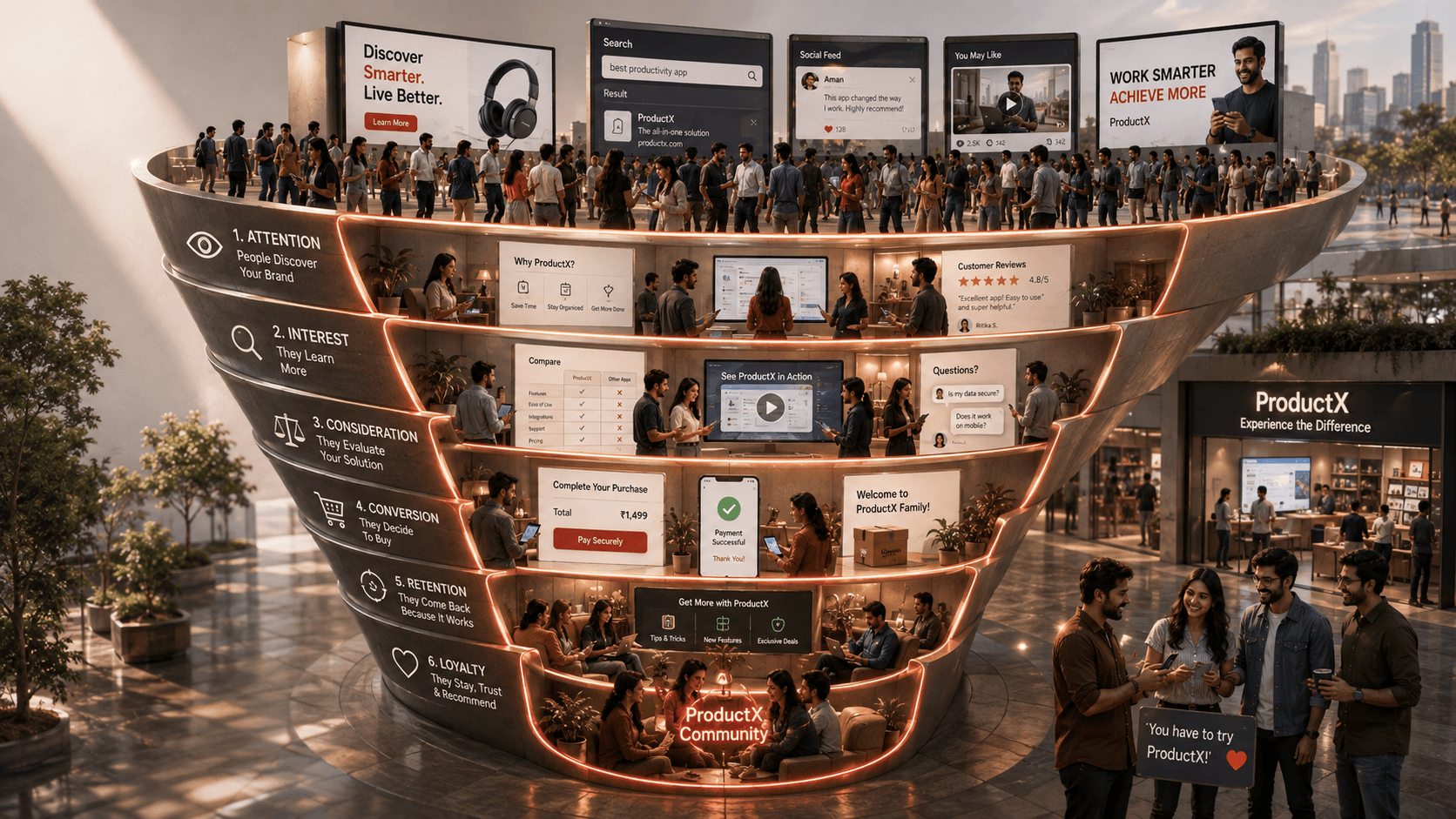
A marketing funnel is a framework that helps us understand how people move from discovering a brand to becoming customers and, eventually, loyal customers.
The important word here is move.
Because not everyone who enters the funnel reaches the end.
Why Is It Called a Funnel?
Think about a normal funnel.
It’s wide at the top.
Narrow at the bottom.
Marketing works in a similar way.
Imagine:
10,000 people see your advertisement.
↓
500 click.
↓
80 seriously consider the product.
↓
20 try it.
↓
5 buy.
The numbers keep getting smaller.
That’s why we call it a funnel.
But here’s something important.
The funnel isn’t simply about numbers getting smaller.
It’s about understanding why they’re getting smaller.
If 10,000 people see your ad and only 500 click, that’s one problem.
If 500 people click but only 5 buy, that’s a completely different problem.
And the solution will also be different.
That’s where funnel thinking becomes useful.
The 5 Stages of a Marketing Funnel
A simple modern marketing funnel can be understood through five stages:
Awareness
↓
Consideration
↓
Conversion
↓
Retention
↓
Advocacy
Let’s understand each one.
1. Awareness
This is where the customer discovers you.
They might see:
An Instagram Reel.
A Google Search result.
A YouTube video.
An advertisement.
A friend’s recommendation.
A blog.
A billboard.
At this point, they may not even be looking to buy.
They’ve simply discovered that you exist.
For Rahul’s gym, imagine a student scrolling Instagram.
He sees:
“New fitness centre opening near you.”
That’s awareness.
The goal at this stage isn’t necessarily:
“Get the sale.”
The first goal is:
“Get noticed by the right people.”
And that’s an important distinction.
You don’t want 1 million random people to know about your brand.
You want the right people to notice it.
2. Consideration
Now the person knows you exist.
But knowing you exist doesn’t mean they trust you.
They start asking questions.
Is this right for me?
Can I trust this brand?
How much does it cost?
How is it different?
What are other people saying?
Let’s go back to Rahul’s gym.
The student clicks the advertisement.
He visits the website.
Checks the membership plans.
Looks at trainer profiles.
Reads reviews.
Checks the gym on Google Maps.
Maybe watches a few Instagram videos.
He’s interested.
But he hasn’t decided yet.
This is consideration.
At this stage, marketers need to reduce uncertainty.
That’s why brands use things like:
Reviews
Testimonials
Demonstrations
Case studies
FAQs
Free trials
Educational content
The customer is basically asking:
“Give me a reason to trust you.”
3. Conversion
Now the customer is ready to take action.
That action depends on the business.
It could be:
Buying a product.
Booking a demo.
Starting a free trial.
Submitting a lead form.
Booking an appointment.
Purchasing a course.
For Rahul’s gym, the customer attends the free trial and purchases a membership.
That’s a conversion.
But notice something.
The conversion didn’t happen because of one advertisement.
The advertisement created awareness.
The website answered questions.
The reviews built trust.
The free trial reduced risk.
And finally, the customer purchased.
That’s why marketers shouldn’t look at conversion in isolation.
Every stage before conversion matters.
4. Retention
Now comes a stage many businesses completely ignore.
The customer has already purchased.
What happens next?
Imagine Rahul’s gym.
A customer joins.
Rahul could simply collect the payment and forget about them.
Or he could:
Check their progress.
Give them a personalised workout plan.
Send helpful fitness tips.
Ask for feedback.
Celebrate milestones.
Make them feel part of the community.
Now the customer has a reason to stay.
That’s retention.
And retention matters because:
A customer who buys once is valuable. A customer who keeps coming back is much more valuable.
This is why marketing doesn’t end when the payment is completed.
The relationship has just started.
5. Advocacy
Now something interesting happens.
A happy customer starts marketing the business for you.
Imagine Rahul’s customer gets a great result.
They post their transformation on Instagram.
Leave a five-star review.
Tell their friends about the gym.
Maybe even bring a friend with them.
The customer has now become an advocate.
This is advocacy.
And it’s powerful because people often trust other customers more than they trust advertisements.
Think about your own behaviour.
If a brand says:
“We are the best.”
You might ignore it.
But if your friend says:
“I’ve been using this for six months. It’s actually really good.”
You probably pay more attention.
That’s the power of advocacy.
The Complete Funnel
So the journey looks like this:
Awareness
People discover you.
↓
Consideration
People explore and evaluate you.
↓
Conversion
People take the desired action.
↓
Retention
People stay and continue buying.
↓
Advocacy
People recommend you to others.
This is the basic marketing funnel.
But now comes the more important question.
What Does a Marketer Actually Do With a Funnel?
This is where funnel thinking becomes useful.
Remember Rahul?
He had:
10,000 ad impressions
↓
500 clicks
↓
80 people checking plans
↓
20 trials
↓
5 customers
A beginner might look at this and say:
“We need more traffic.”
A marketer doesn’t jump to that conclusion.
They investigate.
Maybe the advertisement is working perfectly.
But the landing page is weak.
Or maybe the landing page is good, but the pricing is confusing.
Or maybe people love the offer but don’t trust the gym.
Or maybe the free trial is good, but nobody follows up afterwards.
The funnel helps you locate the leak.
Think of Your Funnel Like a Bucket
Imagine filling a bucket with water.
You keep pouring more water into it.
But there are holes everywhere.
Will pouring more water solve the problem?
No.
You need to fix the holes.
Marketing works the same way.
If you have:
100,000 visitors
but only 1% buy,
the answer isn’t always:
“Let’s get another 100,000 visitors.”
Maybe the better question is:
“Why aren’t the existing visitors buying?”
That’s funnel optimisation.
You identify where customers are dropping off.
Then you improve that stage.
A marketing funnel is only one part of the bigger picture. To understand how marketers connect customer psychology, positioning, branding, strategy and growth, explore the Positioning.co.in Marketing OS Program.
Let’s Find the Leak
Imagine an e-commerce website has this funnel:
100,000 people see the ads
↓
5,000 visit the website
↓
1,000 view product pages
↓
300 add to cart
↓
50 purchase
Now let’s ask questions.
Problem 1
100,000 people saw the ad.
Only 5,000 clicked.
Maybe the creative isn’t strong.
Maybe the targeting is wrong.
Maybe the message isn’t relevant.
Problem 2
5,000 people visited.
Only 1,000 viewed products.
Maybe the landing page isn’t clear.
Maybe visitors don’t understand what the company sells.
Problem 3
1,000 viewed products.
300 added to cart.
That’s actually decent interest.
Problem 4
300 added to cart.
Only 50 purchased.
Now we investigate.
Maybe shipping is expensive.
Maybe checkout is complicated.
Maybe customers don’t trust the payment process.
Maybe they’re waiting for a discount.
Maybe the product page didn’t answer an important question.
Now you know where to look.
That’s why:
A funnel turns “sales are low” into specific marketing problems.
Marketing Funnel vs Sales Funnel
You’ve probably heard the term sales funnel as well.
They’re related, but they’re not exactly the same.
Let’s take a car dealership.
Someone sees a Google advertisement.
They visit the website.
Watch a video.
Read reviews.
This is largely part of the marketing funnel.
Then they book a test drive.
A salesperson contacts them.
Explains the car.
Answers questions.
Negotiates the price.
Closes the deal.
That’s the sales funnel.
In simple terms:
Marketing creates awareness and demand.
Sales converts qualified interest into revenue.
They work together.
Marketing without sales can create lots of interest but little revenue.
Sales without marketing can leave salespeople with too few opportunities.
The best businesses make the two work together.
TOFU, MOFU and BOFU
Now you’ll hear marketers use another set of terms:
TOFU
MOFU
BOFU
Don’t get confused.
They’re simply different parts of the funnel.
TOFU
Top of Funnel
Mostly awareness.
People are discovering you.
MOFU
Middle of Funnel
Mostly consideration.
People are evaluating you.
BOFU
Bottom of Funnel
Mostly conversion.
People are close to taking action.
So:
TOFU → Awareness
MOFU → Consideration
BOFU → Conversion
Retention and advocacy come after this traditional three-stage model.
You don’t need to memorise fancy words.
Just understand the customer stage.
One Customer Doesn’t Always Move Through the Funnel the Same Way
This is important.
The funnel is a framework, not a rigid staircase.
Imagine someone sees your Instagram Reel today.
They might buy tomorrow.
Another person might discover your brand today and purchase three months later.
Someone else might see your advertisement, ignore it, see it again two weeks later, search Google, watch a review and then buy.
Another customer may never buy.
That’s normal.
Real customer journeys are messy.
People jump between channels.
They come back.
They compare.
They leave.
They return.
They talk to friends.
They change their minds.
So don’t think:
“Every customer must move neatly from Stage 1 to Stage 2 to Stage 3.”
Think:
“These are the stages customers typically move through, and our job is to make that journey easier.”
That’s a much more useful way to think about funnels.
How Do You Build a Marketing Funnel?
Let’s make this practical.
Imagine you’re launching a new earbuds brand.
Awareness
You create YouTube videos, Instagram content and Google Ads.
The goal:
Get the right audience to discover the brand.
Consideration
They visit your website.
You show:
Product comparisons.
Reviews.
Battery tests.
Call-quality demonstrations.
FAQs.
The goal:
Give them enough information to evaluate the product.
Conversion
They choose a model.
Add it to cart.
Complete checkout.
The goal:
Make buying easy.
Retention
After purchase:
Send setup tips.
Recommend useful accessories.
Provide support.
Ask for feedback.
The goal:
Create a good experience and encourage another purchase.
Advocacy
Happy customers:
Leave reviews.
Post about the product.
Recommend it to friends.
The goal:
Turn customer satisfaction into organic growth.
Notice what happened.
We didn’t simply create:
“A Google Ads campaign.”
We created a customer journey.
That’s the real job of the funnel.
The Biggest Funnel Mistakes
1. Thinking more traffic will fix everything
If your funnel is leaking, more traffic can simply create more wasted money.
Fix the leak first.
2. Selling too early
Not everyone who discovers your brand is ready to buy.
Give people a reason to trust you.
3. Attracting the wrong audience
10,000 irrelevant visitors are less valuable than 1,000 relevant ones.
4. Making the buying process complicated
Every unnecessary step creates another opportunity for customers to leave.
5. Forgetting existing customers
Acquisition gets attention.
Retention creates long-term value.
6. Measuring only sales
Sales tell you what happened.
Funnel metrics help you understand where and potentially why it happened.
7. Treating every customer the same
Someone discovering your brand for the first time should not necessarily receive the same message as a loyal customer.
Relevance matters.
Your Assignment
Now choose any one brand.
It can be:
Apple.
Nike.
Zomato.
Amul.
Amazon.
A local business.
Or even your own business.
And build its funnel.
Write down:
Awareness
How does the customer discover the brand?
Consideration
What does the brand do to build interest and trust?
Conversion
What finally makes the customer take action?
Retention
Why does the customer come back?
Advocacy
Why would the customer recommend it?
Then ask one more question:
Where do you think the biggest leak in this funnel could be?
That’s the question I want you to start asking as a marketer.
The Real Lesson
A lot of beginners think marketing is:
Get traffic.
Get leads.
Get sales.
But marketing is much bigger than that.
People don’t simply appear and buy.
They discover.
They explore.
They compare.
They hesitate.
They trust.
They decide.
They experience.
They return.
And sometimes, they recommend.
Your job as a marketer is to understand that journey.
Because once you understand the journey, you can start asking much better questions.
Not:
“How do I get more people?”
But:
“How do I help the right people move to the next stage?”
That’s funnel thinking.
And once you start looking at businesses through a funnel, you’ll notice something interesting.
Every business has a funnel.
Some businesses understand theirs.
Some don’t.
Some have leaks.
Some have brilliant customer journeys.
And some are simply pouring more money into the top while customers keep falling out of the bottom.
Don’t just bring people into the funnel.
Learn how to move them through it.
Leave a Reply